Swift
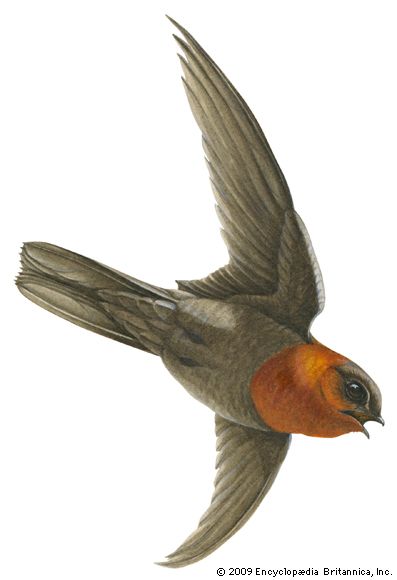
Swifts are agile, fast-flying birds belonging to the family Apodidae, which contains approximately 99 species. They are generally categorized into two main…
What are some of the different species of swifts, and how do they differ?
Swifts are agile, fast-flying birds belonging to the family Apodidae, which contains approximately 99 species. They are generally categorized into two main subfamilies based on their physical characteristics and nesting behaviors:12
Subfamilies and Classification
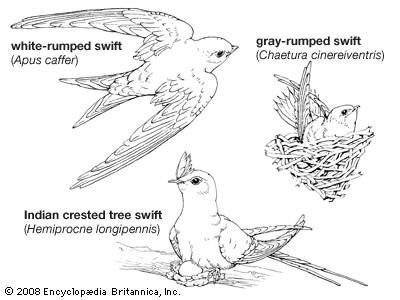
- Apodinae (Soft-tailed swifts): These species have a hind toe that can rotate forward to help them grip vertical surfaces. Examples include the common swift, the white-rumped swift, and the white-throated swift.1
- Chaeturinae (Spine-tailed swifts): These birds use their short, needle-tipped tail feathers for support when clinging to vertical surfaces. The chimney swift is a well-known member of this group.1
Key Differences and Adaptations
While swifts share a generally uniform body plan—characterized by long wings, powerful bodies, and tiny, weak feet—they exhibit significant variation in their habits:
- Nesting: Nesting strategies are highly diverse. Some species, like the Asian palm swift, glue their eggs to tiny feather pads on palm leaves. Others, such as the swiftlet, use their own sticky saliva to construct nests on cave walls. The white-naped swift is unique for building no nest at all, laying eggs directly on sand in caves.13
- Physiology: Young swifts are notable for their ability to enter a poikilothermic (cold-blooded) state during food scarcity, allowing their body temperature to drop to match the environment to conserve energy.13
- Tree Swifts: Distinct from the “true swifts” of the family Apodidae, the family Hemiprocnidae (tree swifts) consists of four species that are capable of perching on branches, a trait true swifts lack.23
What do swifts primarily eat, and how do they catch their food?
Swifts are specialized aerial insectivores that feed exclusively on flying insects. To capture their prey, they course tirelessly through the air with their large mouths held open, effectively scooping insects out of the sky.516
These birds have evolved specific morphological adaptations to support this high-speed, aerial lifestyle, including long, narrow wings for efficient flight and a short, wide, slightly curved bill. Because they are almost constantly in flight, they also drink and bathe by swooping down at the surface of water bodies while remaining on the wing. While most true swifts are unable to perch, tree swifts—a related family—are capable of perching and will launch themselves from high vantage points to intercept flying prey.15
What are the unique nesting habits of swifts?
Swifts are renowned for their highly specialized and diverse nesting habits, which frequently utilize their unique ability to produce sticky saliva as a binding agent.18
Saliva-Based Construction
Many swifts use their salivary glands to cement nesting materials—such as twigs, buds, moss, or feathers—to vertical surfaces like cave walls, chimneys, or hollow trees. In some species, such as certain swiftlets, the nest is composed entirely or primarily of hardened saliva, which is famously harvested for bird’s-nest soup.19108
Diverse Nesting Strategies
- Vertical Surfaces: Many species build semicircular brackets or shallow cups attached to cliffs, buildings, or tunnels.9
- Palm Leaf Nests: The Asian palm swift attaches a flat, feather-lined pad to the underside of a hanging palm leaf, often gluing its eggs directly to the nest to prevent them from falling.19
- Elaborate Structures: Some New World palm swifts construct sack-like nests with tubular entrances located at the bottom.9
- Minimalist Approaches: The white-naped swift is an outlier that builds no nest at all, instead laying its eggs on bare sand within deep cave ledges.9
How do swifts migrate, and what are their migration patterns?
Swifts are highly migratory birds, with many northern species undertaking long-distance journeys between their breeding grounds and wintering areas. Unlike many other birds, the timing of their migration is remarkably regular each year and is not significantly regulated by weather conditions.11112
Migration Patterns
- Long-Distance Travel: Northern species, such as the chimney swift (Chaetura pelagica), breed in eastern North America and migrate to South America for the winter. Similarly, the common swift (Apus apus) breeds across Eurasia and winters in southern Africa.1
- Tropical Movements: Migration also occurs among some tropical species, particularly in Africa, where populations may move to regions south of 20° N latitude, such as the Congo River region or coastal areas of West Africa.1311
- Physiological Preparation: Prior to migration, swifts undergo metabolic changes, including the accumulation of body fat, which is controlled by the pituitary gland and other endocrine factors to prepare them for the physical demands of long-distance flight.12
Navigation
While the exact mechanisms remain a subject of study, migratory birds generally rely on a combination of innate compasses and learned maps. While the ability to maintain a specific direction (such as southwest) may be innate, the knowledge of spatial relationships between summer and winter habitats often develops through the experience of migration.3
Sources
- Swift — Encyclopædia Britannica
- Apodiform - Classification — Encyclopædia Britannica
- Apodiform - Reproduction and life cycle — Encyclopædia Britannica
- biogeographic region - Species adaptations to ecological habitats — Encyclopædia Britannica
- swift — Encyclopædia Britannica
- Bird - Feeding habits — Encyclopædia Britannica
- Apodiform - Behaviour and locomotion — Encyclopædia Britannica
- Swiftlet — Encyclopædia Britannica
- Nest — Encyclopædia Britannica
- Bird - Nesting — Encyclopædia Britannica
- Migration - Physiological stimulus of migration — Encyclopædia Britannica
- Migration - In Europe — Encyclopædia Britannica
- Animal learning - Navigation — Encyclopædia Britannica
Published on · 4 min read