Swim Bladder
The swim bladder is a specialized buoyancy organ found in most bony fish. During development, it originates as an outpocketing, or diverticulum, of the…
How does the swim bladder develop in fish during their life cycle?
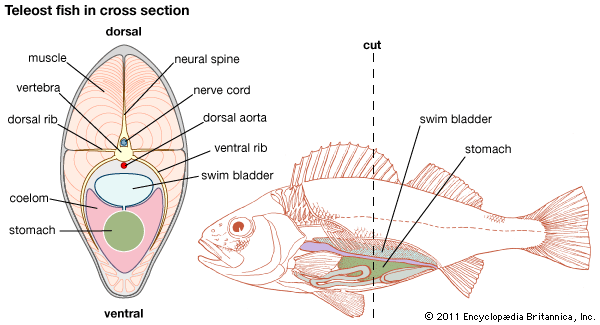
The swim bladder is a specialized buoyancy organ found in most bony fish. During development, it originates as an outpocketing, or diverticulum, of the digestive tract. This developmental pattern is homologous to the formation of lungs in land vertebrates, reflecting a shared historical origin in primitive fish species.12
As fish mature, the connection between the swim bladder and the digestive tract may evolve differently depending on the species:
- Physostomous: Many relatively primitive teleosts retain the connection to the digestive tract throughout their lives.2
- Physoclistic: In more advanced teleosts, such as acanthopterygians, this connection is lost during development, isolating the bladder from the digestive system.2
Once developed, the organ functions as a hydrostatic or ballast device, allowing fish to regulate their depth by adjusting gas levels within the bladder. In some primitive species, it continues to function as a respiratory aid or lung.12
How do changes in water pressure affect a fish’s swim bladder?
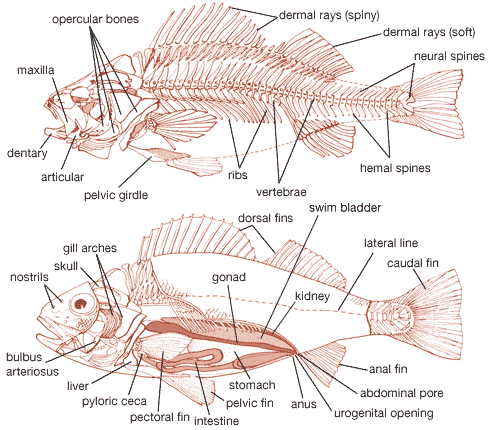
Changes in water pressure significantly impact a fish’s swim bladder, which acts as a hydrostatic or ballast organ to maintain buoyancy at various depths. Because gas volume is sensitive to pressure, fish must actively regulate the amount of gas within the bladder to prevent unintended floating or sinking as they move through the water column.12
In species where the swim bladder functions as a buoyancy device, fish control their depth through the following mechanisms:
- Increasing Buoyancy: When a fish needs to rise or maintain position, special glands secrete gas—primarily oxygen—into the bladder, increasing its volume and the fish’s overall buoyancy.2
- Decreasing Buoyancy: To descend, the fish absorbs gas from the bladder back into the bloodstream through a specialized organ, which reduces the bladder’s volume and allows the fish to sink.2
In some deep-sea species, the swim bladder may contain oil instead of gas, which is less compressible than gas and provides a more stable buoyancy mechanism under high-pressure conditions. Conversely, many bottom-dwelling fish have reduced or entirely absent swim bladders, as they do not require the same depth-regulation capabilities.12
How does the swim bladder’s structure differ between freshwater and saltwater fish?
The premise that the swim bladder differs structurally based specifically on whether a fish lives in freshwater or saltwater is inaccurate. The structure and function of the swim bladder are primarily determined by the fish’s evolutionary lineage, depth, and lifestyle, rather than the salinity of its environment.13
Instead of salinity, the following factors dictate the swim bladder’s characteristics:
- Evolutionary Classification: Primitive teleosts are often physostomous, retaining a connection to the digestive tract, while advanced teleosts (acanthopterygians) are physoclistic, having lost this connection during development.3
- Habitat and Depth: Deep-sea and bottom-dwelling species often show a reduction or complete loss of the swim bladder, as it is less advantageous or physically difficult to maintain at extreme pressures.13
- Specialized Functions: In some groups, such as the Otophysi, the swim bladder is structurally linked to the inner ear via the Weberian apparatus, which enhances hearing capabilities.2
- Composition: While most swim bladders contain gas, some species utilize oils to maintain buoyancy, particularly in deep-sea environments.13
What role does the swim bladder play in fish vocalization?
The swim bladder serves as a vital resonating chamber for sound production in many fish species. By acting as an amplifier or a vibrating membrane, it allows fish to generate various noises used for communication, particularly during reproduction and schooling.15
The mechanisms for sound production involving the swim bladder include:
- Air Expulsion: Some species, such as minnows and loaches, produce sound by expelling air from the swim bladder through the pneumatic duct or the anus.5
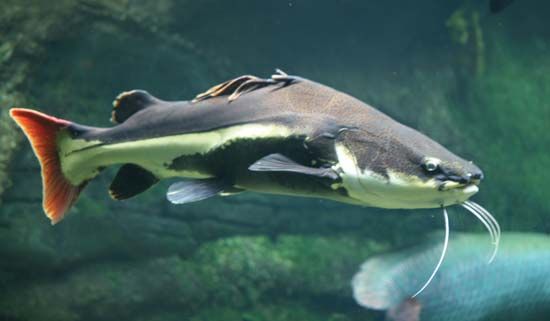
- Muscle Vibration: In many catfish families, specialized muscles attached to a spring-like skeletal mechanism cause the swim bladder wall to vibrate rapidly, creating humming or growling noises.5
- Acoustic Resonance: Beyond production, the swim bladder acts as a receiver. In Otophysi, the bladder walls vibrate in response to underwater sound waves, which are then amplified by the Weberian apparatus and transmitted to the inner ear, providing these fish with highly sensitive hearing.5
These acoustic capabilities are essential for social interaction, species recognition, and survival in environments where visibility is limited.5
Sources
- swim bladder — Encyclopædia Britannica
- fish - The respiratory system — Encyclopædia Britannica
- Biosphere - Hydrostatic pressure — Encyclopædia Britannica
- ostariophysan - Weberian apparatus and swim bladder — Encyclopædia Britannica
- ostariophysan - Sound — Encyclopædia Britannica
Published on · 3 min read