Taiwan
Taiwan’s indigenous peoples—the island's original inhabitants—have significantly shaped its cultural and historical landscape. Though they now constitute…
How has Taiwan’s indigenous population influenced its culture and history?
Taiwan’s indigenous peoples—the island’s original inhabitants—have significantly shaped its cultural and historical landscape. Though they now constitute only about 2 percent of the population, their presence dates back more than 10,000 years.1
Cultural Influence
The culture of Taiwan is a blend of various influences, including the tribe-oriented traditions of aboriginal peoples, which contrast with the clan-oriented Japanese and patriarchal Chinese traditions. Their linguistic and cultural heritage is deeply significant; studies suggest that Taiwan may have been a point of origin for the Austronesian language family, with DNA evidence indicating that indigenous ancestors may have migrated to other regions, including Polynesia and New Zealand. Since the 1990s, the government has increasingly supported the cultural activities of these diverse ethnic groups, a commitment guaranteed by the constitution.213
Historical Impact
Historically, indigenous peoples occupied the entire island before the arrival of Chinese immigrants. As settlers from the mainland expanded, many lowland indigenous groups were assimilated or forced into mountainous regions. Today, the government officially recognizes 16 distinct tribes, such as the Ami, Paiwan, and Atayal, preserving a vital link to the island’s pre-colonial history.41
How does Taiwan’s self-governance impact its international relations and diplomatic recognition?
Taiwan’s status as a self-governing entity, known as the Republic of China (ROC), is central to its complex international relations. Since 1949, both the ROC and the People’s Republic of China (PRC) have asserted they are the legitimate government of China, though Taiwan dropped its claim to the mainland in the 1990s.578
The PRC maintains a “one-China” policy, asserting jurisdiction over Taiwan, a position few nations formally dispute. Consequently, Taiwan’s diplomatic recognition has been limited, particularly after it lost its United Nations seat in 1971. Despite this, Taiwan has remained a global economic powerhouse, with its security supported by the United States through arms sales and military presence.7589
International interactions often trigger friction between the U.S. and China. High-level diplomatic gestures, such as official visits or direct communications between leaders, are frequently viewed by Beijing as provocations that enhance Taiwan’s international standing. While Taiwan has moved toward a vibrant democracy, its path to broader recognition remains constrained by the ongoing geopolitical tension across the Taiwan Strait.895
What is the geographical location and size of Taiwan?
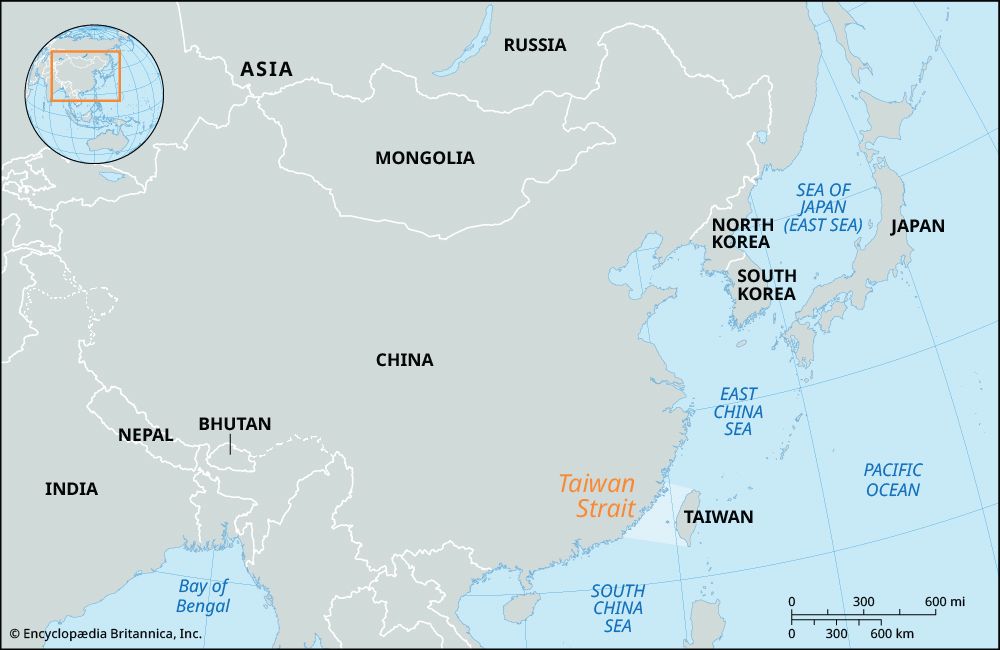
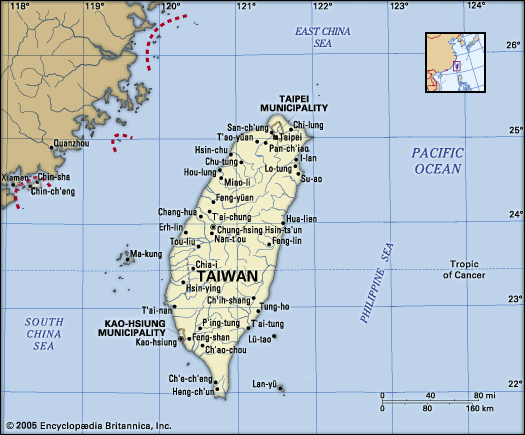
Taiwan is an oval-shaped island located off the coast of East and Southeast Asia, forming part of a chain of islands that stretches from Japan through the Philippines to Indonesia.10
Its geographical boundaries are defined by several bodies of water:
- North and Northeast: East China Sea, with the Ryukyu Islands to the northeast.10
- East: The Pacific Ocean.10
- South: The Bashi Channel, separating the island from the Philippines.10
- West: The Taiwan (Formosa) Strait, which separates Taiwan from the Chinese mainland.10
Regarding its size, Taiwan covers a total land area of 13,976 square miles. Its area is roughly comparable to that of the Netherlands or the combined area of the U.S. states of Massachusetts, Rhode Island, and Connecticut.1110
What are the main cultural and linguistic characteristics of Taiwan?
Taiwan’s culture is primarily rooted in traditional Chinese origins, characterized by a patriarchal and patrilineal social structure that places the family at the center of life. It is a conservative, hierarchical society that emphasizes respect for elders, loyalty to the family, and the importance of education as a means of social advancement. Beyond its Chinese foundations, the culture has been shaped by indigenous aboriginal traditions, Japanese colonial influences, and, more recently, Westernization and democratization.31415
Linguistic Characteristics
Taiwan is a multilingual society. While Mandarin Chinese is the official language and the primary medium for government and education, other languages are widely spoken:1611
- Minnan (Taiwanese): Spoken by the Fukien Taiwanese, this is a form of Southern Min and is widely used alongside Mandarin.16
- Hakka: The Hakka people maintain their own distinct language.16
- Aboriginal Languages: Each indigenous group speaks a unique language, though many also speak Mandarin or Taiwanese.16
Social Customs and Arts
Daily life is heavily oriented toward work and education, with a strong emphasis on ritual and role-playing. Cuisine is a point of national pride, featuring a vast variety of dishes from across China, and the internationally famous bubble tea originated on the island. The arts reflect a blend of traditional Chinese forms—such as calligraphy, opera, and puppet shows—and contemporary themes like realism and nativism. The National Palace Museum serves as a major repository for Chinese antiquities, reflecting the government’s long-standing commitment to preserving and promoting Chinese cultural heritage.1415
Sources
- Taiwan - Ethnic groups — Encyclopædia Britannica
- Taiwan - The arts — Encyclopædia Britannica
- Taiwan - Cultural milieu — Encyclopædia Britannica
- Taiwan - Settlement patterns — Encyclopædia Britannica
- Taiwan - Government and society — Encyclopædia Britannica
- Austronesian languages - Size and geographic scope — Encyclopædia Britannica
- Taiwan — Encyclopædia Britannica
- China - Relations with Taiwan — Encyclopædia Britannica
- history of China - Relations with Taiwan — Encyclopædia Britannica
- Taiwan - Land — Encyclopædia Britannica
- Taiwan: Country Facts — Encyclopædia Britannica
- Taiwan - Climate of Taiwan — Encyclopædia Britannica
- Taiwan - Relief — Encyclopædia Britannica
- Taiwan - Religions — Encyclopædia Britannica
- Taiwan - Languages of Taiwan — Encyclopædia Britannica
- Taiwan - Daily life and social customs — Encyclopædia Britannica
Published on · 4 min read