Tanaid
Tanaids are small, bottom-dwelling crustaceans that inhabit marine and brackish-water environments. Regarding their diet and feeding habits, they primarily…
How do tanaid crustaceans feed, and what is their typical diet?
Tanaids are small, bottom-dwelling crustaceans that inhabit marine and brackish-water environments. Regarding their diet and feeding habits, they primarily consume organic detritus and plankton found on or within soft sediments.1
To facilitate their feeding and survival, these invertebrates possess specialized physical adaptations. Their thorax features seven pairs of walking legs, with the first pair equipped with a large, pincerlike claw known as a chela, which is used for clasping. Additionally, many species are known to construct delicate tubes using fibrous secretions produced by their thoracic limbs, providing them with a stable environment in their sediment-based habitats.1
What role do tanaid crustaceans play in marine ecosystems?
Tanaids play a significant role in marine ecosystems as essential components of the benthic community. By living on or within soft sediments, they act as key processors of organic matter, feeding on organic detritus and plankton that settle on the seafloor.1
Their presence is widespread, ranging from shallow coastal waters to the deep sea, where they contribute to the cycling of nutrients within these environments. Furthermore, their behavior of constructing delicate tubes using fibrous secretions helps modify the physical structure of the sediment, creating microhabitats that can influence the local distribution of other small organisms.1
What are the main characteristics of tanaid crustaceans?
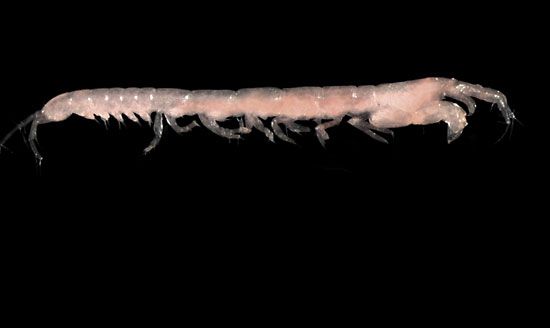
Tanaids are small, bottom-dwelling crustaceans belonging to the order Tanaidacea. They are characterized by several distinct physical and behavioral traits:
- Body Structure: They possess an elongate, slender body typically measuring between 2 and 25 mm (0.08 to 1 inch) in length.1
- Thoracic Appendages: The thorax features seven pairs of walking legs. The first pair is modified into a large, pincerlike claw (chela) used for clasping, while the second pair is specialized for burrowing.1
- Abdominal Features: The abdomen contains five pairs of swimming limbs and a pair of posterior appendages.1
- Habitat and Behavior: Tanaids are found worldwide in marine and brackish-water environments, ranging from shallow coastal areas to the deep sea. They live on or within soft sediments and often construct delicate tubes using fibrous secretions from their thoracic limbs.1
- Reproduction: Females carry their eggs and developing young in a ventral brood pouch.1
Taxonomically, they are part of the superorder Peracarida and are considered intermediate in character between the orders Isopoda and Cumacea.13
How have tanaid crustaceans evolved over time, and what is their evolutionary history?
The evolutionary history of tanaid crustaceans (order Tanaidacea) is primarily understood through their classification within the class Malacostraca and the superorder Peracarida. While the broader fossil record of crustaceans provides evidence of early organization dating back to the Cambrian Period, specific fossil evidence detailing the precise evolutionary timeline of tanaids remains limited in the provided data.14
Morphologically, tanaids are considered intermediate in character between the orders Isopoda and Cumacea. Their evolutionary development is studied through comparative anatomy, which highlights their specialized adaptations for benthic life, such as the modification of thoracic appendages for burrowing and tube-building.13
While scientists continue to use molecular data and comparative studies to resolve uncertainties regarding the ancestral forms of various crustacean groups, the specific evolutionary milestones for Tanaidacea are not as clearly defined in the fossil record as those of more derived groups like decapods or true crabs.4
Sources
- tanaid — Encyclopædia Britannica
- tunicate - Food and feeding — Encyclopædia Britannica
- Tanaidacea — Merriam-Webster
- crustacean - Evolution and paleontology — Encyclopædia Britannica
Published on · 2 min read