Tarantula Hawk
A tarantula hawk is a large, solitary spider wasp belonging to the genus Pepsis (family Pompilidae). Found on every continent except Europe and Antarctica…
What is a tarantula hawk wasp?
A tarantula hawk is a large, solitary spider wasp belonging to the genus Pepsis (family Pompilidae). Found on every continent except Europe and Antarctica, these wasps are particularly common in the southwestern United States and Central America.12
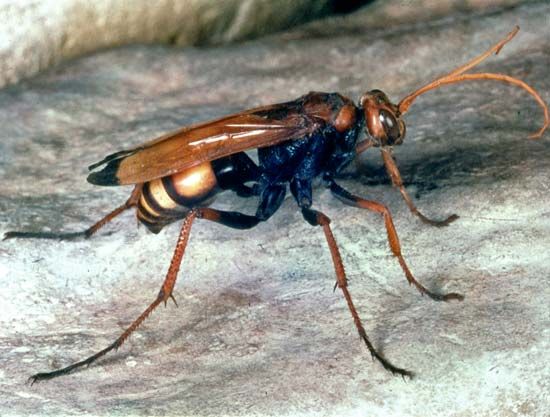
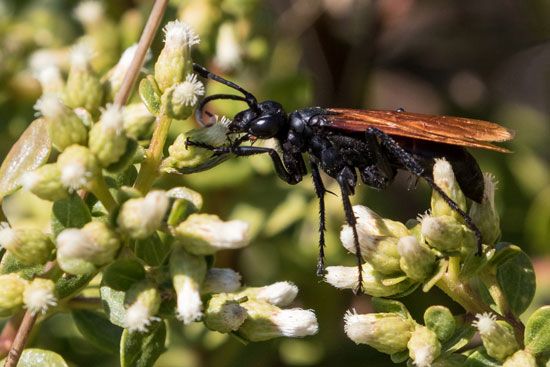
Physically, they are among the largest spider wasps, with some species reaching up to 11 cm in length. They typically feature slender, iridescent blue-black bodies and orange or amber wings, which serve as a warning to predators. While adults primarily feed on nectar and pollen, their name comes from their reproductive behavior: females paralyze large spiders—such as tarantulas—to serve as living food for their larvae.2
Though generally docile, the female possesses a stinger that delivers one of the most painful insect stings in the world, rated 4.0 on the Schmidt sting pain index. Despite the intense, immediate pain, the venom is typically not harmful to humans.2
What does a tarantula hawk wasp look like?
Tarantula hawks are among the largest members of the spider wasp family, with some species reaching up to 11 cm (about 4 inches) in length, while more common varieties measure around 5 cm (2 inches).2
Their physical appearance is characterized by:
- Body: They have slender, steel-blue bodies that often exhibit an iridescent sheen in shades of blue-black, blue-green, or blue-violet.2
- Wings: Most species possess wings that are orange, amber, or blue-black, featuring distinctive venation. This bold coloration serves as a warning to potential predators.2
- Sexual Dimorphism: Males and females can be distinguished by their antennae; females have curled antennae, whereas males have straight ones. Additionally, only females possess a stinger, which is curved and can reach up to 7 mm (0.25 inch) in length.2
Their striking appearance is a form of warning coloration, signaling their potent defense mechanism to potential threats.2
Where do tarantula hawk wasps live?
Tarantula hawk wasps are found on every continent except for Europe and Antarctica. They are particularly common in the southwestern United States and throughout Central America.12
As solitary wasps, they typically inhabit areas where they can hunt for their prey, such as tarantulas and trap-door spiders. They are often observed on flowers, where the adults feed on nectar and pollen, or on the ground searching for spiders. When it comes time to provision their nests, they may construct cells in the soil, among rocks, or in other sheltered locations.12
How does a tarantula hawk wasp hunt its prey?
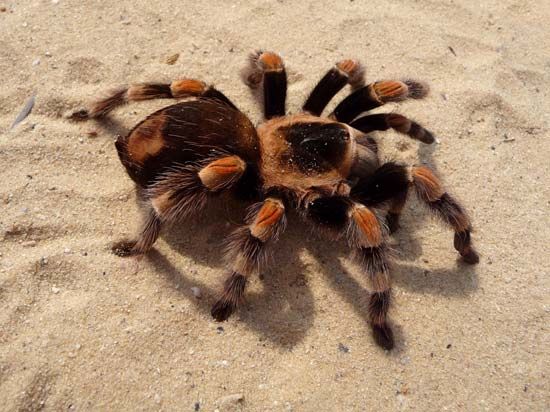
Tarantula hawk wasps are solitary hunters that exhibit a sophisticated and aggressive strategy to capture prey, often targeting spiders significantly larger than themselves, such as tarantulas and trap-door spiders.52
When hunting, the wasp may actively search for spiders on the ground or lure them out of their burrows. If a spider is inside its lair, the wasp mimics the vibrations of trapped prey by tapping its feet on the spider’s webbing, enticing the arachnid to emerge. Once the spider is in the open, the wasp engages in a tactical struggle, often maneuvering to avoid the spider’s fangs before delivering a precise, potent sting to the nerve ganglia on the underside of the spider’s thorax.2
This sting does not kill the spider but renders it completely immobile. The wasp then drags the paralyzed, yet living, victim into a burrow, where she deposits a single egg on its body. The developing larva eventually consumes the spider, beginning with its hemolymph and finishing with its vital organs, ensuring the prey remains fresh throughout the process.52
Sources
- tarantula hawk — Merriam-Webster
- tarantula hawk — Encyclopædia Britannica
- Pepsis — Merriam-Webster
- desert tarantula — Encyclopædia Britannica
- spider wasp — Encyclopædia Britannica
Published on · 3 min read