Spider Wasp
Spider wasps (family Pompilidae) are solitary insects that exhibit specific nesting behaviors distinct from other wasp groups. Unlike social wasps, such as…
How do spider wasps’ nesting habits differ from other wasp species?
Spider wasps (family Pompilidae) are solitary insects that exhibit specific nesting behaviors distinct from other wasp groups. Unlike social wasps, such as hornets or yellow jackets, which live in colonies and construct complex paper nests, spider wasps live alone and build isolated cells in the ground, in rotten wood, or among rock crevices.123
Their nesting habits differ from other solitary wasps in the following ways:
- Provisioning: While many solitary wasps provision their nests with a variety of insects—such as caterpillars, beetles, or cicadas—spider wasps exclusively hunt spiders.12
- Construction: Some species, such as those in the genus Pseudagenia, construct mud cells under bark or stones, whereas others simply utilize existing cavities. Unlike the mason or potter wasps (subfamily Eumeninae), which build elaborate vaselike or juglike mud structures, spider wasp nests are generally simpler.123
- Process: The sequence of hunting and building varies; some spider wasps complete their nest before capturing prey, while others capture the spider first and set it aside to finish the nest.1
What are the defining characteristics of spider wasps?
Spider wasps, belonging to the family Pompilidae, are characterized by several distinct physical and behavioral traits:
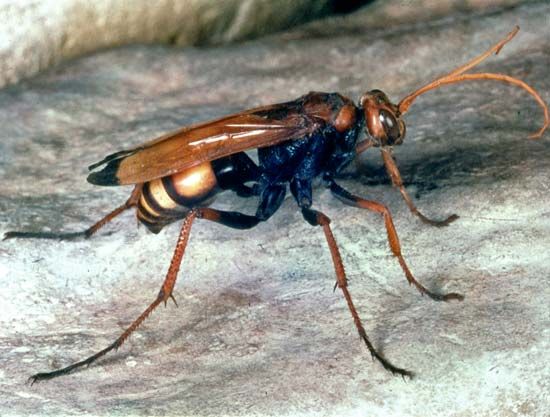
- Physical Appearance: These wasps are generally slender and often dark in color, with some species featuring smoky or yellowish wings. They are known for having long, spiny legs that allow them to run rapidly. They range in size from 1.0 to 2.5 cm (0.4 to 1 inch), though some species can exceed 5 cm (2 inches) in length.1
- Solitary Nature: Unlike social wasps, spider wasps are solitary insects. They do not live in colonies and do not construct complex paper nests.13
- Nesting Habits: They typically build simple, isolated cells in the ground, in rotten wood, or within rock crevices. Some species, such as those in the genus Pseudagenia, construct mud cells.12
- Diet and Provisioning: Spider wasps are parasitoids that exclusively hunt and paralyze spiders to feed their larval young. A single egg is placed in a cell alongside a paralyzed spider, which serves as food for the developing larva.12
- Stinging Behavior: They are known to inflict a very painful sting. Their methods of paralyzing prey vary, with some species achieving complete immobility while others may kill the spider outright.1
What is the life cycle of a spider wasp?
The life cycle of a spider wasp (family Pompilidae) follows the process of holometabolous development, meaning the insect undergoes complete metamorphosis through four distinct stages: egg, larva, pupa, and adult.2
- Nesting and Egg: The female wasp prepares a nest or cell in the ground, in rotten wood, or within rock crevices; some species construct mud cells. After capturing and paralyzing a spider, she places it inside the cell and deposits a single egg upon it.15
- Larval Stage: The larva hatches from the egg and feeds on the paralyzed spider, which provides all the necessary nutrition for its development. In most cases, the spider remains alive but immobile, ensuring a fresh food source for the growing larva.15
- Pupation: Once the larva has finished feeding and reached its full size, it typically spins a silken cocoon. Inside this protective structure, the larva undergoes metamorphosis, transitioning into a pupa and eventually developing into an adult.12
- Adult: The fully developed adult wasp emerges from the cocoon and the nest. Adult spider wasps are commonly found on flowers or searching the ground for new prey to begin the cycle again.5
How do spider wasps hunt and paralyze their prey?
Spider wasps hunt and paralyze their prey through a highly specialized process that varies by species. While some wasps capture prey before preparing a nest, others build their cells first.1
When hunting, a wasp may actively search for spiders, sometimes using clever tactics to lure them out of hiding. For example, tarantula hawks may tap their feet on a spider’s web to mimic the vibrations of trapped prey, enticing the spider to exit its burrow. Once the spider is exposed, the wasp engages in a tactical struggle, often maneuvering to avoid the spider’s fangs before delivering a precise sting.61
The method of paralysis is refined:
- Targeted Injection: Wasps typically inject venom into the nerve ganglia on the underside of the spider’s thorax.6
- Varying Results: In genera like Cryptocheilus, the wasp stings the spider between its poison fangs and then again near the junction of the cephalothorax and abdomen to ensure complete immobility. Other species, such as those in the genus Pompilus, may use a less refined approach that occasionally kills the spider outright.1
Sources
- spider wasp — Encyclopædia Britannica
- Hymenoptera - Solitary forms — Encyclopædia Britannica
- wasp — Encyclopædia Britannica
- Pompilidae — Merriam-Webster
- insect - Types of metamorphosis — Encyclopædia Britannica
- tarantula hawk — Encyclopædia Britannica
Published on · 4 min read