Tayra
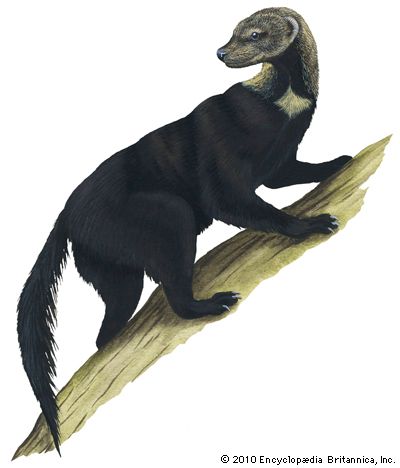
The tayra (Eira barbara) is a member of the weasel family (Mustelidae) native to tropical forests ranging from Mexico to Argentina.
How do tayras interact with humans, and are they ever kept as pets?
The tayra (Eira barbara) is a member of the weasel family (Mustelidae) native to tropical forests ranging from Mexico to Argentina.1
Regarding their interaction with humans, tayras are known to be inquisitive animals that may exhibit behaviors such as snorting, growling, or spitting when they feel alarmed. While they can appear playful and are reportedly easy to tame when captured at a young age, they are generally considered poor pets. Their suitability as household companions is limited by their restless nature and the fact that they possess a strong, unpleasant odor.1
Ethically, it is important to recognize that wild animals like the tayra have complex biological and behavioral needs that cannot be adequately met in a domestic setting. Keeping such animals as pets often compromises their welfare and ignores their natural requirements for space and social structure.
Where are tayras typically found in the wild?
The tayra (Eira barbara) is a weasel-like mammal typically found in the tropical forests of the Americas. Their natural range extends from southern Mexico through Central America and across South America, reaching as far south as northern Argentina.12
Within these forest habitats, they are known to be agile climbers and are active both during the day and at night. They utilize hollow trees or holes in the ground as dens and are often observed traveling alone, in pairs, or in small groups.1
How long do tayras typically live, and what is their life cycle like?
Surprisingly little is known about the life cycle and life span of the tayra (Eira barbara). Despite their relatively large size and wide distribution across tropical forests, scientific data regarding their reproductive habits and longevity remains limited.
Current observations indicate that a typical litter consists of three or four young, which are raised in dens located in hollow trees or holes in the ground. Beyond these basic details, specific information regarding their developmental stages or average life expectancy in the wild has not been established.
What role do tayras play in their ecosystem?
The tayra (Eira barbara) functions as an omnivorous member of the Mustelidae family within its tropical forest ecosystem. By consuming a varied diet that includes fruits, insects, small vertebrates, eggs, and carrion, tayras act as both predators and scavengers. This diverse feeding behavior is comparable to that of raccoons, suggesting they play a role in nutrient cycling and population regulation of smaller forest animals.
As agile climbers that move between the ground and the canopy, they interact with various levels of the forest environment. While specific ecological studies on their precise impact are limited, their presence as active, wide-ranging mammals contributes to the complex food webs of the Americas, from southern Mexico to northern Argentina.
Sources
- tayra — Encyclopædia Britannica
- tahr — Encyclopædia Britannica
- tayra — Merriam-Webster
Published on · 2 min read