Weasel
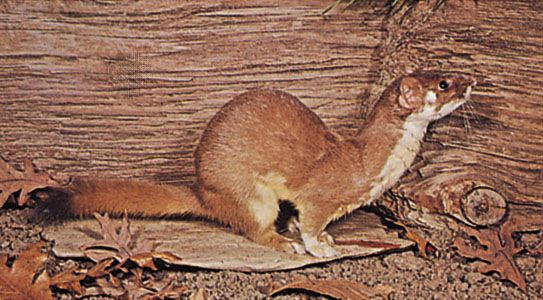
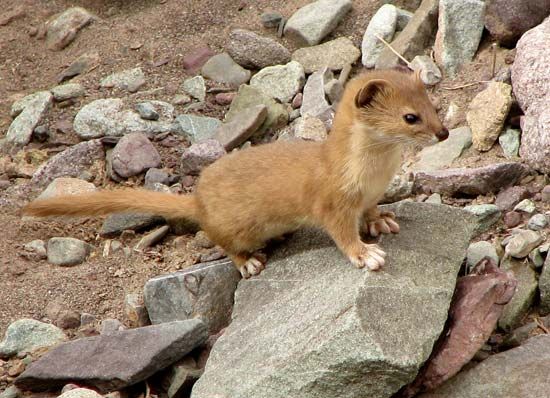
Weasels are small carnivores characterized by their highly elongated, tubelike bodies. Their physical build includes several distinct features:
What are the key physical characteristics of weasels?
Weasels are small carnivores characterized by their highly elongated, tubelike bodies. Their physical build includes several distinct features:1
- Head and Neck: They possess small, flattened heads and long, flexible necks.1
- Limbs: They have short limbs, with each foot featuring five toes that end in sharp, curved claws.1
- Fur and Tail: Their fur is short but dense. They typically have slim, pointed tails, though the stoat is notable for its black-tipped tail.1
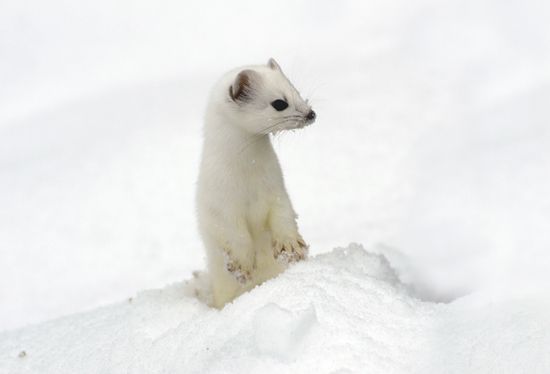
- Coloration: Most are brown with white or yellowish underparts. In colder regions, their coats often turn white during the winter.1
- Size: There is significant variation among species. For instance, the least weasel is the smallest living carnivore, while other species like the long-tailed weasel are larger. Generally, males are about twice the size of females.1
Their slender anatomy is an evolutionary advantage, allowing them to pursue prey into narrow burrows, crevices, and dense vegetation.1

In which habitats can weasels be found, and how are they adapted to these environments?
Weasels are found across a wide range of habitats, primarily in the Northern Hemisphere, where they occupy diverse environments including agricultural areas, forests, and even polar regions.1
Their physical characteristics provide specialized adaptations for these environments:
- Narrow Body Structure: Their elongated, tubelike bodies allow them to pursue and capture prey in tight spaces, such as rodent burrows, rock crevices, and dense vegetation. This agility also enables them to climb trees or enter water to track prey.1
- Seasonal Camouflage: In colder, northerly climates, species such as the least weasel, long-tailed weasel, and stoat undergo a seasonal molt, changing their brown summer coats to white for winter. This transition is triggered by photoperiod (day length) rather than temperature, helping them blend into snowy landscapes.2
- Metabolic Needs: Because they cannot accumulate significant body fat, weasels must hunt frequently. This high metabolic demand drives their aggressive hunting behavior, often leading them to store excess food in their burrows or dens to ensure survival in their respective habitats.1
What is the typical diet of a weasel, and how do they hunt their prey?
Weasels are bold and aggressive predators that primarily hunt alone. Their diet consists mainly of small mammals, including mice, voles, rats, and rabbits. They also consume frogs, birds, and bird eggs.1
Their hunting strategy relies on their unique anatomy. Because they possess narrow, elongated bodies, they are highly effective at pursuing prey into confined spaces, such as rodent burrows, holes, and crevices. They are also capable of chasing prey through dense vegetation, up trees, or into water.1
Because weasels cannot accumulate significant body fat, they have a high metabolic rate and must eat frequently. This necessity drives them to be prolific hunters; they often kill more prey than they can immediately consume, storing the excess for later use. This behavior is frequently observed when they raid chicken coops, leading to significant loss of domestic fowl.1
How do weasels fit into the broader mustelid family, and what are their closest relatives?
Weasels are members of the Mustelidae family, a diverse group of approximately 62 species of fur-bearing carnivores that includes badgers, otters, martens, and the wolverine.13
Within this family, weasels are classified primarily under the genus Mustela, which serves as the core of the subfamily Mustelinae. Their closest relatives within this genus include:41
- Ferrets and Polecats: These share the Mustela genus and are closely related to weasels in both form and behavior.41
- Mink: Often grouped with weasels, these are also members of the Mustela genus (along with the genus Neovison).41
- Ermine (Stoat): One of the most common and widely distributed relatives, often distinguished from other weasels by its black-tipped tail.4
While the family Mustelidae is broad, other genera are also considered weasels or closely related “weasel-like” mustelids, such as the Patagonian weasel (Lyncodon patagonicus), the African striped weasel (Poecilogale albinucha), and the zorilles (African striped polecats). Historically, skunks were included in this family, but modern genetic analysis has placed them in their own separate family, Mephitidae.413
Sources
Published on · 3 min read