Ratel
The ratel (Mellivora capensis), also widely known as the honey badger, is a badgerlike member of the weasel family (Mustelidae) found in forested and covered…
What is ratel?
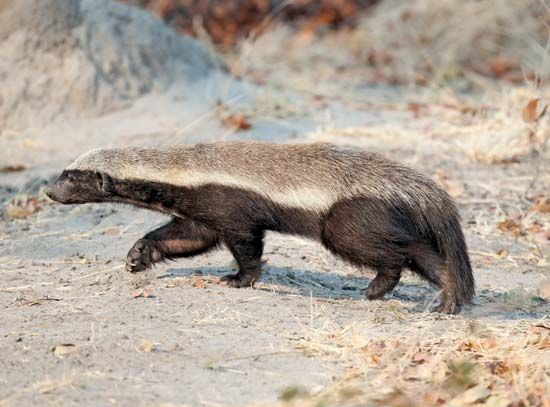
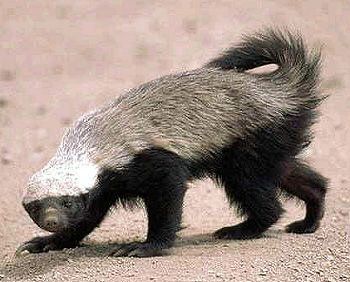
The ratel (Mellivora capensis), also widely known as the honey badger, is a badgerlike member of the weasel family (Mustelidae) found in forested and covered regions across Africa and southern Asia.123
Physically, the ratel is a heavily built animal with thick skin, standing 25–30 cm at the shoulder. It is easily recognized by its distinct coloration: the upper body is whitish, while the face, legs, and lower body are black. These nocturnal mammals are known for being fearless, strong fighters that live in burrows dug with their powerful, incurved front claws.1
The ratel is an omnivore that feeds on fruit, small animals, and honey. It has a unique mutualistic relationship with the greater honey guide, a bird that leads the ratel to bees’ nests. The ratel breaks open the nests to feed on the honey, while the bird consumes the remains.1
How does the honey guide bird help the ratel find food?
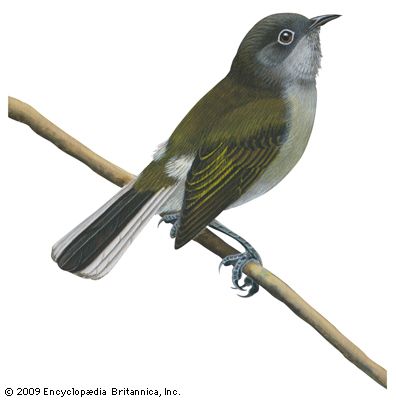
The greater honey guide (Indicator indicator) assists the ratel in locating food through a specialized behavioral pattern. The bird attracts the ratel’s attention by flying ahead of it while emitting distinct chattering calls, effectively leading the mammal to a bees’ nest.41
Once the ratel reaches the nest, it uses its powerful claws to break it open to feed on the honey and larvae. This interaction is a form of mutualism, as the bird benefits by consuming the remaining wax and bee larvae that it would otherwise be unable to access on its own.41
What other animals belong to the Mustelidae family?
The Mustelidae family, commonly known as the weasel family, comprises approximately 62 species of fur-bearing carnivores. While skunks were historically included in this group, genetic analysis has placed them in their own separate family, Mephitidae.67
The family is diverse and categorized into eight subfamilies, including:
- Otters (Lutrinae): Includes sea otters, river otters, and giant otters.67
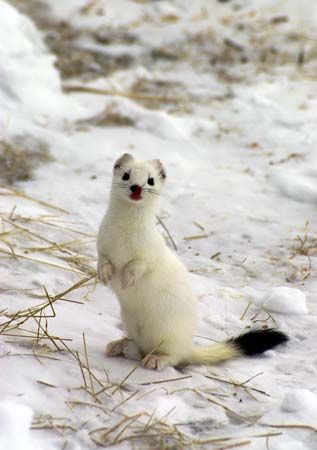
- Weasels, Minks, and Ferrets (Mustelinae): Includes various weasels, minks, ermines, and ferrets.67
- Badgers (Melinae and Taxidiinae): Includes Eurasian badgers and the American badger.badger) and the American badger.67
- Guloninae: Includes the wolverine, martens, fishers, and the tayra.67
- Ictonychinae: Includes grisons, polecats, and the zorille.67
- Honey Badger (Mellivorinae): Consists solely of the ratel.7
- Ferret-badgers (Helictidinae): Includes five species of ferret-badgers. species of ferret-badgers.7
Why is the ratel’s skin considered so unique and protective?
The ratel, also known as the honey badger, possesses a notably thick, loose-fitting skin that serves as a primary defense mechanism. This physical adaptation allows the animal to twist and turn within its own hide, providing it with significant protection during confrontations with predators or when navigating through dense vegetation and bees’ nests.
While the provided information confirms the ratel is characterized by its heavily built, thick-skinned body, the specific biological mechanisms—such as the exact tensile strength or the chemical composition of the skin—are not detailed in the current knowledge base.
Sources
- ratel — Encyclopædia Britannica
- ratel — Merriam-Webster
- badger — Encyclopædia Britannica
- Honey guide — Encyclopædia Britannica
- honeyguide — Merriam-Webster
- List of mustelids — Encyclopædia Britannica
- mustelid — Encyclopædia Britannica
Published on · 2 min read