Tent Caterpillar Moth
Tent caterpillar moths belong to the genus Malacosoma within the family Lasiocampidae. These moths are known for their larvae, which construct large…
What species of tent caterpillar moths are commonly found, and where are they distributed?
Tent caterpillar moths belong to the genus Malacosoma within the family Lasiocampidae. These moths are known for their larvae, which construct large, communal silken webs in trees and can cause significant defoliation to forest, fruit, and ornamental species.12
Common species and their distributions include:
- Eastern tent caterpillar moth (Malacosoma americanum): Found throughout eastern North America, these moths lay their eggs in tarlike bands on branches, with larvae emerging in the spring to feed on trees such as apple and wild cherry.13
- Forest tent caterpillar moth (Malacosoma disstria): This species is commonly found in the southern United States and is recognized as a serious defoliator of deciduous trees.14
- Western tent caterpillar moth (Malacosoma pluviale): Distributed across the western regions of the United States and Canada, these larvae feed on various trees, including apple and cherry.5
How do tent caterpillar moths get their name, and what kind of structures do they build?
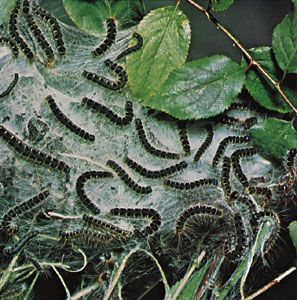
The name “tent caterpillar moth” is derived from the behavior of the larvae, which construct large, communal, tent-shaped webs made of silk in the forks of trees.15
These structures serve as a central nest for the social caterpillars. After hatching in the spring, the larvae migrate to a branch fork to build these silken tents, which they use as a base. The caterpillars typically leave the nest each day to feed on the tree’s foliage before returning, continuing this pattern until they are fully grown in early summer.51
Are tent caterpillar moths considered pests, and if so, why?
Tent caterpillar moths are indeed considered pests because their larvae are capable of causing serious defoliation to forest, fruit, and ornamental trees.51
The primary reason for their status as pests is the feeding behavior of the caterpillars. After hatching in the spring, these social larvae congregate in large, communal silken webs. From these nests, they emerge daily to consume the foliage of their host trees. When populations are high, this intensive feeding can strip trees of their leaves, which weakens the plants and can lead to significant damage or loss of tree health.152
What are the distinguishing features of tent caterpillar moths?
Tent caterpillar moths, belonging to the genus Malacosoma in the family Lasiocampidae, are characterized by several distinct physical and behavioral traits:
- Adult Appearance: These moths are stout-bodied and typically yellowish-brown in color. They generally possess a wingspan ranging from 25 to 75 mm (1 to 3 inches). Many species are further distinguished by their hairy bodies and legs, as well as feathery antennae.1
- Larval Behavior: The larvae, commonly known as tent caterpillars, are often brightly colored. They are well-known for their social behavior, which involves constructing large, communal, tent-shaped webs made of silk in the forks of trees.1
- Life Cycle Indicators: The presence of these moths is often marked by egg masses that appear as shiny, tarlike bands on tree branches. When the larvae reach the pupal stage, they form cocoons composed of silk mixed with a characteristic yellowish-white powder.1
The genus includes various species, such as the eastern tent caterpillar moth and the forest tent caterpillar moth, both of which are recognized for their ability to defoliate trees.12
Sources
- tent caterpillar moth — Encyclopædia Britannica
- forest tent caterpillar — Merriam-Webster
- western tent caterpillar — Merriam-Webster
- eastern tent caterpillar — Merriam-Webster
- tent caterpillar — Merriam-Webster
- Lepidoptera - Head — Encyclopædia Britannica
- Malacosoma — Merriam-Webster
Published on · 2 min read