Window-winged Moth
The window-winged moth refers to any member of the family Thyrididae, a group of small to medium-sized tropical moths (order Lepidoptera) typically…
What is window-winged moth?
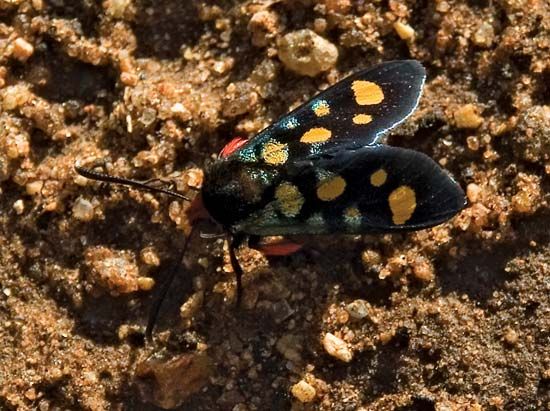
The window-winged moth refers to any member of the family Thyrididae, a group of small to medium-sized tropical moths (order Lepidoptera) typically characterized by their dark coloration and a wingspan ranging from 10 to 30 mm (0.4 to 1.2 inches).1
These moths derive their name from a distinctive, translucent yellow or whitish area of exposed membrane found in the middle of each wing, which resembles a small window.12
The life cycle and habits of these moths vary by species:
- Larval behavior: Some larvae act as leaf rollers, creating tunnels by tying leaf edges together with silk. Others may burrow into stems or twigs, often causing gall-like swellings, or feed directly on flowers and seeds.1
- Pupation: When ready to pupate, they construct a cocoon on the ground.1
- Evolutionary significance: Some researchers suggest that the several hundred species within the Thyrididae family may be closely related to ancestral butterflies.1
How do the translucent ‘windows’ on their wings help these moths survive?
The provided search results do not contain specific information regarding how the translucent “windows” on the wings of the Thyrididae family contribute to their survival.
While the literature on Lepidoptera extensively discusses various defense mechanisms—such as concealing coloration, aposematism, and the use of eyespots to deflect predator attacks—the specific adaptive function of the translucent membrane in window-winged moths is not detailed in the available data.
What are some other unique ways that moth larvae protect themselves?
Moth larvae have evolved a diverse array of strategies to protect themselves from predators, ranging from behavioral maneuvers to chemical defenses.
Behavioral Defenses
- Evasive Maneuvers: When disturbed, many small larvae drop suddenly from their host plants, either falling to the ground for concealment or dangling from a silk thread.6
- Startle Displays: Some caterpillars perform displays to deter attackers, such as raising their heads to mimic a biting motion or arching their hindparts to resemble a stinging wasp.7
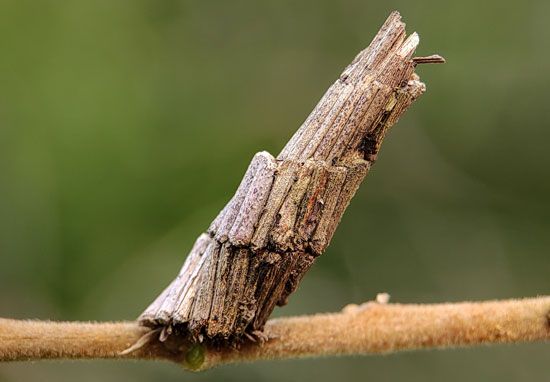
- Concealment and Nesting: Many larvae live in individual nests made of folded, rolled, or webbed leaves. Others, such as bagworm moths and casebearer moths, construct portable cases masked with debris, leaves, or twigs to hide their bodies.6
- Communal Living: Species like tent caterpillar moths aggregate in communal nests for added protection.6
Physical and Chemical Defenses
- Irritating Hairs: Certain caterpillars possess hollow, barbed hairs that break off upon contact, injecting toxins that cause pain, swelling, and intense itching in predators.68
- Chemical Repellents: Larvae may store toxins derived from their host plants in their bodies, making them distasteful. Others produce their own chemical defenses, such as formic acid sprayed from prothoracic glands or volatile, foul-smelling substances released from scent organs called osmeteria.786
- Reflex Bleeding: Some larvae practice autohemorrhization, releasing blood from body or leg joints when threatened.6
Camouflage
Many larvae utilize concealing coloration to blend into their environments. This includes caterpillars that resemble leaf veins, twigs, or twisted dead leaves, often combined with the behavior of remaining perfectly immobile to avoid detection.68
Why are the Thyrididae family considered to be related to ancestral butterflies?
Some authorities consider the several hundred species of the Thyrididae family to be closely related to ancestral butterflies. While the specific evolutionary evidence for this classification is not detailed in the provided search results, this connection is noted by researchers studying the taxonomy of the order Lepidoptera.
Sources
- window-winged moth — Encyclopædia Britannica
- Thyrididae — Merriam-Webster
- neuropteran - Annotated classification — Encyclopædia Britannica
- Lepidoptera - Thorax — Encyclopædia Britannica
- Lepidoptera - Size range and distribution — Encyclopædia Britannica
- Lepidoptera - Protection against danger — Encyclopædia Britannica
- Lepidoptera - Larva, or caterpillar — Encyclopædia Britannica
- Reproductive behaviour - Protective adaptations — Encyclopædia Britannica
- insect - Protection from enemies — Encyclopædia Britannica
- What’s the difference between moths and butterflies? — Encyclopædia Britannica
- thrips - Evolution, paleontology, and classification — Encyclopædia Britannica
- Major types of pollinators - Butterflies and moths — Encyclopædia Britannica
- thrips - Annotated classification — Encyclopædia Britannica
Published on · 3 min read