Thread-waisted Wasp
Thread-waisted wasps (family Sphecidae) are solitary insects that play a significant role in their ecosystems as predators and natural population…
What role do thread-waisted wasps play in their ecosystem, and are they considered beneficial or harmful to humans?
Thread-waisted wasps (family Sphecidae) are solitary insects that play a significant role in their ecosystems as predators and natural population controllers. By hunting and paralyzing various insects and spiders—such as caterpillars, grasshoppers, crickets, beetles, and cicadas—to provision their nests, they help regulate the populations of these prey species.123
Regarding their impact on humans, thread-waisted wasps are generally considered beneficial rather than harmful. As solitary wasps, they are not aggressive like social wasps (such as yellow jackets or hornets) because they do not have a colony to defend. While females possess a stinger used for paralyzing prey, they typically only sting humans if handled or directly threatened. Their predatory habits often assist in managing insect populations that might otherwise become pests in gardens or agricultural settings.123
What types of nests do thread-waisted wasps build, and where do they construct them?
Thread-waisted wasps (family Sphecidae) exhibit diverse nesting habits depending on their specific tribe. While many solitary wasps typically nest in the ground by digging tunnels, thread-waisted wasps utilize a variety of locations and materials:13
- Burrows: Members of the tribe Sphecini and Chlorionini typically nest in the ground, excavating tunnels in the soil to house their larvae.1
- Mud Cells: Mud daubers (tribe Sceliphronini) construct several mud cells, often grouping them together in sheltered areas such as the corners of ceilings or under eaves.1
- Other Substrates: Beyond soil and mud, some species within this group may nest in wood or pithy plant stems.3
Regardless of the location, these wasps provision their nests with paralyzed prey—such as caterpillars, spiders, cockroaches, grasshoppers, or crickets—to serve as food for their developing larvae.13
What family do thread-waisted wasps belong to, and how many species are there?
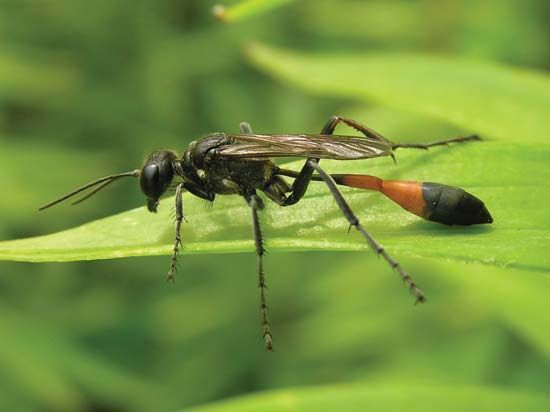
Thread-waisted wasps belong to the family Sphecidae, which is part of the order Hymenoptera. These insects are characterized by a stalklike anterior end of the abdomen, which gives them their common name.145
Regarding the number of species, the provided search results do not specify an exact count for the family Sphecidae. While the broader order Hymenoptera contains more than 115,000 described species, specific data regarding the total number of species within the Sphecidae family is not available in the provided information.4
What are the defining physical characteristics of thread-waisted wasps?
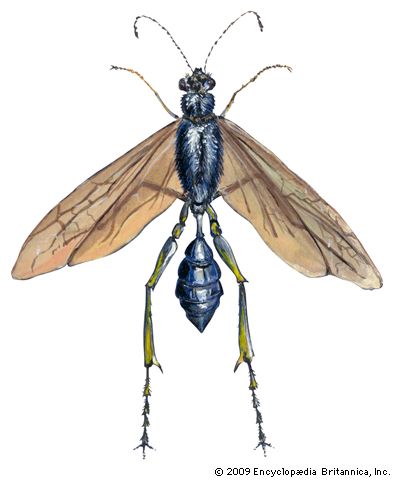
Thread-waisted wasps, members of the family Sphecidae, are defined by several distinct physical characteristics:
- Abdominal Petiole: Their most prominent feature is a very slender, stalklike anterior end of the abdomen, often described as a long, smooth, cylindrical petiole that attaches the abdomen to the thorax.173
- Size: These wasps are generally large, typically measuring more than 2.5 cm (about 1 inch) in length.1
- General Morphology: Like other wasps in the suborder Apocrita, they possess a slender, smooth body and legs with relatively few hairs. They have biting mouthparts and antennae consisting of 12 or 13 segments.5
- Coloration: Appearance varies by tribe; for example, members of the tribe Sphecini are often black with yellow or orange abdominal markings, while mud daubers (tribe Sceliphronini) are commonly black with yellow spots and legs, though some species exhibit a metallic blue coloration.1
- Stingers: Females are equipped with a formidable sting, which is a modified ovipositor used for both paralyzing prey and defense.15
Sources
- thread-waisted wasp — Encyclopædia Britannica
- Hymenoptera - Solitary forms — Encyclopædia Britannica
- wasp — Encyclopædia Britannica
- list of ants, bees, and wasps — Encyclopædia Britannica
- Sphecidae — Merriam-Webster
- Sphecoidea — Merriam-Webster
- thread-waisted wasp — Merriam-Webster
- homopteran - Annotated classification — Encyclopædia Britannica
Published on · 3 min read