Tiger Swallowtail
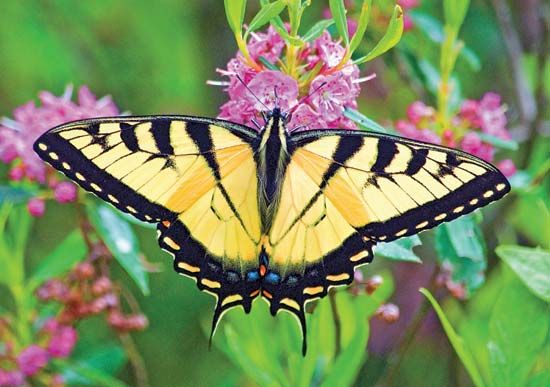
The term "tiger swallowtail" refers to a group of closely related North American swallowtail butterflies characterized by black-and-yellow markings.
Are there different species of tiger swallowtail butterflies, and how do they differ?
The term “tiger swallowtail” refers to a group of closely related North American swallowtail butterflies characterized by black-and-yellow markings.12
The most widely distributed species is the eastern tiger swallowtail (Papilio glaucus). In this species, males are typically yellow with black wing margins and stripes. Females exhibit geographic variation: in northern regions where the distasteful pipevine swallowtail is absent, females are usually yellow like the males. However, in the south, where they coexist with the black-colored pipevine swallowtail, female tiger swallowtails are often all or mostly black, a form of mimicry that provides a survival advantage.123
Other species within this group include the western tiger swallowtail (P. rutulus), which is also a black-and-yellow swallowtail. These species are distinguished primarily by their geographic distribution and specific variations in wing patterns and coloration.21
What are the distinctive physical characteristics of tiger swallowtail butterflies?
Tiger swallowtail butterflies are defined by their striking black-and-yellow coloration and distinct wing patterns. These large swallowtail butterflies are characterized by several key physical features:
- Wing Markings: The wings typically feature a yellow base color accented by prominent black margins and black stripes, which give the butterfly its “tiger” appearance.1
- Sexual Dimorphism: In the eastern tiger swallowtail, males are consistently yellow with black markings. Females, however, show geographic variation; while northern females resemble the males, southern females are often all or mostly black.1
- Mimicry: The dark coloration found in some southern females serves as a form of mimicry, allowing them to resemble the distasteful pipevine swallowtail that shares their habitat.1
How have tiger swallowtail butterflies been depicted in art and culture?
Sorry, the Britannica knowledge base does not contain information regarding the depiction of tiger swallowtail butterflies in art and culture.
What is the origin of the name ‘tiger swallowtail’ for this butterfly?
The name “tiger swallowtail” is derived from the butterfly’s distinctive visual appearance. The “tiger” portion of the name refers to the bold black stripes and margins that contrast against the insect’s yellow wing base, creating a pattern reminiscent of a tiger’s coat. The “swallowtail” designation refers to the family of swallowtail butterflies, which are characterized by the elongated, tail-like extensions on their hindwings.14
While the term is used to describe several closely related species across North America, such as the eastern tiger swallowtail, the name specifically highlights this combination of striped, tiger-like markings and the signature tail structure of the Papilio genus.14
Sources
- tiger swallowtail — Encyclopædia Britannica
- tiger swallowtail — Merriam-Webster
- Lepidoptera - Protection against danger — Encyclopædia Britannica
- tiger butterfly — Merriam-Webster
Published on · 2 min read