Lace Bug
It is important to clarify that there is a distinction between lace bugs (family Tingidae) and lacewings (family Chrysopidae). While the names sound similar…
Are there any beneficial aspects of lace bugs, despite their reputation as pests?
It is important to clarify that there is a distinction between lace bugs (family Tingidae) and lacewings (family Chrysopidae). While the names sound similar, they are different groups of insects with very different ecological roles.
Lace bugs are primarily known as plant-feeding pests that suck juices from foliage, causing damage to leaves. The provided search results do not identify any beneficial aspects of lace bugs; they are consistently categorized as serious pests of various plants.12
Conversely, green lacewings are widely recognized as beneficial insects. Their larvae, often called aphidlions, are voracious predators that feed on aphids and other soft-bodied garden pests. Because of this, they are frequently encouraged in gardens and agriculture as a form of biological control to manage pest populations naturally.34
It is possible the confusion stems from their similar names or the “lacy” appearance of their wings. Would you like to explore more about how other predatory insects contribute to natural pest management in gardens?13
What are some common species of lace bugs found in different parts of the world?
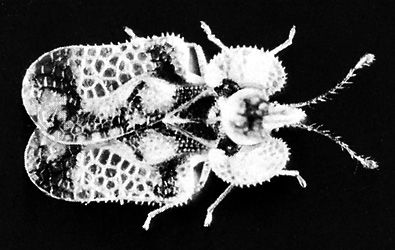
The family Tingidae, commonly known as lace bugs, comprises approximately 800 species worldwide. These insects are characterized by a distinctive, lacelike pattern of ridges and membranous areas on their wings and upper body surfaces.12
While the family is cosmopolitan in distribution, specific species are often identified by the plants they infest. One notable example is the azalea lace bug (Stephanitis pyrioides), which is a common pest found in the southeastern United States.1
Beyond this specific example, the provided search results do not detail other common species by name or geographic region. Because the family is large and widespread, many other species exist, but they are generally categorized by their shared behavior of feeding on plant juices, which often leads to foliage discoloration and leaf drop.12
What types of plants do lace bugs typically feed on?
Lace bugs (family Tingidae) are specialized plant-feeders that primarily extract juices from the foliage of various plants. While the family includes approximately 800 species, they are generally characterized by their destructive feeding habits, which cause yellow spotting, browning, and premature leaf drop on their host plants.12
The most well-documented example is the azalea lace bug (Stephanitis pyrioides), which is a significant pest of azaleas, particularly in the southeastern United States. Beyond specific species like this, the family is cosmopolitan, and different members of the group target a wide variety of other ornamental and agricultural plants, though the provided information does not list every specific host plant species.12
What is the life cycle of a lace bug, from egg to adult?
The life cycle of a lace bug (family Tingidae) follows a specific developmental process that typically spans seven to nine weeks, with most species producing two generations per season.1
Developmental Stages
- Egg: The female deposits eggs on the underside of a leaf. These eggs are covered with a mucous secretion that hardens into a distinct, dark, conelike form.1
- Nymph: Upon hatching, the insects emerge as small, dark, spiny nymphs. These nymphs do not resemble the adult form.1
- Adult: After progressing through their nymphal stages, the insects mature into adults, which are generally less than 5 mm (0.2 inch) long and feature a characteristic lacelike pattern on their wings and upper body.1
Depending on the specific species, lace bugs may overwinter in either the adult or the egg stage. It is important to distinguish these insects from green lacewings, which are beneficial predators that undergo a different life cycle involving a pupal stage and stalked eggs.15
Sources
- lace bug — Encyclopædia Britannica
- lace bug — Merriam-Webster
- homopteran - Associations with other insects — Encyclopædia Britannica
- weed - Biological control — Encyclopædia Britannica
- green lacewing — Encyclopædia Britannica
- Tingidae — Merriam-Webster
- tingid — Merriam-Webster
- Coleoptera - Eggs — Encyclopædia Britannica
Published on · 3 min read