Tillandsia
Tillandsia is the most widely distributed genus within the pineapple family, Bromeliaceae, comprising approximately 500 species of tropical American plants.…
What is Tillandsia?
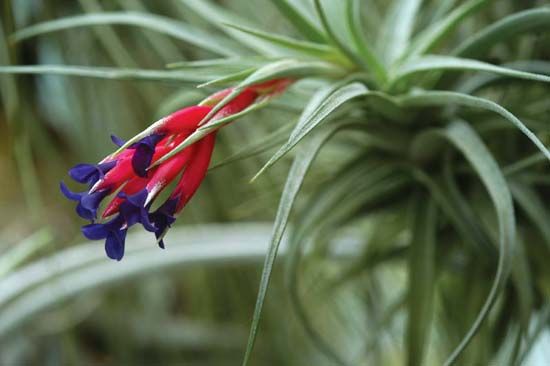
Tillandsia is the most widely distributed genus within the pineapple family, Bromeliaceae, comprising approximately 500 species of tropical American plants1. These plants are primarily perennial herbs that function as epiphytes, meaning they grow supported by other plants and utilize aerial roots to absorb moisture and nutrients directly from the atmosphere and rain.123
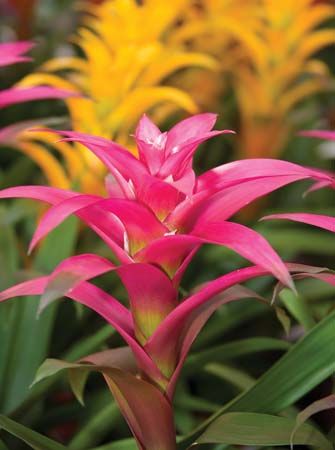
Commonly referred to as air plants, their physical characteristics vary significantly: some species grow in rosettes with overlapping leaves that form cups to collect rainwater, while others hang loosely from their perches. Their foliage often appears grayish or silvery, and their flowers range from inconspicuous to quite showy. Notable members include Spanish moss, which has historically been used for packing or upholstery, and T. xiphoides, which is sometimes utilized in local traditional medicine. The genus was named in honor of the 17th-century Finnish botanist Elias Tillands.13
How do epiphytes get nutrients without soil?
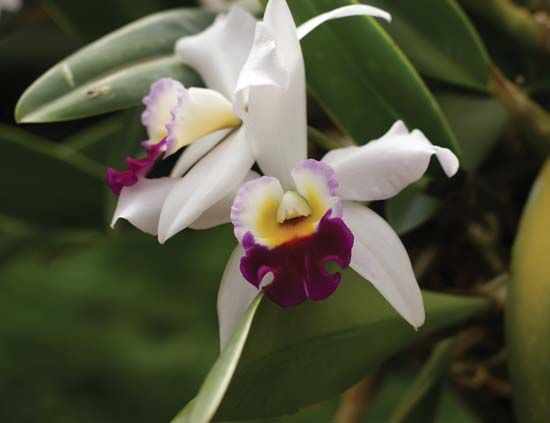
Epiphytes are plants that grow on other objects, such as trees or rocks, solely for physical support rather than for nutrition, meaning they do not derive their sustenance from the host plant in a parasitic manner. Because they lack a connection to the ground, they have evolved specialized methods to acquire water and nutrients from their environment.45
- Water Acquisition: Epiphytes primarily obtain water from rainfall and atmospheric moisture, such as water vapor or marine fog. While many species absorb this moisture through their roots, others possess specialized leaves capable of taking in water directly from the air.45
- Nutrient Absorption: Nutrients are generally obtained from organic debris—such as decaying leaves and other matter—that collects on the supporting plants or within the crevices of the host. While some minerals are captured directly from rainwater, the decomposition of this accumulated organic material provides the essential nutrients required for the epiphyte’s growth.4
- Attachment: To remain in place on these non-soil surfaces, many epiphytes, including various orchids and Tillandsia species, utilize adventitious roots as their primary means of anchorage.6
What is the difference between an epiphyte and a parasite?
The primary difference between an epiphyte and a parasitic plant lies in how they interact with their host and obtain nutrients.
- Epiphytes: These plants use other plants or objects solely for physical support to reach better light or moisture conditions. They do not derive water or nutrients from the host, nor do they harm it. Instead, they obtain moisture from the air and rain and gather nutrients from organic debris that collects on the host’s surface.84
- Parasitic Plants: These plants obtain all or part of their nutrition directly from a host plant, often causing it damage. Their defining feature is the haustorium, a specialized organ that penetrates the host to create a vascular union, allowing the parasite to siphon water, minerals, or carbohydrates from the host’s own tissues.4
While both may grow on other plants, epiphytes are independent, self-sustaining organisms, whereas parasites are physiologically dependent on their hosts to complete their life cycles.84
How does Spanish moss differ from other Tillandsia species?
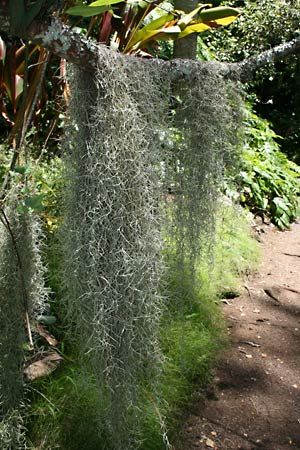
Spanish moss (Tillandsia usneoides) is a member of the genus Tillandsia, but it is distinct from many other species within that group due to its unique growth habit and morphology.101
- Growth Habit: While many Tillandsia species grow in rosettes—with leaves that overlap at the base to form a cup for holding rainwater—Spanish moss lacks this structure. Instead, it grows in long, threadlike, beardlike masses that hang loosely from its aerial perches.110
- Morphology: Spanish moss is characterized by its extremely long, threadlike stems, which can reach lengths of 6 to 7.5 meters (20 to 25 feet), and small, threadlike leaves. In contrast, other Tillandsia species exhibit a wider variety of forms, including flared rosettes, and their leaves can be more varied in color and shape.101
- Common Misconception: Despite its name, Spanish moss is not a true moss (which are nonvascular, spore-bearing plants), but rather a flowering epiphyte in the pineapple family (Bromeliaceae).101112
Sources
- Tillandsia — Encyclopædia Britannica
- air plant — Merriam-Webster
- tillandsia — Merriam-Webster
- Epiphyte — Encyclopædia Britannica
- Adventitious root — Encyclopædia Britannica
- Angiosperm - Uptake of water and mineral nutrients from the soil — Encyclopædia Britannica
- Angiosperm - Evolution of the transport process — Encyclopædia Britannica
- epiphyte — Merriam-Webster
- Parasitic plant — Encyclopædia Britannica
- Spanish moss — Encyclopædia Britannica
- moss — Encyclopædia Britannica
- Plant - Division Bryophyta — Encyclopædia Britannica
Published on · 3 min read