Timor Sea
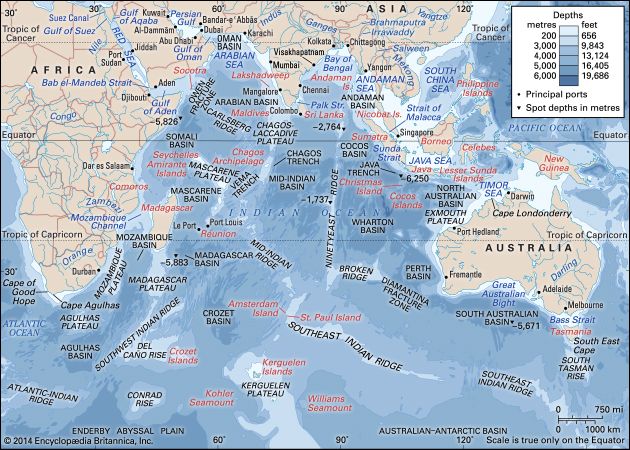
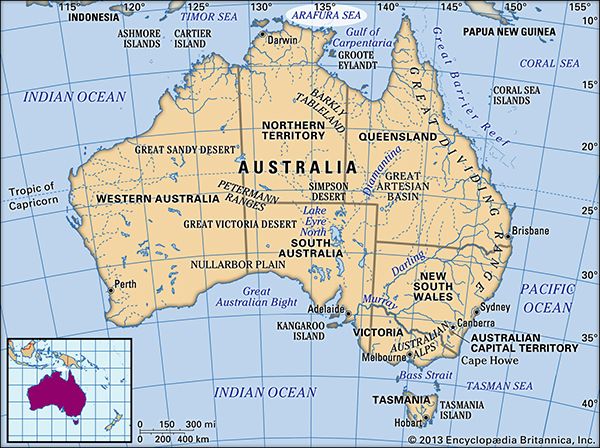
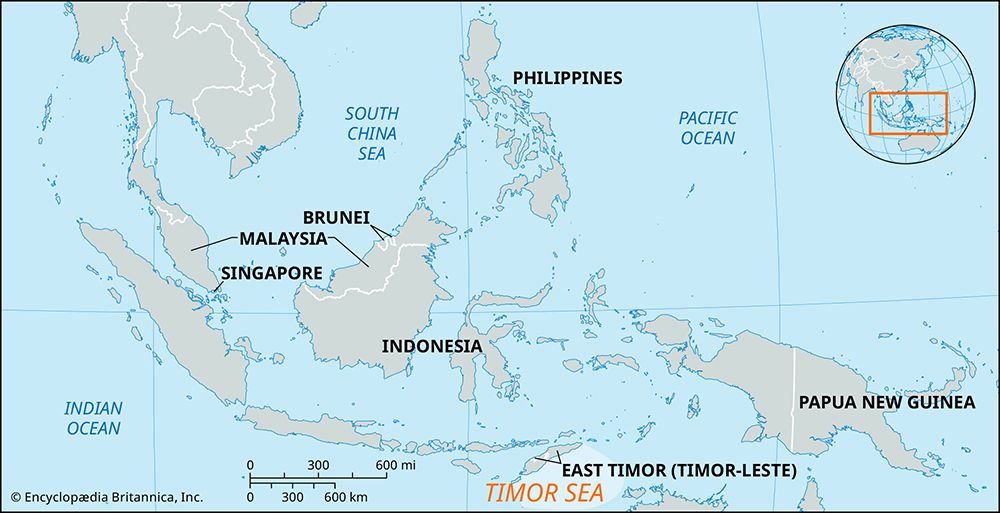
The Timor Sea is an arm of the Indian Ocean situated between the island of Timor to the northwest and Australia to the southeast. Spanning approximately…
What is Timor Sea?
The Timor Sea is an arm of the Indian Ocean situated between the island of Timor to the northwest and Australia to the southeast. Spanning approximately 235,000 square miles (610,000 square km), it serves as a vital maritime link, opening westward into the Indian Ocean and eastward into the Arafura Sea of the Pacific Ocean.1
Geographically, the sea is characterized by the Timor Trough in the north, which reaches depths exceeding 10,800 feet (3,300 meters), though more than half of the sea is relatively shallow, measuring less than 650 feet (200 meters) deep. The region is influenced by monsoon belts and trade winds, making it prone to typhoons, and it experiences a consistent southwesterly surface flow known as the Timor Current.1
Economically, the Timor Sea is highly significant due to its substantial hydrocarbon reserves, including important oil and natural gas fields that are critical to the economies of both East Timor and Australia’s Northern Territory.123
What is the significance of the Timor Trough?
The Timor Trough is a significant geological feature located in the northern portion of the Timor Sea. Its primary significance lies in its extreme depth, as it reaches a maximum of more than 10,800 feet (3,300 meters), which stands in stark contrast to the rest of the sea, where more than half of the area is relatively shallow at less than 650 feet (200 meters) deep.1
Beyond its role as a deep-water basin, the trough serves as a defining physical boundary within the region, marking the transition between the shallow continental shelf of Australia and the deeper oceanic waters to the north.1
We could dive deeper into the tectonic activity that formed this deep-sea trench or explore how such bathymetric features influence regional ocean currents.
How do monsoon winds affect the climate of the Timor Sea?
The climate of the Timor Sea is significantly shaped by its location within a monsoonal belt, where it is influenced by the alternating effects of the southeast trade winds and the Malaysian-Australian monsoon system.
This seasonal regime creates a distinct climatic rhythm:
- Wind Reversal: The area experiences a seasonal shift in wind direction. During the cooler months, southeasterly winds prevail, while the warmer months are characterized by a northwesterly flow.15
- Weather Patterns: These winds are central to the region’s moisture and heat distribution. The interaction between continental and maritime influences leads to marked seasonal contrasts, often resulting in periods of heavy rainfall and high humidity, as well as drier intervals.65
- Storm Activity: The Timor Sea is well known for generating typhoons, which develop within the monsoonal air and bring additional complexity to the regional weather.15
These atmospheric conditions also influence the Timor Current, a southwesterly surface current that persists throughout the year, further linking the sea’s physical environment to the broader dynamics of the Indian Ocean.1
What are the main differences between the Indian and Pacific Oceans?
The Indian Ocean and the Pacific Ocean differ significantly in their physical characteristics, geological history, and environmental dynamics.
Physical and Geological Differences
- Size and Depth: The Pacific is the world’s largest ocean, covering about one-third of the globe’s surface, with double the area and water volume of the Atlantic. It also contains the world’s greatest depth, the Mariana Trench. In contrast, the Indian Ocean is the smallest and geologically youngest of the three major oceans, with a smaller average depth and fewer marginal seas.89
- Geography: The Indian Ocean is landlocked in the Northern Hemisphere and lacks a temperate-to-cold zone in that region. It features narrower continental shelves and fewer islands compared to the Pacific.8
- Circulation: The Indian Ocean is unique for its asymmetric surface circulation, which reverses semiannually due to monsoonal influences. Unlike other oceans, it lacks a separate source of bottom water, as its deep water originates outside its boundaries.8
Biological and Climatic Distinctions
- Biodiversity: The Pacific hosts the most varied array of marine life, including extensive coral reefs in the western tropical regions that support significantly more fish species than those in the Atlantic. While the Indian Ocean also possesses a rich reef fauna due to its tropical connections, the Pacific’s vast scale and diverse current conditions foster unique indigenous biotas and massive kelp forests along its eastern coasts.1011
- Climate Interactions: The Pacific is central to global climate phenomena like the Southern Oscillation and El Niño, which involve complex ocean-atmosphere feedback loops. The Indian Ocean, meanwhile, is defined by its monsoonal climate, which dictates its surface currents and nutrient distribution.81213
Sources
- Timor Sea — Encyclopædia Britannica
- Timor — Encyclopædia Britannica
- Northern Territory - Resources and power — Encyclopædia Britannica
- East Timor — Encyclopædia Britannica
- Pacific Ocean - The monsoon regime — Encyclopædia Britannica
- Malaysian-Australian monsoon — Encyclopædia Britannica
- Monsoon Current — Encyclopædia Britannica
- Indian Ocean — Encyclopædia Britannica
- Climate - The Southern Oscillation — Encyclopædia Britannica
- Equatorial current — Encyclopædia Britannica
- Pacific Ocean — Encyclopædia Britannica
- Pacific Ocean - Biological resources — Encyclopædia Britannica
- Pacific Ocean - Trade and transportation — Encyclopædia Britannica
- Indian Ocean - Biological resources — Encyclopædia Britannica
Published on · 3 min read