Monsoon Current
Monsoon currents and the broader monsoonal environment play a significant role in the lifecycle of tropical cyclones, particularly in regions like the…
How do monsoon currents affect the formation and movement of tropical cyclones?
Monsoon currents and the broader monsoonal environment play a significant role in the lifecycle of tropical cyclones, particularly in regions like the western Pacific and the Indian Ocean.12
Formation
In the western Pacific, tropical storms often originate from loosely organized convection events within the monsoon trough, a large-scale area of low pressure situated along the Equator. While the presence of a large-scale cyclonic circulation in the lower troposphere is a primary factor for development, the monsoonal flow itself can be a limiting factor. Monsoonal flows are typically characterized by high vertical wind shear—the change in wind speed or direction with height—which is generally not conducive to tropical cyclone development because it prevents the system from retaining the heat and moisture necessary for intensification.13
Movement
The movement of tropical cyclones is largely dictated by the large-scale tropospheric flow. While trade winds generally drive cyclones westward, the complex, seasonally changing surface currents of the northern Indian Ocean, known as the Monsoon Current, reflect the broader atmospheric circulation patterns that influence storm tracks.345
How do monsoon currents differ from other ocean currents?
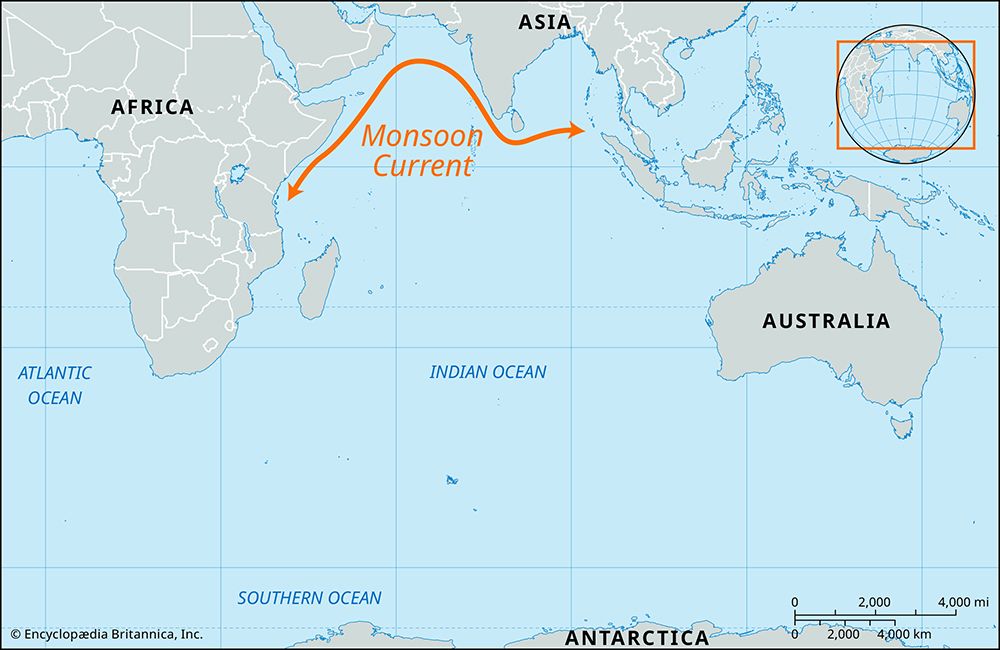
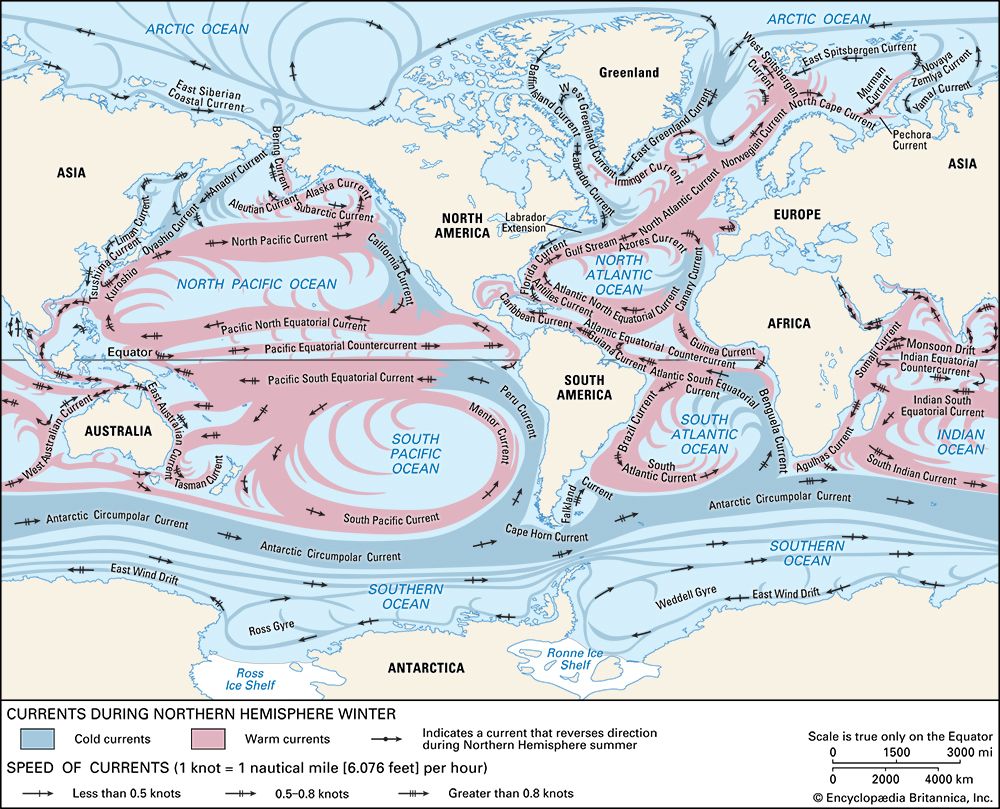
The Monsoon Current is distinct from most other major ocean currents primarily due to its seasonal variability, which is driven by the monsoon wind system.69
While the Atlantic and Pacific oceans feature strong, relatively stable currents that circulate clockwise north of the Equator, the northern Indian Ocean experiences surface currents that reverse direction twice a year in response to changing atmospheric pressure and wind patterns.6
- Northeast Monsoon (November–March): The current flows southwest and west, crossing the Equator.6
- Southwest Monsoon (April–October): The flow reverses, pushing the Southwest Monsoon Drift eastward and sending branches into the Arabian Sea and Bay of Bengal.6
In contrast, typical wind-driven equatorial currents, such as the North Equatorial Current and South Equatorial Current, are generally directed westward and remain more consistent throughout the year, influenced primarily by the steady trade winds.9
How do monsoon currents contribute to the global ocean circulation patterns?
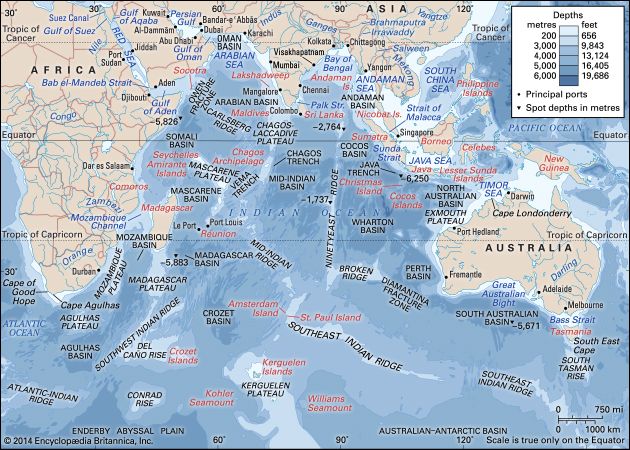
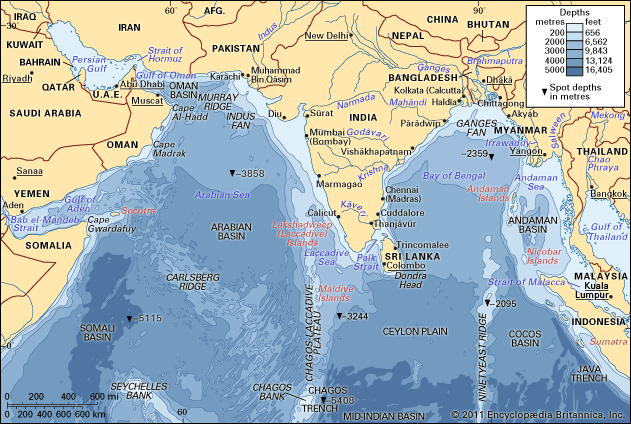
Monsoon currents are a defining feature of the northern Indian Ocean, where they significantly influence regional hydrology and surface circulation patterns by reversing direction twice annually in response to the monsoon wind system6.6
Unlike the relatively stable, wind-driven gyres found in the Atlantic and Pacific oceans, the Indian Ocean’s surface circulation is highly dynamic. During the southwest monsoon (April–October), the Monsoon Current flows eastward, acting as a major boundary current that pushes water into the Arabian Sea and Bay of Bengal. Conversely, during the northeast monsoon (November–March), the flow reverses to the west.126
These seasonal shifts drive critical oceanographic processes, including:
- Upwelling: Intense seasonal upwelling occurs off the coasts of Somalia, Arabia, and India, which alters surface temperatures and nutrient distribution.1211
- Water Mass Formation: The interaction of these currents with atmospheric conditions helps create distinct horizontal layers of water, contributing to the ocean’s overall thermohaline circulation and density structure.13
How have monsoon currents changed over time due to climate change?
The intensity and behavior of the Indian Ocean monsoon system, which drives the seasonal reversal of monsoon currents, have fluctuated significantly over time due to natural climate variations.
Paleoclimatic evidence indicates that the monsoon was greatly amplified during the early Holocene (approximately 11,700 to 6,000 years ago). During this period, higher summer solar radiation—caused by orbital forcing—led to warmer continental temperatures and lower surface pressure. This intensified the pressure gradient between the ocean and land, resulting in a stronger inflow of moisture-laden air into continental interiors. Consequently, regions that are now arid, such as parts of the Sahara Desert, experienced much higher precipitation and supported lush vegetation and diverse wildlife.6
Over the past 4,000 to 6,000 years, decreasing summer insolation has led to a weakening of the monsoon. Today, the system remains subject to interannual and decadal variability, influenced by factors such as El Niño events, snow cover on the Plateau of Tibet, and sea surface temperature anomalies.616
Sources
- tropical cyclone - Intensification — Encyclopædia Britannica
- tropical storm — Encyclopædia Britannica
- Climate - Conditions associated with cyclone formation — Encyclopædia Britannica
- tropical cyclone - Formation — Encyclopædia Britannica
- climate of India - Tropical cyclones — Encyclopædia Britannica
- Monsoon Current — Encyclopædia Britannica
- tropical cyclone - Tropical cyclone tracks — Encyclopædia Britannica
- tropical cyclone - Long-term forecasts — Encyclopædia Britannica
- Monsoon — Encyclopædia Britannica
- Pacific Ocean - The monsoon regime — Encyclopædia Britannica
- ocean current - Equatorial currents — Encyclopædia Britannica
- Indian Ocean - Surface currents — Encyclopædia Britannica
- Indian Ocean - Climate — Encyclopædia Britannica
- Indian Ocean - Hydrology — Encyclopædia Britannica
- Indian Ocean - Upwelling of the Indian Ocean — Encyclopædia Britannica
- Climate change - Amplification of the Indian Ocean monsoon — Encyclopædia Britannica
- Climate - Climate and the oceans — Encyclopædia Britannica
- Climate - Diurnal variability — Encyclopædia Britannica
- Climate - Interannual variability — Encyclopædia Britannica
Published on · 3 min read