Timor Current
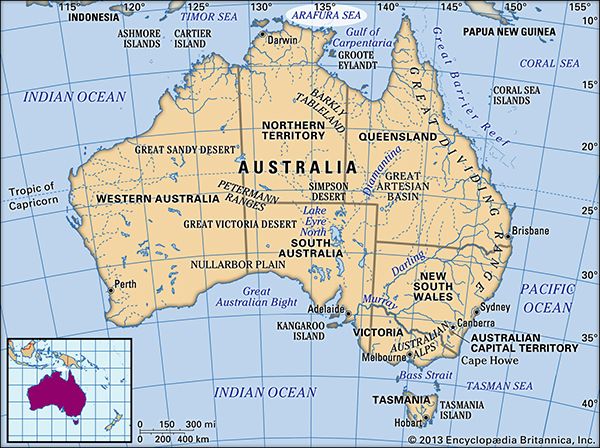
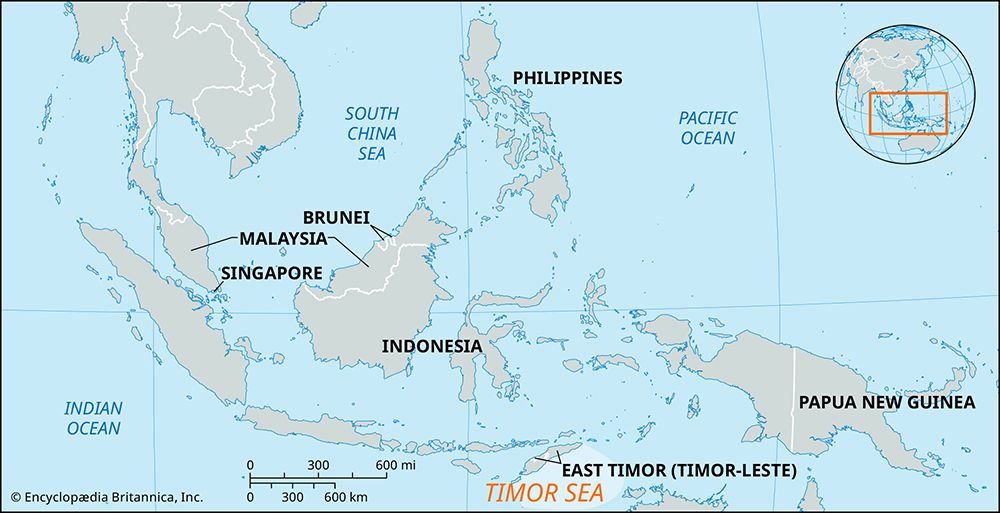
The Timor Current is a surface oceanic current that flows in a southwesterly direction along the coast of Timor within the Indonesian Archipelago.
What is Timor Current?
The Timor Current is a surface oceanic current that flows in a southwesterly direction along the coast of Timor within the Indonesian Archipelago.12
Fed by waters from the Arafura Sea and the Banda Sea of the Pacific Ocean, this current moves through the Timor Sea at an average speed of 0.5 to 1 mile (0.8 to 1.6 km) per hour. It is a significant body of water, transporting between 35 and 53 million cubic feet (1 and 1.5 million cubic metres) of water per second.12
What is the Indonesian Throughflow?
Sorry, the Britannica knowledge base does not contain this information.
How do ocean currents influence global climate?
Ocean currents play a fundamental role in regulating global climate by acting as a massive heat-distribution system, moving energy from the tropics toward the poles. This process occurs through two primary mechanisms: wind-driven circulation and thermohaline circulation.34567
Heat Transport and Climate Moderation
Ocean currents effectively exchange heat between low and high latitudes, significantly influencing the climate of coastal regions.5
- Wind-Driven Circulation: Large-scale surface currents, such as the Gulf Stream, are driven by prevailing winds. These currents transport warm water poleward, moderating the climates of regions like northwestern Europe, which would otherwise be much cooler.365
- Thermohaline Circulation: Often called the “ocean conveyor belt,” this slower, deep-ocean circulation is driven by differences in temperature and salinity. It involves the sinking of cold, dense water in polar regions, which pulls warm surface waters northward. This process is crucial for maintaining the relatively mild winter temperatures in the British Isles and Norway.67
Ocean-Atmosphere Interaction
The ocean and atmosphere are deeply connected through the transfer of heat and moisture.45
- Energy Exchange: Heat moves from the ocean to the atmosphere via direct transfer and evaporation. This moisture can later condense into clouds, releasing latent heat that influences weather systems.45
- Climate Patterns: Complex interactions, such as the El Niño/Southern Oscillation, demonstrate how anomalies in sea-surface temperatures can trigger major climatic shifts, affecting precipitation and atmospheric circulation across entire hemispheres.45
What are the main differences between the Pacific and Indian Oceans?
The Pacific and Indian oceans differ significantly in their size, geological characteristics, and circulation patterns.
Size and Physical Geography
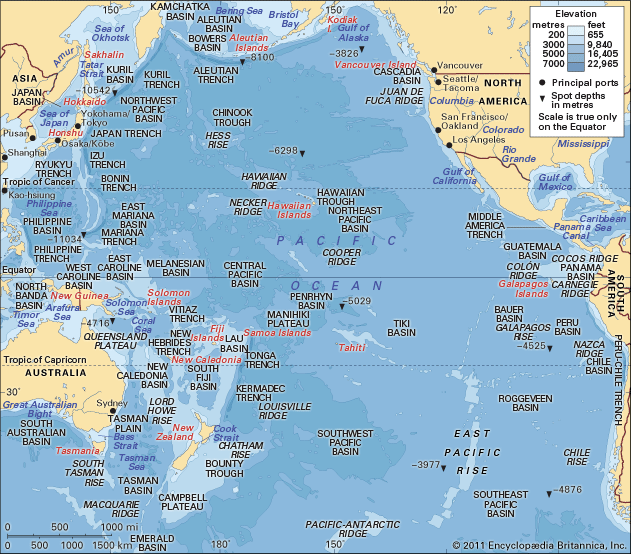
- Scale: The Pacific Ocean is the world’s largest ocean, covering about one-third of the globe’s surface—double the area and volume of the Atlantic. In contrast, the Indian Ocean is the smallest of the three major oceans, covering approximately one-fifth of the world’s ocean area.89
- Depth: The Pacific contains the greatest known ocean depth, the Mariana Trench (36,201 feet), while the Indian Ocean’s deepest point is the Sunda Deep in the Java Trench (24,442 feet).89
- Features: The Indian Ocean is geologically younger and physically more complex, with fewer marginal seas, fewer islands, and narrower continental shelves compared to the Pacific.8
Circulation and Climate
- Surface Currents: The Indian Ocean is unique for its asymmetric, semiannually reversing surface circulation driven by the monsoon regime, whereas the Pacific is dominated by large-scale, wind-driven [gyres].810
- Water Sources: The Indian Ocean lacks a separate source of bottom water, with its deep water originating outside its boundaries. It also receives highly saline water from the Persian Gulf and Red Sea.8
Geological Activity
- Seafloor Spreading: The Pacific Ocean exhibits much more rapid rates of seafloor spreading compared to the Indian and Atlantic oceans, allowing for the production of its entire crustal area in approximately 100 million years.11
Sources
- Timor Current — Encyclopædia Britannica
- Timor Sea — Encyclopædia Britannica
- How Do Ocean Currents Affect the Biosphere? — Encyclopædia Britannica
- Climate - Climate and the oceans — Encyclopædia Britannica
- thermohaline circulation — Encyclopædia Britannica
- Climate - Circulation, currents, and ocean-atmosphere interaction — Encyclopædia Britannica
- Climate - Thermohaline circulation — Encyclopædia Britannica
- Indian Ocean — Encyclopædia Britannica
- Pacific Ocean — Encyclopædia Britannica
- Pacific Ocean - Biological resources — Encyclopædia Britannica
- Equatorial current — Encyclopædia Britannica
- ocean current - Distribution of ocean currents — Encyclopædia Britannica
- Pacific Ocean - Climate — Encyclopædia Britannica
- Pacific Ocean - The monsoon regime — Encyclopædia Britannica
- plate tectonics - Seafloor spreading — Encyclopædia Britannica
Published on · 3 min read