Tonga Trench
The Tonga Trench is a prominent submarine trench located on the floor of the South Pacific Ocean. Stretching approximately 850 miles (1,375 km) in length, it…
What is Tonga Trench?
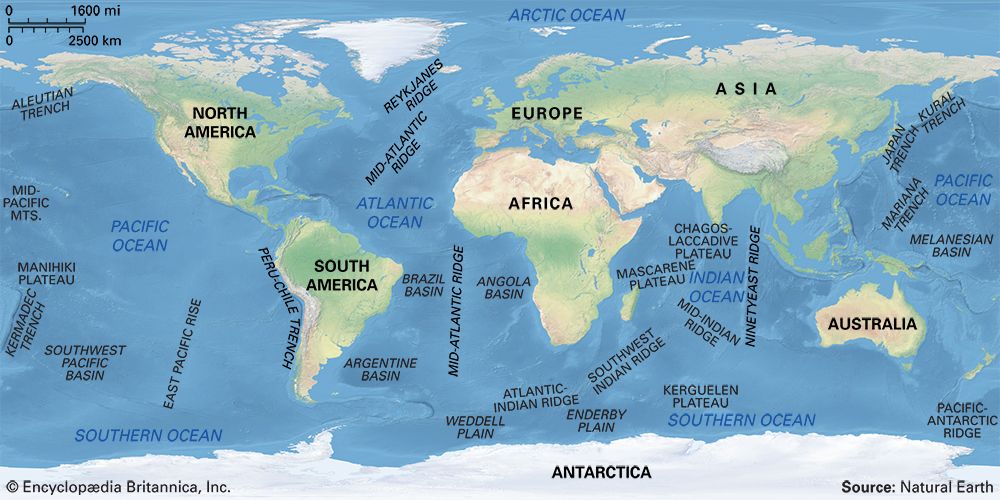
The Tonga Trench is a prominent submarine trench located on the floor of the South Pacific Ocean. Stretching approximately 850 miles (1,375 km) in length, it forms the eastern boundary of the Tonga Ridge. Together, these features constitute the northern half of the Tonga-Kermadec Arc, a significant structural component of the Pacific floor that is completed to the south by the Kermadec Trench and Ridge.1
The trench is characterized by its extreme depth and steep topography. While it has an average depth of 20,000 feet (6,000 m) and a width of about 50 miles (80 km), it reaches a maximum depth of 35,702 feet (10,882 m). It is notable for its steep slopes, which have been measured as high as 45°. As a subduction zone, the trench is associated with complex geological activity, including the formation of back-arc basins like the Lau Basin, which are sites of seafloor spreading.12
What is a subduction zone?
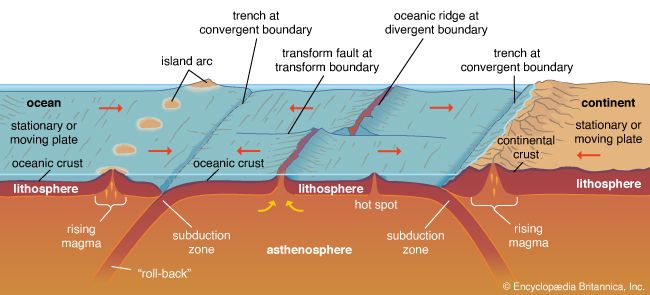
A subduction zone is a geological region at a convergent plate boundary where one tectonic plate, typically older and denser, is forced beneath another and descends into the Earth’s upper mantle. This process is the antithesis of mid-oceanic ridges, where new seafloor is created; at subduction zones, the seafloor is consumed.324
Key characteristics of these zones include:
- Deep-Sea Trenches: The site of subduction is marked by a deep, V-shaped trench, often reaching depths of 5 to 11 km.52
- Seismic Activity: The path of the descending slab is defined by the Wadati-Benioff zone, a plane of frequent earthquakes that can extend 300 to 700 km below the surface.2
- Volcanism: As the subducting plate descends, it carries water and sediments that reduce the melting temperature of mantle rocks, creating magma that rises to form explosive subduction-zone volcanoes on the overriding plate.64
- Accretionary Wedges: Sediments scraped from the descending plate accumulate on the overriding plate, forming a chaotic mixture of deformed rock known as an accretionary prism.52
How do volcanic island arcs form?
Volcanic island arcs are long, curved chains of islands formed primarily at convergent plate boundaries where two tectonic plates collide. The process is driven by subduction, where a dense oceanic plate is forced downward into the Earth’s mantle beneath an overriding plate.789
As the descending slab reaches depths of approximately 100 km (60 miles), increasing heat and pressure cause it to release volatile components. These components lower the melting temperature of the overlying mantle wedge, generating magma. This magma, which is typically basaltic in composition, rises through the overriding plate to the surface, creating a line of explosive volcanoes parallel to the nearby deep-sea trench.978
Over time, the accumulation of extruded volcanic materials—such as basalts and andesites—builds these islands up from the seafloor. While these arcs are most common in the western Pacific, they represent a fundamental mechanism of mountain-building and crustal evolution across the globe.7810
What is the difference between a trench and a fracture zone?
Deep-sea trenches and fracture zones are distinct geological features with different origins and tectonic roles.
Deep-Sea Trenches
Deep-sea trenches are long, narrow, V-shaped depressions that form at convergent plate boundaries where subduction occurs. In these zones, an older, denser tectonic plate is forced beneath another plate and descends into the Earth’s mantle.2312
- Characteristics: They are associated with negative gravity anomalies, low heat flow, and the Wadati-Benioff zone, which is a plane of frequent, deep-seated earthquakes.21213
- Activity: They are often accompanied by volcanic island arcs or continental mountain chains on the overriding plate.2
Fracture Zones
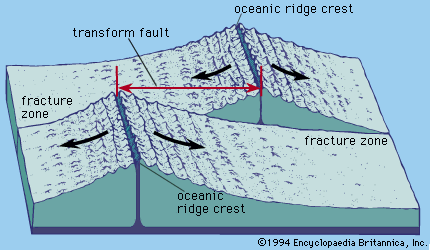
Submarine fracture zones are long, mountainous lineations that typically form perpendicular to oceanic ridges. They represent scars on the seafloor created by transform faults, where tectonic plates slide horizontally past one another.141315
- Characteristics: They consist of complex ridges and troughs and are generally not sites of volcanic activity.1413
- Activity: Seismic activity is restricted strictly to the portion of the fracture zone located between offset ridge crests (the transform fault); the remaining, longer portions of the fracture zone are seismically inactive.141513
Sources
- Tonga Trench — Encyclopædia Britannica
- deep-sea trench - Structure — Encyclopædia Britannica
- subduction zone — Encyclopædia Britannica
- plate tectonics - Subduction zones — Encyclopædia Britannica
- volcano - Subduction volcanoes — Encyclopædia Britannica
- volcano - Volcanoes related to plate boundaries — Encyclopædia Britannica
- island arc — Encyclopædia Britannica
- plate tectonics - Island arcs — Encyclopædia Britannica
- volcanism — Encyclopædia Britannica
- Asia - Cenozoic events in the island arcs and the marginal basins — Encyclopædia Britannica
- mountain - Volcanoes and island arcs surrounding the northwest Pacific basin — Encyclopædia Britannica
- deep-sea trench - Origin of deep-sea trenches — Encyclopædia Britannica
- submarine fracture zone — Encyclopædia Britannica
- transform fault — Encyclopædia Britannica
- plate tectonics - Discovery of ocean basin features — Encyclopædia Britannica
- plate tectonics - Transform faults — Encyclopædia Britannica
- plate tectonics - Plate boundaries — Encyclopædia Britannica
Published on · 3 min read