Tonguefish
A tonguefish is a small marine flatfish belonging to the family Cynoglossidae, primarily found in tropical regions, particularly throughout Asia.
What is tonguefish?
A tonguefish is a small marine flatfish belonging to the family Cynoglossidae, primarily found in tropical regions, particularly throughout Asia.12
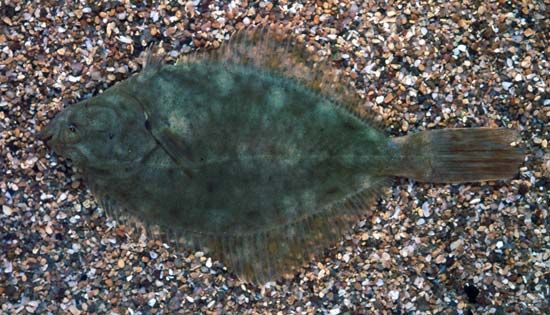
These fish are characterized by their flattened, drop-shaped bodies and small eyes, both of which are positioned on the left side of the head. They feature long dorsal and anal fins that connect directly to the tail fin. Most species remain small, typically growing to a maximum length of about 30 cm (12 inches). While some are consumed as food, the majority of tonguefish have little to no commercial value due to their diminutive size.1
What are other types of flatfish?
Flatfish belong to the order Pleuronectiformes and are categorized into approximately 600 species across 14 families. While they share the trait of having both eyes on one side of the head as adults, they vary significantly in size, habitat, and classification.34
Common types of flatfish include:
- Flounders: A diverse group including “left-eyed” families like Bothidae and Paralichthyidae, as well as “right-eyed” Pleuronectidae.54
- Halibuts: Large, right-eyed flatfish within the family Pleuronectidae; the Atlantic halibut can weigh up to 720 pounds.34
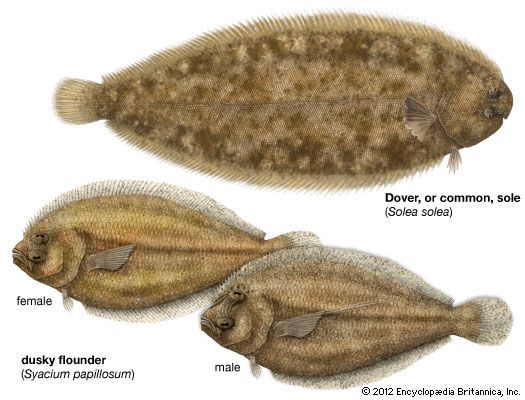
- Soles: Members of the family Soleidae, such as the commercially valuable Dover sole, which typically have eyes on the right side.64
- Turbots: Large, left-eyed flatfish belonging to the family Scophthalmidae, known to reach weights of up to 23 kg.4
- Plaice: A European food fish in the family Pleuronectidae, recognized by its brown body with red or orange spots.7
How do flatfish eyes migrate as they grow?
Flatfish undergo a remarkable transformation during their development. While larval flatfish are bilaterally symmetrical—meaning they possess one eye on each side of the head—they undergo a period of rapid change known as metamorphosis.8
During this process, one eye migrates across the head to join the other on the same side. This shift is accompanied by significant osteological changes in the skull, which result in the permanent asymmetry characteristic of adult pleuronectiforms. Once this migration is complete, the fish settles to the ocean floor to begin its adult benthic existence.89
What is the difference between right-eyed and left-eyed flatfish?
The primary difference between right-eyed and left-eyed flatfish lies in the final orientation of their eyes following metamorphosis, a process where one eye migrates across the skull to join the other on a single side of the head.106
- Right-eyed (Dextral) Flatfish: In these species, the left eye migrates to the right side of the head. This group includes families such as Pleuronectidae (which contains halibuts and many flounders) and Soleidae (soles).8
- Left-eyed (Sinistral) Flatfish: In these species, the right eye migrates to the left side of the head. This group includes families such as Bothidae (left-eyed flounders), Scophthalmidae (turbots), and Cynoglossidae (tongue soles).8
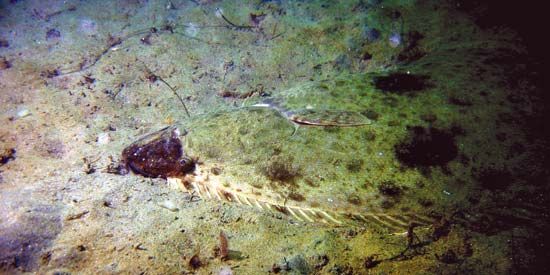
While most families are consistently either right-eyed or left-eyed, some primitive groups, such as the Psettodidae, may have eyes on either side. The side with the eyes, known as the ocular side, is typically pigmented to allow the fish to mimic its environment, while the blind side remains unpigmented and faces the ocean floor.8103
Sources
- tonguefish — Encyclopædia Britannica
- tonguefish — Merriam-Webster
- Did you know? — Merriam-Webster
- flounder — Encyclopædia Britannica
- sole — Encyclopædia Britannica
- pleuronectiform - Annotated classification — Encyclopædia Britannica
- plaice — Encyclopædia Britannica
- pleuronectiform — Encyclopædia Britannica
- pleuronectiform - Reproduction — Encyclopædia Britannica
- pleuronectiform - Form and function — Encyclopædia Britannica
Published on · 3 min read