Turbot
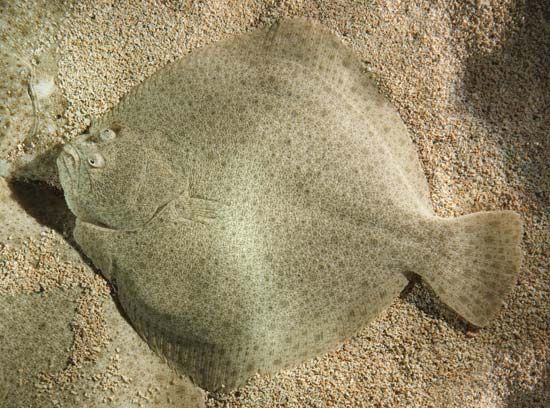
The turbot (Psetta maxima, also known as Scophthalmus maximus) is a highly valued, broad-bodied flatfish belonging to the family Scophthalmidae.
What is turbot?
The turbot (Psetta maxima, also known as Scophthalmus maximus) is a highly valued, broad-bodied flatfish belonging to the family Scophthalmidae.12
Native to European waters, this species typically inhabits sand and gravel shores. It is characterized as a left-sided flatfish, meaning its eyes are positioned on the left side of its head. The fish is scaleless, though its body and head are covered in distinct bony knobs known as tubercles. While its coloration varies to match its surroundings, it is generally light or gray-brown with darker markings and a white undersurface. A large species, the turbot can reach lengths of up to 1 metre (40 inches) and weigh as much as 25 kilograms (55 pounds).12
The name “turbot” is also applied to several other species, including the Black Sea turbot and certain right-sided flatfish found in the Pacific Ocean.12
How do flatfish develop their unique body shape?
Flatfish, which belong to the order Pleuronectiformes, develop their unique asymmetrical body shape through a dramatic process of metamorphosis during their transition from larvae to adults.34
While newly hatched flatfish larvae are bilaterally symmetrical—possessing one eye on each side of the head—they undergo significant physiological changes as they prepare to settle into a bottom-dwelling (benthic) existence. The most defining feature of this transformation is the migration of one eye across the head to the other side. This is achieved through one of two paths: the eye moves either over the middorsal ridge or directly through the head, facilitated by the reabsorption of the dorsal edge of the supraorbital bar.453
These changes are accompanied by extensive remodeling of the skull, including the twisting (torsion) of the frontal bones, ethmoid, and mouthparts. Once the eye migration is complete, the supraorbital bars ossify to form the interorbital bone, and the fish settles to the ocean floor on its side. This process results in the adult form, where both eyes are positioned on the upper (ocular) side, while the lower (blind) side remains unpigmented.34
What are some other types of popular flatfish?
Beyond the turbot, there are many other popular and commercially significant flatfish. These species are generally categorized by whether their eyes are positioned on the right side (dextral) or the left side (sinistral) of their heads.9
Common Types of Flatfish
- Halibut: These are among the largest and most economically valuable flatfish. The Atlantic halibut is the largest species, while the Pacific halibut is also widely consumed. Both are right-eyed members of the family Pleuronectidae.10
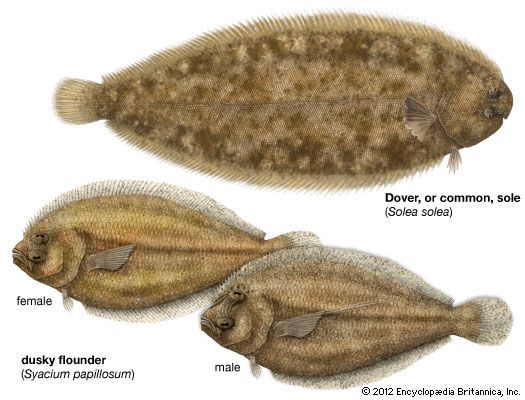
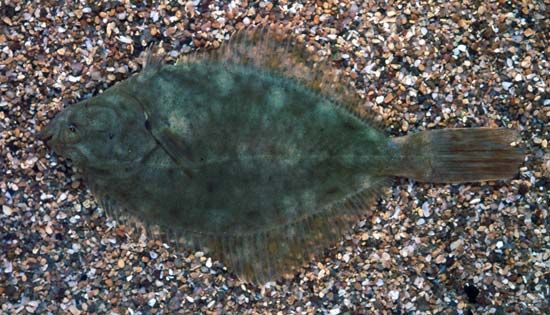
- Flounder: This term encompasses numerous species across several families. Examples include the European flounder, the starry flounder, and the winter flounder (all right-eyed), as well as the summer flounder and peacock flounder (left-eyed).11
- Sole: True soles belong to the family Soleidae and are typically right-eyed. The Dover sole is a highly esteemed food fish in Europe. Note that some species, like the Pacific Dover sole, belong to the family Pleuronectidae.121
- Brill: A relatively large, commercially important European species (Scophthalmus rhombus) that is a member of the same family as the turbot.11
Flatfish are found in temperate and tropical seas worldwide, with most species living on the continental shelf at depths of less than 200 metres.13
How does camouflage work for fish living on the ocean floor?
Fish living on the ocean floor utilize a variety of sophisticated strategies to achieve crypsis, the ability to blend into their environment to avoid predation. These adaptations involve a combination of coloration, body form, and behavior.
Mechanisms of Concealment
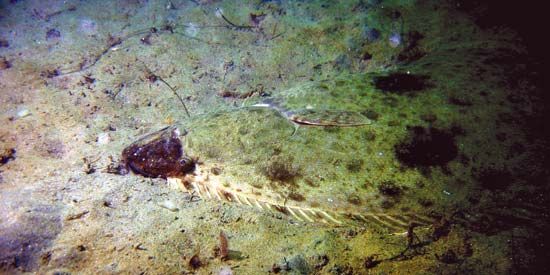
- Background Matching: Many bottom-dwelling fish possess the remarkable ability to match the color and pattern of the substrate upon which they rest. Flatfishes, for example, can adjust their appearance to mirror the texture and hue of the seafloor.16
- Disruptive Coloration: This technique uses patterns that break up the fish’s body outline, making it difficult for predators to perceive the animal’s true shape. Species like the blenny use mottled patterns or dark “saddles” to blend into environments filled with sponges, barnacles, and algae.17
- Morphological Adaptations: Some fish, such as scorpion fishes and sculpins, feature fleshy lappets on their heads and fins. These structures mimic the appearance of marine organisms like rocks or coral, rendering the fish virtually invisible in their natural habitat.18
- Physiological Control: Fish control their appearance through chromatophores, specialized pigment cells. By moving pigment within these cells, fish can change their color to suit different backgrounds.19
Sources
- turbot — Encyclopædia Britannica
- turbot — Merriam-Webster
- pleuronectiform - Form and function — Encyclopædia Britannica
- pleuronectiform — Encyclopædia Britannica
- pleuronectiform - Reproduction — Encyclopædia Britannica
- pleuronectiform - Critical appraisal — Encyclopædia Britannica
- ostariophysan - Swimming — Encyclopædia Britannica
- Animal development - The larval stage — Encyclopædia Britannica
- pleuronectiform - General features — Encyclopædia Britannica
- halibut — Encyclopædia Britannica
- flounder — Encyclopædia Britannica
- Dover sole — Merriam-Webster
- sole — Encyclopædia Britannica
- flathead — Encyclopædia Britannica
- pleuronectiform - Annotated classification — Encyclopædia Britannica
- coloration - Background matching — Encyclopædia Britannica
- fish - The skin — Encyclopædia Britannica
- coloration - Disruptive coloration — Encyclopædia Britannica
- coloration - Territorial advertising — Encyclopædia Britannica
- scorpaeniform - Camouflage and coloration — Encyclopædia Britannica
- fish - Locomotion — Encyclopædia Britannica
- crypsis — Merriam-Webster
Published on · 3 min read