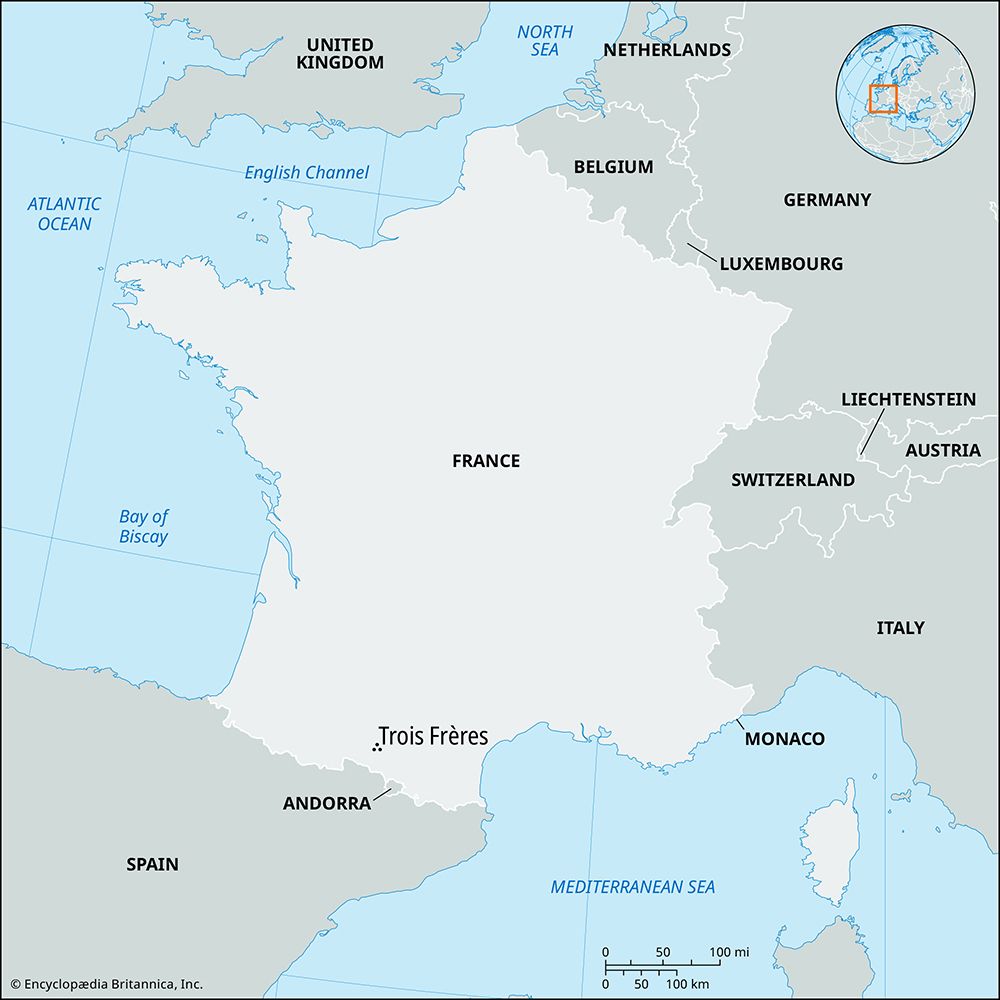
Trois Frères
The art found within the Trois Frères cave, particularly in the deep interior chamber known as the Sanctuary, is widely believed to have served a symbolic or…
What theories exist about the purpose or meaning of the art in Trois Frères?
The art found within the Trois Frères cave, particularly in the deep interior chamber known as the Sanctuary, is widely believed to have served a symbolic or religious purpose. Because the chamber contains approximately 280 overlapping animal figures, scholars often interpret the space as a site for magical ceremonies.1
The cave’s most prominent figure, the Horned God—a therianthrope (half-human, half-animal)—is frequently viewed as a representation of a “great spirit” or a “master of the animals,” suggesting a spiritual or shamanistic function. This aligns with broader theories on Paleolithic art, where some experts propose that shamans entered deep caves to perform rituals, potentially entering trance states to contact spirits and seek their benevolence.12
Additionally, the “Chapel of the Lioness” contains a large engraving situated above a natural “altar” where objects like animal teeth and flint tools were carefully placed. These are interpreted as votive objects, further supporting the theory that the cave was a setting for ritualistic activity.1
How has the Trois Frères cave contributed to our understanding of Paleolithic culture and art?
The Trois Frères cave has significantly deepened our understanding of Paleolithic culture by providing rare evidence of ritualistic behavior and complex symbolic thought. Unlike many other sites where animal depictions appear as isolated figures, the “Sanctuary” chamber at Trois Frères contains a dense, concentrated collection of approximately 280 overlapping engravings, suggesting the space served as a dedicated site for magical ceremonies.
The discovery of the Horned God—a therianthrope—challenges the notion that Paleolithic art focused solely on hunting. While some theories suggest these images relate to sympathetic magic for hunting success, the fact that many depicted species were not primary food sources suggests a more profound spiritual or mythological significance, such as the veneration of a “master of the animals.”16
Furthermore, the “Chapel of the Lioness” provides tangible evidence of ritual activity through the placement of votive objects, such as flint tools and animal teeth, near a natural altar. These findings indicate that these ancient societies possessed structured, symbolic traditions that extended beyond mere survival.
What is the ‘Sorcerer’ figure, and why is it important in the context of the Trois Frères cave?
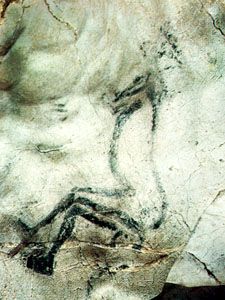
The “Sorcerer,” also known as the Horned God, is a small, enigmatic figure found in the deep interior chamber of the Trois Frères cave in France. Created during the mid-Magdalenian Period (approximately 14,000 years ago), the image is both painted and engraved on the cave wall, positioned 13 feet above the floor to dominate the surrounding mass of animal figures.1
The figure is significant because it is a therianthrope—a human depicted with the features of several different animals. While its exact meaning remains unknown, it is widely interpreted by scholars as a representation of a “great spirit” or a “master of the animals.”1
Its importance lies in what it suggests about the function of the cave’s “Sanctuary.” Because the Sorcerer oversees a dense collection of nearly 280 overlapping animal engravings, the site is believed to have been a location for magical ceremonies. Unlike the perfunctory and rare depictions of humans elsewhere in Paleolithic art, the Sorcerer’s prominent placement and unique hybrid nature highlight the complex symbolic and potentially spiritual life of the cave’s inhabitants.17
When was the Trois Frères cave discovered, and who first explored it?
The Trois Frères cave was discovered in 1914. While the provided information confirms the date of discovery, it does not specify the names of the individuals who first explored the site.
Sources
- Trois Frères — Encyclopædia Britannica
- Cave art — Encyclopædia Britannica
- Paleolithic Period — Encyclopædia Britannica
- Rock art - Cave painting in Europe — Encyclopædia Britannica
- Font-de-Gaume — Encyclopædia Britannica
- Western painting - Upper Paleolithic — Encyclopædia Britannica
- prehistoric religion - Shamanism , sorcery , and magic — Encyclopædia Britannica
- Shamanism - Classic shamanism — Encyclopædia Britannica
- prehistoric religion - Proto-Neolithic and Neolithic — Encyclopædia Britannica
Published on · 3 min read