Tozeur
The oasis of Tozeur has served as a vital regional hub in west-central Tunisia for centuries, functioning as a strategic "gate of the desert".
How has the oasis of Tozeur historically impacted the development of the region?
The oasis of Tozeur has served as a vital regional hub in west-central Tunisia for centuries, functioning as a strategic “gate of the desert”.1
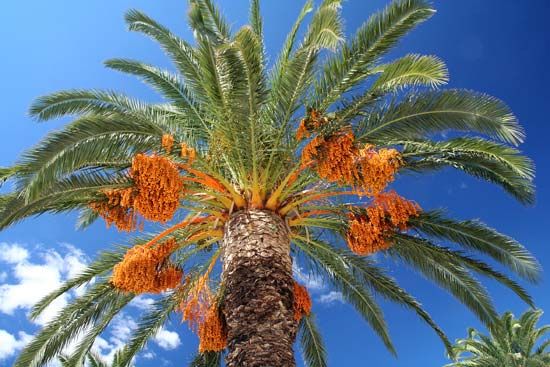
Historically, its development was shaped by its position on an ancient caravan route between Vescra and Tacapae, where it evolved from a Numidian town into an active 14th-century marketplace. The oasis has long been a center of Amazigh culture, maintaining a distinct identity and resisting Arabization. Its economic foundation has relied on a sophisticated 13th-century irrigation system fed by 200 springs, which supports the cultivation of high-quality dates. Since the 11th century, these dates, alongside handwoven rugs and silver jewelry, have been the town’s primary exports.1
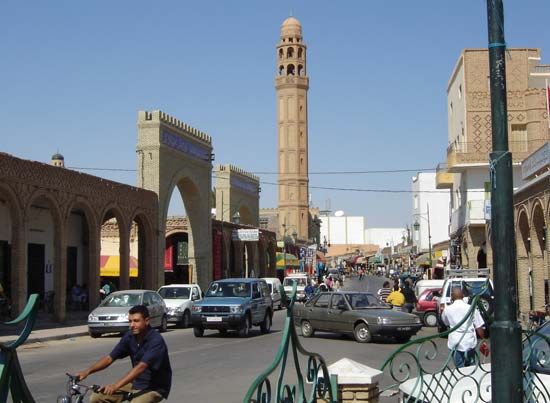
Architecturally, the region is defined by traditional buildings featuring yellow bricks in stylized geometric patterns, seen in landmarks like the Great Mosque (built in 1030). Today, Tozeur continues to serve as a significant political and commercial center, bolstered by an international airport and a robust tourism industry.1
What are some of the most famous landmarks or attractions in Tozeur?
Tozeur is renowned for its unique architectural heritage and its status as a gateway to the desert. The town’s most famous landmarks are characterized by traditional facades constructed from yellow bricks, which are arranged in relief to form intricate, stylized geometric patterns.1
Key attractions include:
- The Great Mosque: A historic site originally built in 1030.1
- Sīdī ʿAbīd Mosque: A notable example of the region’s distinct brickwork architecture.1
- Sīdī Mūldī: A zāwiyah, or the seat of a religious fraternity, showcasing local design.1
- Sīdī ʿAlī Abū Lifah: A marabout (holy man) tomb dating back to 1282.1
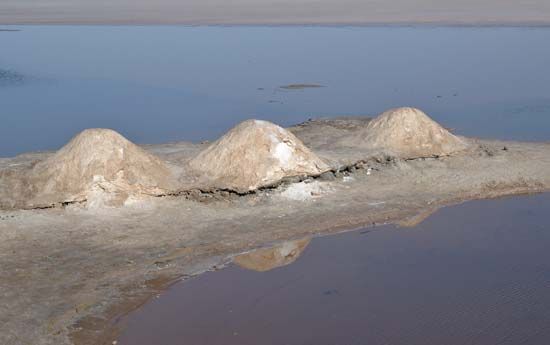
Beyond these structures, the oasis itself is a major attraction, famous for its complex 13th-century irrigation system fed by 200 springs, which sustains the lush palm groves of the jarīd country. Visitors are also drawn to the surrounding landscape, which features the Chott El-Jarid and Al-Rharsah saline lakes, areas historically known for their frequent mirages.1
Can you describe the traditional oasis farming techniques used in Tozeur?
Traditional oasis farming in Tozeur is defined by a sophisticated, long-standing reliance on irrigation to sustain agriculture in an arid environment. The oasis is famous for its complex irrigation system, which was established in the 13th century and is fed by 200 natural springs.1
This water management is essential for the cultivation of the date palm, which serves as the primary crop and a major export for the region. In the shade provided by these palms, farmers traditionally grow a variety of other crops, including:14
- Fruits: Citrus, figs, peaches, and apricots.4
- Cereals: Wheat, barley, and millet.45
- Vegetables: Various garden crops maintained through intensive hand labor.45
While ancient methods like the shadoof (a pivoted pole and bucket) and the animal-driven noria (a Persian wheel) were historically used to lift water, many modern oases have transitioned to motorized pumps. Despite these advancements, oasis agriculture remains a delicate balance, as farmers must constantly manage risks such as soil salinization from high evaporation rates and the encroachment of desert sands.5
What is the climate like in Tozeur, and how does it affect life in the oasis?
Tozeur experiences an arid, desert climate characterized by extreme heat and very low annual precipitation, with rainfall totals typically falling below 4 inches (100 mm) per year. This harsh environment is further influenced by Saharan conditions, including the sirocco—a hot, dry, and dusty wind from the south that can have a severe drying effect on local vegetation.6
The climate profoundly shapes life in the oasis:
- Water Management: Because of the scarcity of rain, the community relies on a complex 13th-century irrigation system fed by 200 natural springs to sustain the palm groves that define the region.61
- Architecture: Tozeur’s traditional buildings are constructed with yellow bricks arranged in relief to create geometric patterns, a design choice that reflects the local environment and cultural heritage.1
- Landscape Phenomena: The combination of intense heat and the glittering mineral salts found in the nearby chott (saline lake) depressions frequently creates mirages, which historically challenged travelers on ancient caravan routes.1
- Economic Adaptation: The oasis environment supports the cultivation of high-quality dates, which have been a primary export since the 11th century.1
Sources
- Tozeur — Encyclopædia Britannica
- Touat — Encyclopædia Britannica
- Sahara - Transportation — Encyclopædia Britannica
- oasis — Encyclopædia Britannica
- Sahara - People of the Sahara — Encyclopædia Britannica
- Tunisia - Climate — Encyclopædia Britannica
- Sahara - Climate of the Sahara — Encyclopædia Britannica
- Tunisia - Housing — Encyclopædia Britannica
Published on · 3 min read