Turban Shell
A turban shell is any marine snail belonging to the family Turbinidae (subclass Prosobranchia, class Gastropoda). These mollusks are characterized by a…
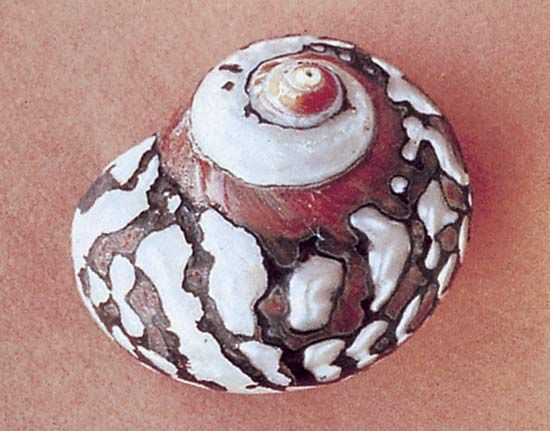
What is turban shell?
A turban shell is any marine snail belonging to the family Turbinidae (subclass Prosobranchia, class Gastropoda). These mollusks are characterized by a stout, spiral shell that features a wide aperture in the first whorl and is topped by a bulbous, turban-like coil. The exterior of the shell can be ridged, knobbed, or beaded.12
A defining feature of these snails is the operculum—a lid used to close the shell’s aperture. In the largest species, the green turban (Turbo marmoratus), which can reach up to 20 centimeters (8 inches) in length, this operculum is broad, round, and often referred to as a “cat’s-eye,” and it has historically been used in the production of buttons.12
What is a cat’s-eye operculum?
A “cat’s-eye” is the common name for the operculum found in certain marine snails of the family Turbinidae.
An operculum is a horny or shelly plate located on the posterior dorsal surface of a gastropod’s foot. When the snail retracts into its shell, this plate acts as a lid to seal the aperture, providing protection against predators and desiccation. In the case of the green turban snail (Turbo marmoratus), the operculum is notably broad, round, and distinctively patterned, which has led to its popular nickname and its historical use in the manufacturing of buttons.142
What do turban snails eat in their marine habitat?
The provided search results do not contain information regarding the specific diet of turban snails (family Turbinidae). While the results describe the physical characteristics of the turban shell and the feeding habits of the unrelated worm shell (family Vermetidae), they do not address the nutritional habits of the Turbinidae family.
How do gastropods build their shells?
Gastropods build their shells through a process of secretion performed by the mantle, a specialized fleshy organ that covers the animal’s body.897
The shell is constructed in layers, with growth occurring primarily at the outer lip of the aperture. The process involves several key components:87
- Periostracum: The outermost layer is composed of a protein mixture known as conchin (or conchiolin), which provides a protective horny covering.87
- Mineral Layers: Beneath the periostracum, the mantle secretes inner layers consisting of calcium carbonate interlaced with a network of conchin and mineral salts. In marine species, this is typically in the form of calcite crystals, while terrestrial species often utilize aragonite.8
- Growth Mechanism: A marginal band of cells at the mantle edge facilitates outward growth at the shell’s lip. Additionally, the general surface of the mantle secretes the smooth, inner nacreous layer, which thickens the shell over time.87
This biological process allows gastropods to create diverse shell forms, ranging from complex spirals to cap-shaped structures, tailored to their specific environmental needs.8
Sources
- turban shell — Encyclopædia Britannica
- turban shell — Merriam-Webster
- Turbinidae — Merriam-Webster
- operculum — Merriam-Webster
- Integument - Mollusks — Encyclopædia Britannica
- gastropod - The head — Encyclopædia Britannica
- worm shell — Encyclopædia Britannica
- gastropod - The shell — Encyclopædia Britannica
- mantle — Encyclopædia Britannica
Published on · 2 min read