Mitre Shell
A mitre shell refers to any of the various marine snails belonging to the family Mitridae, which are part of the class Gastropoda and the subclass…
What is mitre shell?
A mitre shell refers to any of the various marine snails belonging to the family Mitridae, which are part of the class Gastropoda and the subclass Prosobranchia. These mollusks are characterized by their thick, bullet-shaped shells, which derive their name from their resemblance to a bishop’s headdress, or mitre.1
These snails are primarily found in the Indo-Pacific region. One of the most notable and largest members of this family is the episcopal mitre (Mitra mitra), which can grow to approximately 10 centimeters (4 inches) in length and is distinguished by its orange-checked shell pattern.1
What are the primary characteristics of gastropods?
Gastropods, the largest group within the phylum Mollusca, comprise over 65,000 species, including snails and slugs. They are uniquely successful in occupying diverse habitats, ranging from the ocean and fresh waters to terrestrial environments.23
Key characteristics of gastropods include:
- Anatomy: Most gastropods possess a coiled shell, often accompanied by an operculum, though some species have lost their shells through evolution. A defining feature is torsion, a 180° twisting of the body during the larval stage that shifts the posterior part of the body to an anterior position behind the head.45
- Feeding: They utilize a radula—a ribbon-like organ covered in thousands of microscopic teeth—to scrape, cut, or drill food. Their diets are highly varied, including herbivory, predation, scavenging, and parasitism.62
- Reproduction: While primitive species release gametes into the water for external fertilization, many have evolved complex reproductive strategies, including internal fertilization, hermaphroditism, and various forms of parental care for their eggs.5
- Diversity: They exhibit immense structural and ecological variability, ranging in size from 0.3 millimeters to over 1 meter.4
How do marine snails like the mitre shell feed?
Marine snails like the mitre shell feed using a specialized organ called a radula. This horny, ribbon-like structure is located in the mouth and is supported by a cartilage-like mass known as the odontophore.17
The feeding process involves the following steps:
- Extrusion: Muscles push the radula out of the mouth and spread it over the odontophore.7
- Rasping: The radula is covered in rows of microscopic, tooth-like structures called denticles. As the odontophore is pressed against a surface or prey, these denticles scrape or cut food particles.17
- Ingestion: The radula is then retracted back into the mouth, carrying the collected food particles into the esophagus for digestion.7
Because the radula is subject to wear, it grows continuously throughout the snail’s life, with new rows of denticles forming at the back to replace those worn away at the front. While the basic ancestral feeding method for gastropods was browsing on algae, many species have evolved specialized radular forms to suit diverse diets, including predation and scavenging.174
What other types of shells are found in the Indo-Pacific region?
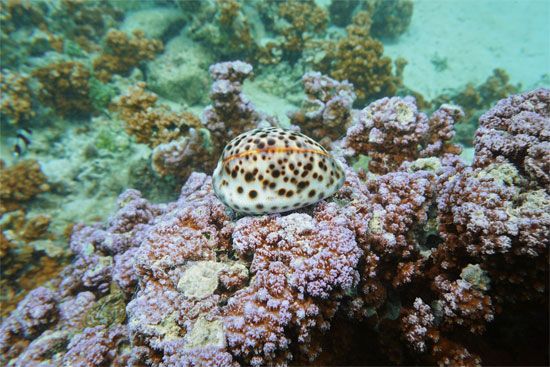
The Indo-Pacific region is home to an extraordinary diversity of mollusks, particularly those associated with its extensive coral reefs. Beyond the well-known cone shells, cowries, and top shells, the region hosts a wide variety of other shell-bearing species, including:
- Giant Clams: The giant clam (Tridacna gigas) is a spectacular example of the region’s bivalve diversity, thriving in reef environments.1011
- Conches: Members of the family Strombidae are common in these tropical waters.12
- Helmet Shells: These large, robust shells from the family Cassidae are found throughout the region.12
- Murex: Known for their often elaborate and spiny shells, the family Muricidae is well-represented.12
- Olive Shells: Sleek, glossy shells belonging to the family Olividae.12
- Triton Shells: Large, predatory snails of the family Cymatiidae.12
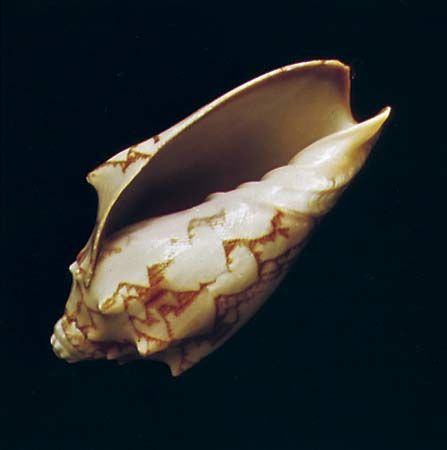
- Volutes: Members of the family Volutidae, often prized for their patterns.12
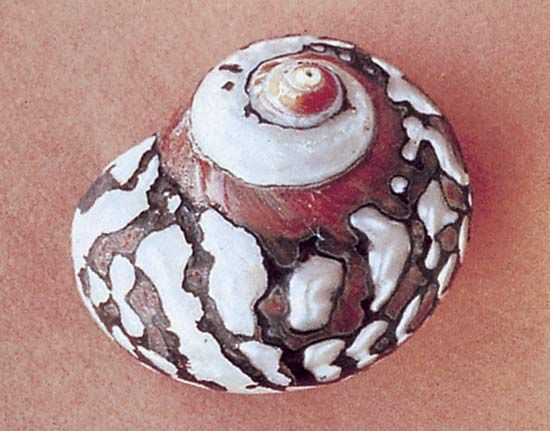
- Turban Shells: Sturdy, spiral shells from the family Turbinidae.12
This region’s unique marine conditions have promoted significant evolutionary diversification, resulting in a much richer mollusk fauna compared to other oceanic regions like the Caribbean.11
Sources
- mitre shell — Encyclopædia Britannica
- gastropod — Encyclopædia Britannica
- mollusk - Annotated classification — Encyclopædia Britannica
- gastropod - Food and feeding — Encyclopædia Britannica
- gastropod - Reproduction and life cycles — Encyclopædia Britannica
- mollusk - Habitats, feeding habits, and associations — Encyclopædia Britannica
- radula — Encyclopædia Britannica
- gastropod - Ecology and habitats — Encyclopædia Britannica
- bivalve - Features of defense and aggression — Encyclopædia Britannica
- cowrie — Encyclopædia Britannica
- top shell — Encyclopædia Britannica
- cone shell — Encyclopædia Britannica
- bivalve - Associations — Encyclopædia Britannica
- list of mollusks — Encyclopædia Britannica
- mollusk — Encyclopædia Britannica
- bivalve - Annotated classification — Encyclopædia Britannica
- bivalve - Distribution and abundance — Encyclopædia Britannica
- Pacific Ocean - Biological resources — Encyclopædia Britannica
Published on · 3 min read