Turkey Vulture
The turkey vulture (Cathartes aura) is the most widespread New World vulture, with a range spanning across the Americas from Canada to the southern tip of…
How widespread are turkey vultures and what habitats do they prefer?
The turkey vulture (Cathartes aura) is the most widespread New World vulture, with a range spanning across the Americas from Canada to the southern tip of South America. While they are common throughout this vast territory, populations in the northern and southernmost regions are migratory.12
Regarding their habitat preferences, turkey vultures do not build traditional nests. Instead, they lay their eggs in secluded areas that provide protection, such as:
- Thick ground cover1
- Natural cavities in caves1
- Gaps between rocks1
- Hollow tree stumps1
- Abandoned hawk nests1
These birds are highly adaptable scavengers that rely on their keen sense of smell to locate carrion, which allows them to thrive in a variety of environments across their extensive range.12
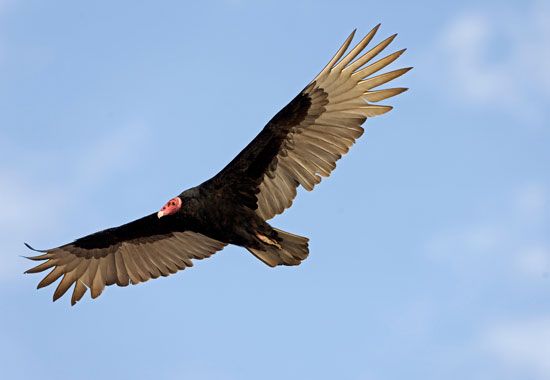
What is the scientific name of the turkey vulture and what does it mean?
The scientific name of the turkey vulture is Cathartes aura.1
The genus name, Cathartes, is derived from the New Latin and Greek word kathartēs, which means “cleanser” or “purifier,” originating from the verb kathairein, meaning “to clean”. This name reflects the bird’s ecological role as a scavenger that consumes carrion, effectively helping to clear the environment of decaying organic matter.31
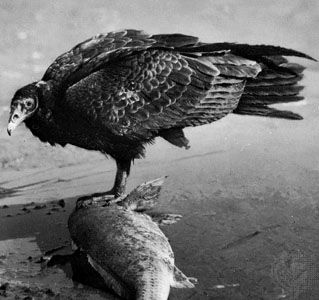
How do turkey vultures use their keen sense of smell, and how does it compare to other birds?
The turkey vulture (Cathartes aura) possesses a highly developed sense of smell, which it uses to locate carrion—its primary food source—often reaching carcasses before other scavenging species. This ability is facilitated by an elaborate olfactory canal, a specialized anatomical feature that allows the bird to detect the scent of decaying flesh from great distances.14
In contrast, most other birds have poorly developed olfactory chambers, and their sense of smell is generally considered rudimentary and far less important than their vision. While many birds of prey, such as hawks, rely on exceptional visual acuity to hunt, the turkey vulture is unique among many avian groups for its reliance on olfaction. In the broader avian world, the sense of smell is typically not a primary tool for foraging, making the turkey vulture’s reliance on its olfactory system a distinct evolutionary adaptation for its scavenging lifestyle.54
How do turkey vultures differ from other vulture species found in North and South America?
Turkey vultures (Cathartes aura) are distinct from other vulture species found in the Americas, primarily due to their unique physiological and behavioral adaptations. While all New World vultures belong to the family Cathartidae, the turkey vulture stands out in several key ways:
- Olfactory Ability: Unlike most other vultures, which rely almost exclusively on keen eyesight to locate food, the turkey vulture possesses an elaborate olfactory canal and a highly developed sense of smell. This allows it to detect the scent of carrion even when hidden beneath dense forest canopies, often making it the first species to arrive at a carcass.126
- Social Behavior: Despite being the first to locate food, turkey vultures are notably more timid than other vulture species. They often retreat when larger or more aggressive scavengers arrive to feed.2
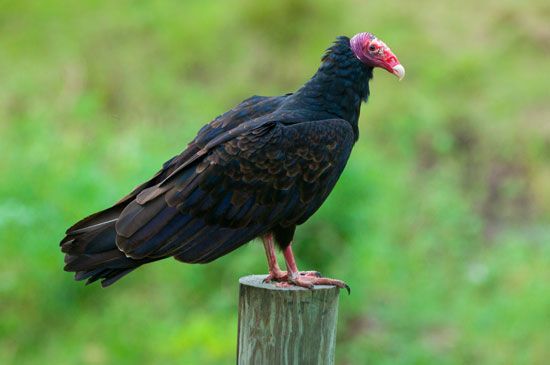
- Physical Characteristics: Turkey vultures are relatively small, brownish-black birds with a distinct red head in adulthood. They lack a syrinx, meaning they have no voice, and they possess a perforated nasal septum, a characteristic shared with other New World vultures but absent in Old World species.27
- Nesting Habits: Like other New World vultures, they do not build nests. Instead, they lay their eggs in natural cavities, such as caves, hollow tree stumps, or abandoned nests of other birds.12
Sources
- Turkey vulture — Encyclopædia Britannica
- Vulture — Encyclopædia Britannica
- Cathartes — Merriam-Webster
- Falconiform - Vision, hearing, and smell — Encyclopædia Britannica
- Chemoreception - Smell — Encyclopædia Britannica
- Falconiform - Annotated classification — Encyclopædia Britannica
- Why do vultures circle? — Encyclopædia Britannica
Published on · 3 min read