Utah Beach
The U.S. 82nd and 101st airborne divisions played a critical role in the success of the Utah Beach landing during the Normandy Invasion of World War II.…
What role did airborne divisions play in supporting the Utah Beach landing?
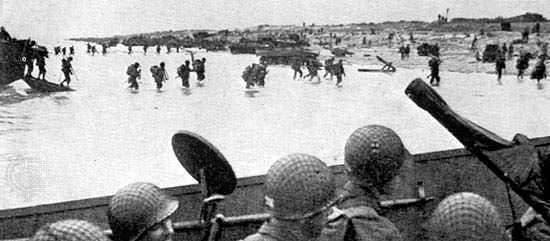
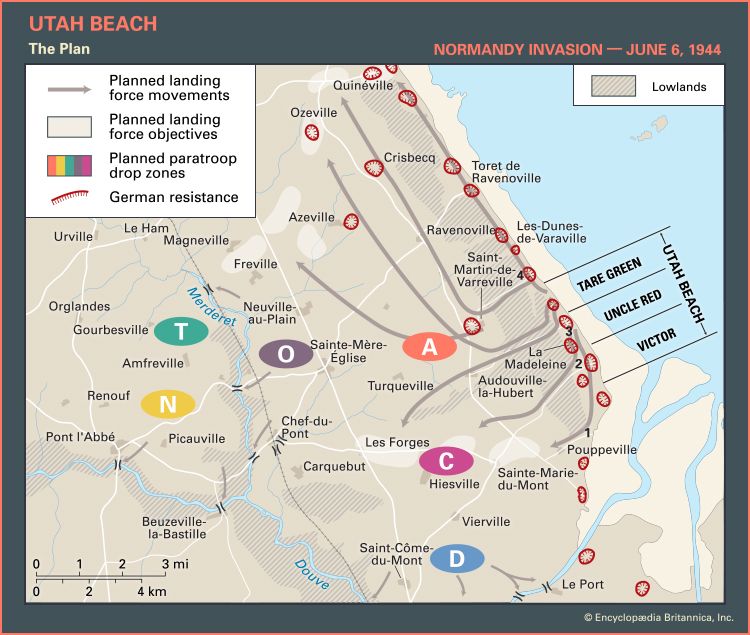
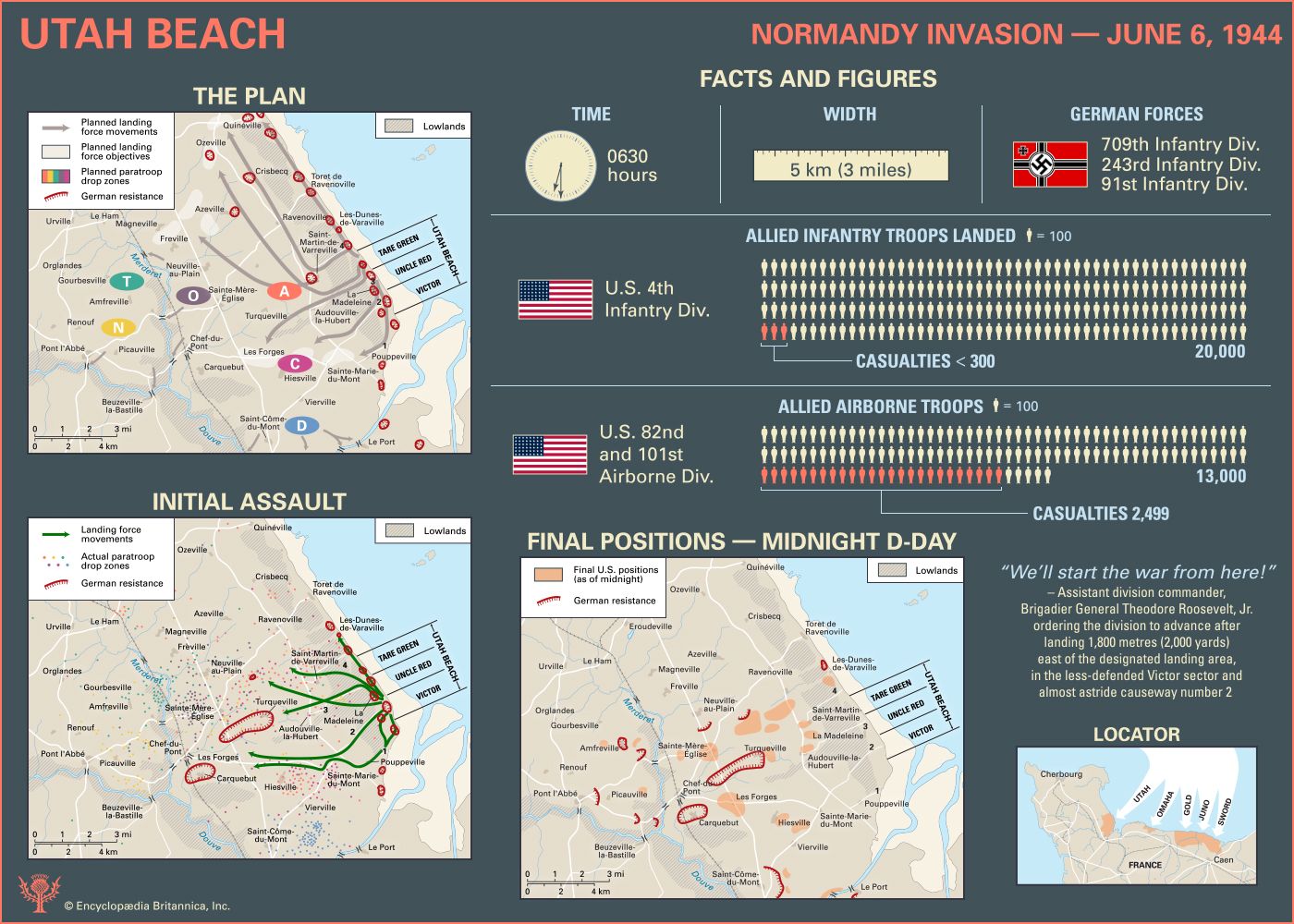
The U.S. 82nd and 101st airborne divisions played a critical role in the success of the Utah Beach landing during the Normandy Invasion of World War II. Dropped inland in the predawn hours of June 6, 1944, their primary objectives were to isolate the seaborne invasion force from German reinforcements and secure the beach exits.1
Specifically, the 101st Airborne was tasked with seizing the inland sides of the four causeways leading from the beach to allow the 4th Infantry Division to move inland, as well as destroying key bridges and capturing the lock at La Barquette to control the flooded lowlands. The 82nd Airborne was assigned to capture the town of Sainte-Mère-Église and secure a bridgehead across the Merderet River.1
Although the airborne drops suffered from significant scattering and heavy casualties, their presence created confusion among German commanders, preventing a coordinated counterattack against the seaborne troops. By the end of D-Day, the airborne units had successfully held the beach exits and achieved a vital linkup with the 4th Infantry Division.1
What types of German defenses were present at Utah Beach?
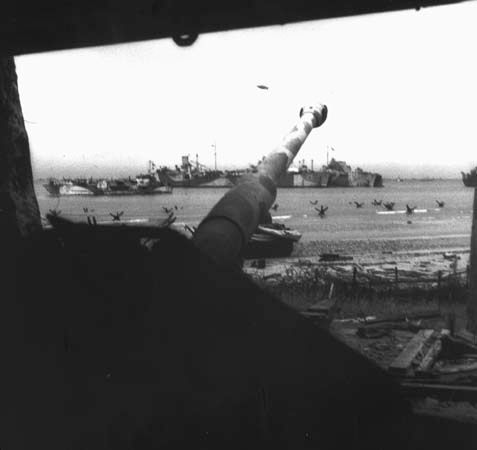
German defenses at Utah Beach were notably sparse compared to other landing sites, primarily because the Germans relied on the natural geography of the area to impede Allied movement. The low-lying terrain immediately behind the beach was intentionally flooded, and the Germans controlled these water levels using a system of locks.
Key defensive features included:
- Causeway Strongpoints: Because the flooded lowlands restricted movement inland, the Germans established strongpoints equipped with automatic weapons along the four causeways that served as the only viable exits from the beach.
- Artillery: Coastal and field artillery batteries were positioned approximately 3 km (2 miles) inland to provide fire support.
- General Coastal Defenses: As part of the broader Atlantic Wall, the area featured standard obstacles, including barbed wire, antitank and antipersonnel mines, and various beach obstacles embedded in the sand to hinder landing craft.
- Defending Units: The area was defended by elements of the German 709th, 243rd, and 91st infantry divisions.
How did the capture of Utah Beach contribute to the overall success of Operation Overlord?
The capture of Utah Beach was a vital component of Operation Overlord, primarily because it facilitated the Allied objective of securing the strategically important port of Cherbourg at the northern tip of the Cotentin Peninsula. Although not part of the original invasion plan, General Dwight D. Eisenhower added the Utah landing to ensure the Allies could establish a deep-water port necessary for offloading the massive volume of supplies and vehicles required for the campaign.1
The success at Utah Beach contributed to the overall operation in several key ways:
- Strategic Linkup: By the end of D-Day, the U.S. 4th Infantry Division had successfully linked up with airborne troops, securing the beach exits and establishing a foothold for the U.S. VII Corps.12
- Isolation of German Forces: The airborne divisions effectively isolated the seaborne invasion force from German reinforcements by holding critical roads and causeways, preventing a coordinated counterattack during the initial landing phase.1
- Efficiency: Despite initial navigational errors that caused the landing force to drift 1,800 meters east, the troops landed in a less-defended sector, resulting in a remarkably successful operation with fewer than 300 casualties.1
How did the geography of Utah Beach impact the invasion plans?
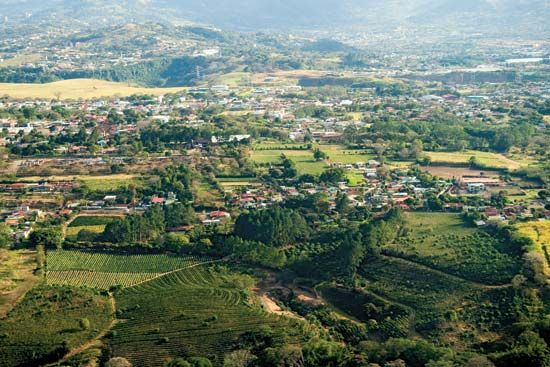
The geography of Utah Beach significantly dictated the tactical planning of the Normandy Invasion. The area was characterized by sandy, duned beaches backed by low-lying marshes that the Germans had intentionally flooded using a system of locks. This terrain created a natural bottleneck, as all movement inland was restricted to four narrow causeways that traversed the flooded lowlands.
Because these causeways were the only viable routes for troops and vehicles to exit the beach, they became critical focal points for the invasion plan:
- Airborne Objectives: To ensure the 4th Infantry Division could successfully exit the beach, Allied planners tasked the 82nd and 101st airborne divisions with dropping inland to seize the causeway exits and destroy key bridges, preventing German reinforcements from flanking the landing force.1
- Movement Constraints: The flooded marshes effectively funneled all land traffic through specific, easily defended crossroads, such as Carentan and Sainte-Mère-Église, which the Allies had to secure to maintain momentum.1
- Defensive Strategy: The Germans relied on this geography for their defense, placing automatic weapon strongpoints along the causeways and positioning artillery further inland, rather than relying on the heavy fortifications seen at other beaches.1
Sources
- Utah Beach — Encyclopædia Britannica
- Normandy Invasion - The landings — Encyclopædia Britannica
- amphibious warfare — Encyclopædia Britannica
- fortification - German channel defenses — Encyclopædia Britannica
- Omaha Beach — Encyclopædia Britannica
- Normandy Invasion - The lodgment area established — Encyclopædia Britannica
- Facts and Statistics about the Normandy Invasion — Encyclopædia Britannica
Published on · 4 min read