Venyukovia
Venyukovia is a genus of extinct, herbivorous therapsids—often referred to as mammal-like reptiles—that lived during the Permian Period. Fossils of this…
What is Venyukovia?
Venyukovia is a genus of extinct, herbivorous therapsids—often referred to as mammal-like reptiles—that lived during the Permian Period. Fossils of this creature have been discovered in eastern Europe.1
Characterized by its primitive teeth, Venyukovia is considered a potential ancestor to the Dicynodontia, a significant group of plant-eating therapsids. However, it is important to note that neither Venyukovia nor the dicynodonts evolved into more advanced biological forms.1
What are therapsids?
Therapsids are a major clade of tetrapods that flourished during the Permian and Triassic periods. While they are traditionally called “mammal-like reptiles” due to their shared characteristics with both groups, they are not part of the reptile lineage; rather, they represent the evolutionary stock that gave rise to mammals.23
Key features of therapsids include:
- Dentition: Many species evolved specialized, mammal-like teeth, including incisors, canines, and grinding cheek teeth.23
- Locomotion: Their limbs and girdles were modified for efficient four-footed movement, with limbs positioned closer to the trunk.23
- Skull Structure: Like mammals, they possessed a single temporal opening in the skull. Advanced forms also developed a bony palate, which separates food and air passages developed a bony palate, which separates food and air passages.23
- Jaw Anatomy: Despite these advancements, their lower jaw remained structurally reptilian, composed of multiple bones rather than the single bone found in mammals.2
What were the characteristics of the Permian Period?
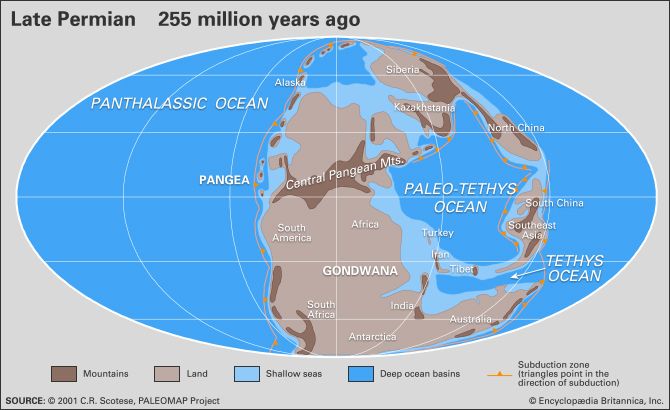
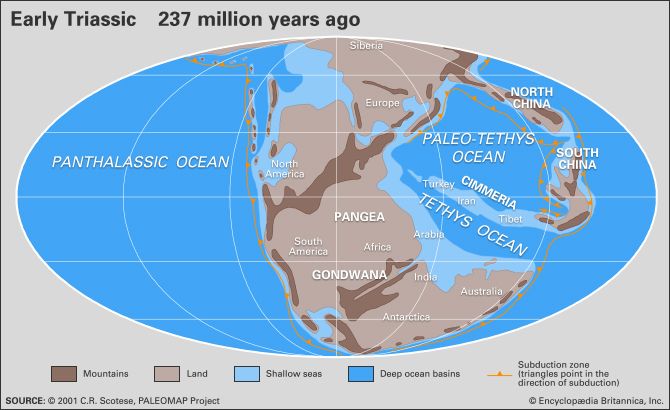
The Permian Period (298.9 to 252.2 million years ago) was a transformative era defined by significant geological and climatic shifts. The assembly of the supercontinent Pangea and the surrounding Panthalassa ocean were the period’s primary geographic features.45
Climate and Environment
The period began with widespread glaciation inherited from the Carboniferous, but the climate gradually warmed. As Pangea formed, mountain-building events and the closure of seaways disrupted atmospheric flow, leading to increasingly hot and arid conditions. By the Late Permian, deserts were widespread, and massive volcanism—specifically the Siberian Traps—likely altered the atmosphere and ocean chemistry.46
Life and Biodiversity
- Flora: Terrestrial plants diversified, shifting from marsh-dwelling ferns and lycophytes to coniferophytes adapted to drier environments.7
- Fauna: Insects evolved rapidly alongside plantsuna:** Insects evolved rapidly alongside plants. Crucially, this period saw the emergence of reptile lineages that would eventually lead to mammals.47
- Mass Extinction: The period ended with the largest mass extinction in Earth’s history, where over 90 percent of species perished due to extreme environmental changes.4
What are dicynodonts?
Dicynodonts (suborder Dicynodontia) were a successful and widely distributed group of herbivorous therapsids that lived during the Permian and Triassic periods. Often referred to as “two-tuskers,” their name is derived from the Greek words for “two-dog-teeth,” referencing the pair of large, canine-like tusks typically found in the upper jaw.2910
Key characteristics of dicynodonts include:
- Dentition: They are distinguished by their significantly reduced dentition. Aside from the characteristic upper tusks, their other teeth were absent, replaced by a horny bill or beak that covered the jaws.211
- Diet and Lifestyle: They were primarily herbivorous. While some forms, such as the genus Dicynodon, are thought to have been semiaquatic or marsh-dwelling, the group as a whole occupied various ecological niches across the globe.10911
- Classification: As members of the order Therapsida, they represent a notable side branch of the evolutionary lineage that eventually led to mammals, though they are distinct from the carnivorous therapsids like gorgonopsians or the advanced cynodonts.2
Sources
- Venyukovia — Encyclopædia Britannica
- therapsid — Encyclopædia Britannica
- mammal - The evolution of the mammalian condition — Encyclopædia Britannica
- A Journey Through Time Since the Precambrian - Permian Period: 298.9 million to 252.2 million years ago — Encyclopædia Britannica
- Permian Period - Marine and terrestrial life — Encyclopædia Britannica
- Permian Period - The Permian environment — Encyclopædia Britannica
- Permian Period - Paleoclimate — Encyclopædia Britannica
- Permian Period - Temperature crises — Encyclopædia Britannica
- dicynodont — Merriam-Webster
- cynodont — Encyclopædia Britannica
- Dicynodon — Merriam-Webster
- Dicynodontia — Merriam-Webster
Published on · 3 min read