Velvet Water Bug
The velvet water bug (family Hebridae) is a tiny insect belonging to the true bug order, Heteroptera. These insects are typically less than 3 mm (0.1 inch)…
What is velvet water bug?
The velvet water bug (family Hebridae) is a tiny insect belonging to the true bug order, Heteroptera. These insects are typically less than 3 mm (0.1 inch) long and are characterized by their plump bodies covered in fine, velvetlike hairs.12
These bugs are found in freshwater habitats globally, though they are considered relatively rare. They are often observed walking or running on moist ground at the edges of water bodies or directly on the water’s surface, where they are supported by the surface film thanks to their hydrofuge (water-repellent) hairs. While they are thought to be predatory, their specific food habits remain largely unknown. Some species may have been historically transported across regions via drinking water on early sailing ships.12
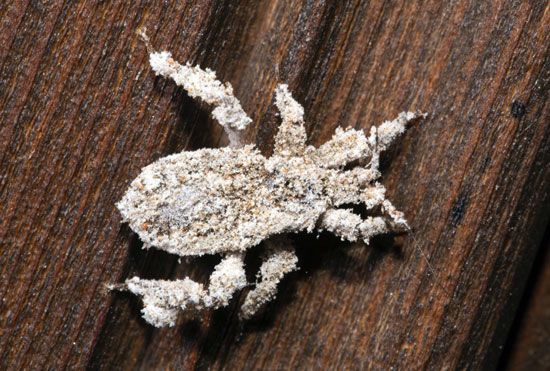
It is important not to confuse them with the velvety shore bug (family Ochteridae), which is a distinct group of insects that resemble tiny toads and live among plants near streams and ponds.3
How do velvet water bugs use their hairs to walk on water?
Velvet water bugs (family Hebridae) are able to traverse the surface of water because they possess fine, velvetlike hairs that are hydrofuge, or water-repellent. These specialized hairs allow the insects to take advantage of surface tension, a physical property of liquids that causes the surface to act like a stretched, elastic membrane.15
By utilizing these water-repellent hairs, the bugs can stand or run on the water’s surface film without breaking through it. While similar hair structures in other insects, such as certain beetles, can form a plastron to trap air for underwater respiration, the primary function of the hairs for velvet water bugs in this context is to provide the necessary support to remain atop the water’s surface.16
What other types of insects are classified as true bugs?
True bugs belong to the suborder Heteroptera within the order Hemiptera. These insects are characterized by their piercing-sucking mouthparts and forewings that are thickened and leathery at the base while membranous at the tips.78910
Below is a list of various insects classified as true bugs:7
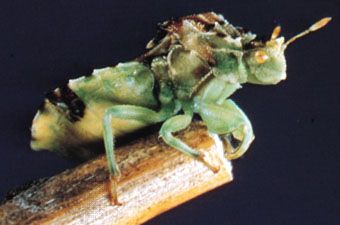
- Assassin bugs (family Reduviidae), including ambush bugs, the wheel bug, and the masked hunter
- Backswimmers (family Notonectidae)
- Bat bugs (family Polyctenidae)
- Bedbugs (family Cimicidae)
- Chinch bugs (family Blissidae)
- Coreid bugs (family Coreidae)
- Creeping water bugs (family Naucoridae)
- Damsel bugs (family Nabidae)
- Flat bugs (family Aradidae)
- Flower bugs (family Anthocoridae)
- Giant water bugs (family Belostomatidae)
- Kissing bugs (subfamily Triatominae)
- Lace bugs (family Tingidae)
- Lygaeid bugs (family Lygaeidae)
- Marsh treaders (family Hydrometridae)
- Plant bugs (family Miridae)
- Red bugs (family Pyrrhocoridae)
- Shore bugs (family Saldidae)
- Smaller water striders (family Veliidae)
- Stilt bugs (family Berytidae)
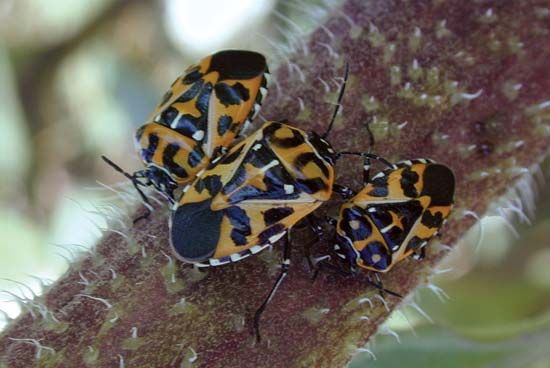
- Stink bugs (family Pentatomidae), such as the harlequin cabbage bug
- Toad bugs (family Gelastocoridae)
- Unique-headed bugs (family Enicocephalidae)
- Velvet water bugs (family Hebridae)
- Velvety shore bugs (family Ochteridae)
- Water boatmen (family Corixidae)
- Water striders (family Gerridae)
- Water treaders (family Mesoveliidae)
How do semiaquatic insects differ from fully aquatic ones?
Semiaquatic and fully aquatic insects differ primarily in their relationship with the water’s surface and their methods of respiration and locomotion.
Semiaquatic Insects
Semiaquatic insects, such as water striders, are supported by the water’s surface tension, allowing them to walk or run on the surface film.112
- Physical Adaptations: They typically have small, slender bodies and long, thin legs that distribute their weight to prevent breaking the surface film.2
- Water Repellency: Their bodies are covered in a dense, water-repellent (hydrofuge) pile that traps a thin layer of air, preventing them from becoming wet if they are submerged.2
- Habitat: While they live on the surface, they often overwinter on land.2
Fully Aquatic Insects
Fully aquatic insects spend most or all of their life cycle submerged and have evolved specialized adaptations for life beneath the surface.11
- Respiration: Unlike semiaquatic insects, fully aquatic species have diverse ways to obtain oxygen. Some, like water boatmen, must surface periodically to replenish air stored in chambers or trapped by hairs. Others, such as certain water beetles, use a “plastron”—a permanent air shell held by dense hairs—to extract dissolved oxygen from the water indefinitely. Many larvae use tracheal gills to breathe underwater.2511
- Locomotion: These insects often possess legs modified into oarlike structures with flattened segments or rows of movable hairs to propel themselves through the water.11
Sources
- velvet water bug — Encyclopædia Britannica
- heteropteran - Habitats — Encyclopædia Britannica
- heteropteran - Annotated classification — Encyclopædia Britannica
- velvety shore bug — Encyclopædia Britannica
- Respiratory system - Trachea — Encyclopædia Britannica
- surface tension — Encyclopædia Britannica
- list of true bugs — Encyclopædia Britannica
- homopteran - Critical appraisal — Encyclopædia Britannica
- heteropteran - Distinguishing taxonomic features — Encyclopædia Britannica
- The Difference Between 'Bug,' 'Insect,' and 'Beetle' — Merriam-Webster
- insect - Aquatic insects — Encyclopædia Britannica
- Locomotion - Bottom locomotion — Encyclopædia Britannica
- Terrestrial locomotion — Encyclopædia Britannica
Published on · 3 min read