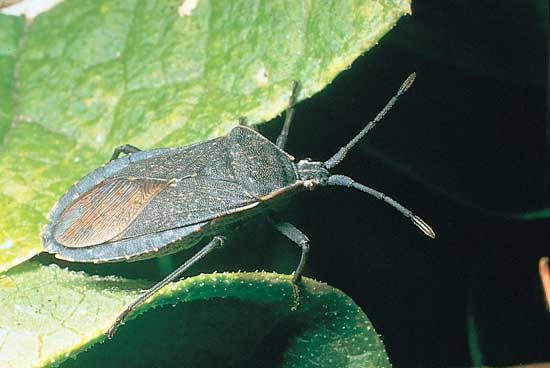
Shore Bug
A shore bug is any of the more than 200 species of small, dark-colored insects that make up the family Saldidae within the order Heteroptera.
What is shore bug?
A shore bug is any of the more than 200 species of small, dark-colored insects that make up the family Saldidae within the order Heteroptera.1
These insects are found globally and are typically identified by the specific shape of cells in their wings. While they primarily inhabit shorelines near fresh or saltwater, they are also known to make occasional short forays onto the surface of adjacent water. Unlike some semiaquatic insects that rely on the water’s surface film for support, shore bugs are generally heavier-bodied and possess strong, often long legs that allow them to run quickly across rocks, ground, and other exposed surfaces.12
Shore bugs are predatory insects, often featuring thickened or spined front legs used to grasp prey. When disturbed, they typically fly short distances before hiding in crevices or beneath vegetation. During the winter, adults generally survive by sheltering beneath objects on land.12
How do shore bugs use their legs to catch prey?
Shore bugs (family Saldidae) are predatory insects that utilize specialized front legs to capture their prey. These legs are distinctly thickened and are often equipped with spines to ensure a secure grip on a victim.1
To effectively grasp and hold prey, the tibia and tarsus of the front legs are adapted to fold tightly against the thickened femur. The presence of stout hairs or spines along the opposing surfaces of these grasping legs prevents the prey from slipping away once it has been caught. While their strong, long legs are primarily used for running quickly across rocks, ground, and other exposed surfaces, these specialized front appendages are essential for their predatory lifestyle.31
What distinguishes shore bugs from other semiaquatic insects like water striders?
Shore bugs (family Saldidae) are distinguished from typical semiaquatic insects, such as water striders, primarily by their habitat preferences and physical build.
While semiaquatic insects are adapted to live on the water’s surface, relying on the surface film for support, shore bugs are generally heavier-bodied and primarily inhabit shorelines rather than the water itself. Their anatomy reflects this terrestrial-adjacent lifestyle:
- Locomotion: Unlike surface dwellers that have slender bodies and long, thin legs designed to distribute weight across the water’s surface, shore bugs possess strong, often long legs built for running quickly across rocks, ground, and other exposed surfaces.
- Surface Interaction: While they may make occasional short forays onto the water, they do not rely on the surface film for constant support.
- Predatory Adaptations: Shore bugs feature distinctly thickened front legs, often equipped with spines, which are specialized for grasping prey. In contrast, the front legs of many surface-dwelling insects are often shorter and used primarily for holding prey while the middle and hind legs provide the primary means of locomotion.
How do shore bugs survive the winter months?
Shore bugs (family Saldidae) survive the winter months by entering a state of dormancy. As adults, they typically overwinter by seeking shelter beneath convenient objects, such as rocks, logs, or other debris found on land.1
This behavior is a common survival strategy among many insects, which may undergo diapause—a period of reduced metabolic activity—to endure unfavorable environmental conditions like extreme cold. By hiding in these protected, relatively dry locations, shore bugs are able to withstand winter temperatures that fall within their normal range, resuming their normal predatory activities once more favorable conditions return in the spring.31
Sources
- shore bug — Encyclopædia Britannica
- List of insects - hemipterans (order Hemiptera) — Encyclopædia Britannica
- heteropteran - Habitats — Encyclopædia Britannica
- Coleoptera - Annotated classification — Encyclopædia Britannica
- heteropteran — Encyclopædia Britannica
- crustacean - Appendages — Encyclopædia Britannica
- heteropteran - Feeding — Encyclopædia Britannica
- heteropteran - Legs — Encyclopædia Britannica
- smaller water strider — Encyclopædia Britannica
- Dormancy - Diapause in insects — Encyclopædia Britannica
Published on · 3 min read