Whirligig Beetle
Whirligig beetles (family Gyrinidae) are primarily known for their ability to spin and whirl on the surface of ponds and lakes. While they are capable of…
How do whirligig beetles breathe underwater?
Whirligig beetles (family Gyrinidae) are primarily known for their ability to spin and whirl on the surface of ponds and lakes. While they are capable of diving and swimming underwater when threatened, they are fundamentally air-breathing insects.12
Like many other insects, whirligig beetles rely on a tracheal system consisting of branching tubes that deliver oxygen directly to their tissues through openings called spiracles. When these beetles submerge, they do not possess specialized internal gills like some aquatic larvae; instead, they typically rely on air trapped at the surface to facilitate respiration. Many aquatic beetles carry a supply of air in a space between their wing covers (elytra) and their abdomen, which functions as a physical gill by allowing oxygen to diffuse from the surrounding water into the bubble as it is consumed.3412
What is the life cycle of a whirligig beetle, from egg to adult?
The life cycle of the whirligig beetle (family Gyrinidae) consists of four distinct stages: egg, larva, pupa, and adult.
- Egg: The female deposits cylindrical eggs in parallel rows directly onto underwater vegetation.1
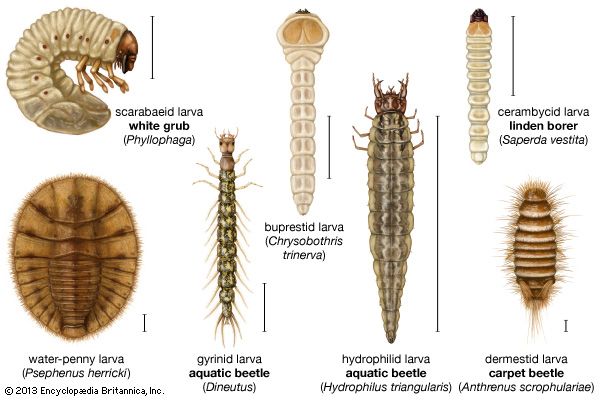
- Larva: The emerging larvae are long and narrow with three pairs of true legs. They possess fringed gills on each abdominal segment, which give them a resemblance to centipedes. They use hooks located at the end of their abdomen to anchor themselves while capturing prey.1
- Pupa: When ready to pupate, the larva leaves the water and hangs upside down on shore vegetation using its abdominal hooks. It constructs a protective pupal case using a mixture of dirt and saliva. During this stage, the insect undergoes metamorphosis, developing adult features such as wings and elytra. undergoes metamorphosis, developing adult features such as wings and elytra.15
- Adult: Once the transformation is complete, the adult emerges. It possesses a flattened, oval body with specialized eyes divided to see both above and below the water surface, and it is capable of both swimming and flight.1
How do whirligig beetles’ unique eyes help them survive in their aquatic habitat?
Whirligig beetles (family Gyrinidae) possess a remarkable adaptation that aids their survival in aquatic environments: their compound eyes are divided into two distinct parts. This unique structure makes it appear as though the beetle has two pairs of eyes, with one pair positioned above the water surface and the other submerged below it.16
This dual-vision capability is essential for their survival, as it allows the beetle to simultaneously monitor its surroundings for two different types of threats and opportunities. The upper portion of the eye provides a clear view of the air above the water, helping the beetle detect potential predators or obstacles in its terrestrial environment. Simultaneously, the lower portion of the eye scans the water below, enabling the beetle to navigate, locate prey, and identify underwater hazards. By effectively splitting their visual field, these insects can maintain constant situational awareness while spinning and whirling on the surface of ponds and lakes.1
What family do whirligig beetles belong to, and how many species are there?
Whirligig beetles belong to the family Gyrinidae. There are approximately 700 species of these beetles worldwide, all of which are part of the insect order Coleoptera.1
Sources
- whirligig beetle — Encyclopædia Britannica
- insect - Aquatic insects — Encyclopædia Britannica
- Respiratory system - Trachea — Encyclopædia Britannica
- insect - Respiratory system — Encyclopædia Britannica
- Coleoptera - Pupae — Encyclopædia Britannica
- whirligig beetle — Merriam-Webster
- Photoreception - Differences in resolution — Encyclopædia Britannica
- ostariophysan - Annotated classification — Encyclopædia Britannica
- Gyrinidae — Merriam-Webster
Published on · 2 min read