Why Are Most Calico Cats Female?
Most calico cats are female because the genes responsible for their black and orange fur patches are located on the X chromosome.
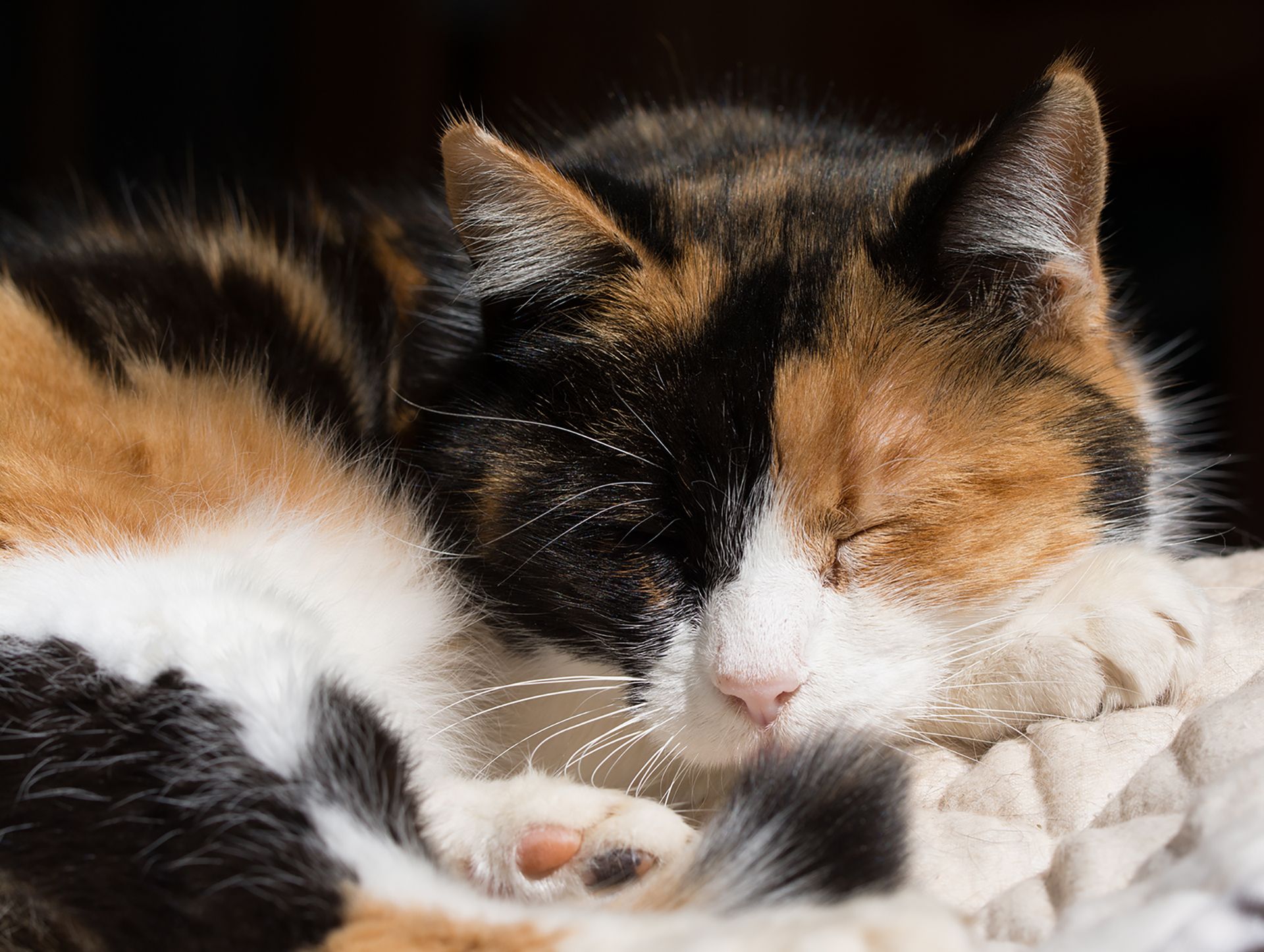
Why are most calico cats female?
Most calico cats are female because the genes responsible for their black and orange fur patches are located on the X chromosome.1
Because female cats possess two X chromosomes, they can inherit a gene for black fur from one parent and a gene for orange fur from the other, resulting in the characteristic calico pattern. In contrast, male cats typically carry only one X chromosome paired with a Y chromosome, meaning they can express either black or orange coloration, but not both.12
While rare, male cats can be calico if they possess an extra X chromosome (XXY), a chromosomal anomaly that usually renders them sterile. The white patches seen on calico cats are determined by a separate gene not linked to the sex chromosomes.1
What is the difference between a calico and a tortoiseshell cat?
The primary difference between a calico cat and a tortoiseshell cat lies in the presence of white fur.
- Calico cats: These cats are characterized by a coat that is predominantly white with distinct patches of black and orange (or red) fur. Because of this specific pattern, they are sometimes referred to as tortoiseshell-and-white.3
- Tortoiseshell cats: These cats typically display a mottled or brindled coat consisting of black and orange (or red) patches, generally without significant white markings.1
Both patterns are the result of sex-linked genetics. Because the genes for black and orange fur are located on the X chromosome, female cats—who possess two X chromosomes—can express both colors simultaneously. Male cats, having only one X chromosome, can typically only express one of these colors at a time. Consequently, both calico and tortoiseshell cats are almost exclusively female, with rare exceptions occurring only in males with an XXY chromosomal anomaly.41
How does X-inactivation affect the appearance of female mammals?
X-inactivation, also known as “lyonization,” is a biological process that significantly influences the physical appearance of female mammals by ensuring that they do not express twice the amount of gene products from the X chromosome compared to males.6
During early development, one of the two X chromosomes in each somatic cell of a female embryo is randomly inactivated and condensed into a structure called a Barr body. Because this process is random, female mammals are effectively mosaics: roughly half of their cells express genes from the maternal X chromosome, while the other half express genes from the paternal X chromosome.6
This mosaicism is responsible for the distinct coat patterns seen in certain animals. For example, in calico cats and tortoiseshell cats, the genes for black and orange fur are located on the X chromosome. As cells develop, the random inactivation of one X chromosome means that some patches of skin will express the gene for black fur, while others will express the gene for orange, resulting in their characteristic multicolored appearance.716
What are some other genetic traits linked to sex chromosomes in animals?
Genetic traits linked to sex chromosomes are those controlled by genes located on the X or Y chromosomes. Because these chromosomes determine an organism’s sex, the inheritance and expression of these traits often differ significantly between males and females.89
X-Linked Traits
In many species, including humans and Drosophila (fruit flies), the X chromosome is much larger than the Y chromosome and carries a vast array of genes. Because males typically have only one X chromosome, they lack a second allele to counteract or “mask” recessive genes. Consequently, recessive X-linked traits are expressed much more frequently in males than in females.6109
- Red-green color blindness: A common condition where individuals have difficulty distinguishing between certain colors.89
- Hemophilia: A disorder that impairs the body’s ability to control blood clotting.810
- Duchenne muscular dystrophy: A severe form of muscular degeneration.8
- Fragile-X syndrome: A genetic condition that causes a range of developmental problems.8
- Eye color in Drosophila: Historically significant in genetics, the discovery that the gene for white eyes is located on the X chromosome provided foundational proof for sex-linked inheritance.6
Y-Linked Traits
Traits controlled by genes on the Y chromosome are expressed only in males, as females typically do not possess a Y chromosome. These genes are primarily involved in male-specific development, such as the formation of the testes. Other minor traits, such as webbed toes, have also been associated with genes on the Y chromosome.89
Sources
- Why are most calico cats female? — Encyclopædia Britannica
- Why are orange cats more likely to be male? — Encyclopædia Britannica
- calico cat — Encyclopædia Britannica
- cat - Tortoiseshell cats — Encyclopædia Britannica
- tortoiseshell cat — Merriam-Webster
- heredity - Sex linkage — Encyclopædia Britannica
- human genetic disease - Abnormalities of the sex chromosomes — Encyclopædia Britannica
- sex-linked character — Encyclopædia Britannica
- Sex - Sex chromosomes — Encyclopædia Britannica
- linkage group — Encyclopædia Britannica
- sex chromosome — Encyclopædia Britannica
Published on · 3 min read