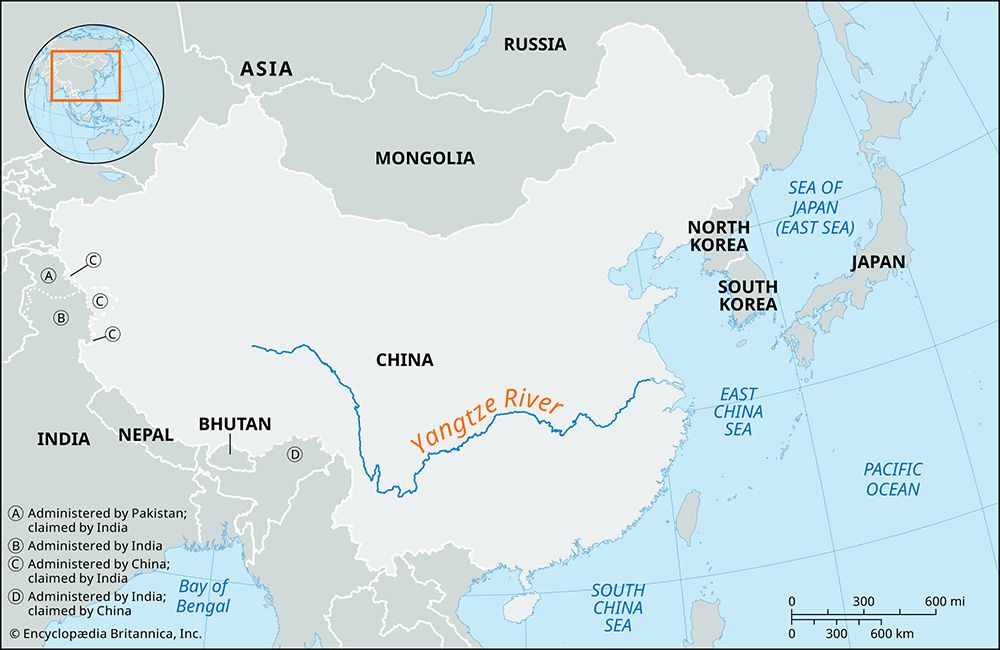
Xin River
The Xin River is a significant waterway located in the northeastern Jiangxi province of eastern China. As a tributary within the Yangtze River system, it…
What is Xin River?
The Xin River is a significant waterway located in the northeastern Jiangxi province of eastern China. As a tributary within the Yangtze River system, it spans approximately 194 miles (312 km) and drains a basin of roughly 6,500 square miles (16,800 square km).1
The river originates near Yushan along the province’s northeastern border and flows southwestward through Shangrao, a commercial hub known for tea processing and paper production. Continuing westward to Yingtan, the river eventually turns northwest to empty into Lake Poyang. The region surrounding the middle and lower stretches of the Xin River is a vital agricultural area, primarily dedicated to rice cultivation, while wheat and tea are produced in the upper reaches.12
What is the importance of Lake Poyang to China’s river systems?
Lake Poyang is vital to China’s river systems as the largest freshwater lake in the country and a critical component of the Yangtze River drainage network. Located in northern Jiangxi province, it serves as the ultimate drainage basin for nearly all of the province’s rivers, including the Gan River, the Xin River, and the Xiu River.32
The lake functions as a natural retention reservoir for the Yangtze. During the summer flood season, it receives excess water from the Yangtze, which helps manage water levels, though this process often leads to extensive flooding of surrounding farmland. Conversely, in winter, the lake’s water levels recede as the Yangtze’s flow decreases, leaving behind marshy terrain. Unlike Dongting Lake, Lake Poyang lacks an artificial retention basin to further increase its flood-control capacity. Because the lake’s water levels are highly dependent on the simultaneous flow of the Yangtze and its own tributaries, extreme weather can lead to inevitable flooding in the region.32
How does the Yangtze River influence the geography of Jiangxi province?
The Yangtze River exerts a profound influence on the geography of Jiangxi province primarily through its connection to Lake Poyang, which acts as the province’s central drainage hub.23
- Hydrological Regulation: Lake Poyang is linked to the Yangtze by a wide neck at Hukou. This connection creates a dynamic relationship where the lake’s size, depth, and water volume fluctuate significantly based on the Yangtze’s water levels.23
- Seasonal Transformation: During the summer, when the Yangtze rises, it pushes water into Lake Poyang, causing the lake to expand significantly. In winter, as the Yangtze’s waters recede, the lake shrinks, transforming the surrounding landscape into a vast marshland.23
- Flood Dynamics: Because the lake serves as a natural retention reservoir for the Yangtze, the region is highly susceptible to flooding. If high-water stages occur simultaneously on the Yangtze and Jiangxi’s internal rivers—such as the Gan River—the resulting overflow often inundates surrounding farmland.23
- Geographic Evolution: Over centuries, the interaction between these water systems has led to significant silting. Large areas of farmland have been reclaimed from lacustrine deposits, and cities like Nanchang have shifted their position relative to the receding lakeshore.3
What are the main agricultural products grown in the Xin River basin?
The Xin River basin, located in northeastern Jiangxi province, is an important agricultural region. The lower and middle stretches of the river are primarily utilized for rice production, which is the most significant food crop in the province. In the areas farther upstream, tea and wheat are also cultivated.71
More broadly, the region surrounding the river basin benefits from Jiangxi’s diverse agricultural output. Other common products grown throughout the province include:
- Commercial Crops: Sugarcane, peanuts (groundnuts), sweet potatoes, cotton, tobacco, soybeans, rapeseed, and sesame seeds.7
- Fruits: A wide variety of fruits are produced, most notably citrus, watermelons, pears, and persimmons.7
- Specialty Crops: The indigo plant is grown in the valleys east of Lake Poyang, and various medicinal herbs are harvested from the hillsides.7
Sources
- Xin River — Encyclopædia Britannica
- Jiangxi - Drainage — Encyclopædia Britannica
- Lake Poyang — Encyclopædia Britannica
- Dongting Lake — Encyclopædia Britannica
- Yangtze River - The lower course — Encyclopædia Britannica
- Jiangsu - Drainage — Encyclopædia Britannica
- Jiangxi - Agriculture, forestry, and fishing — Encyclopædia Britannica
- Xinjiang - Agriculture — Encyclopædia Britannica
- China - Farming and livestock — Encyclopædia Britannica
- Tarim River — Encyclopædia Britannica
- Guangxi - Drainage and soils — Encyclopædia Britannica
Published on · 3 min read