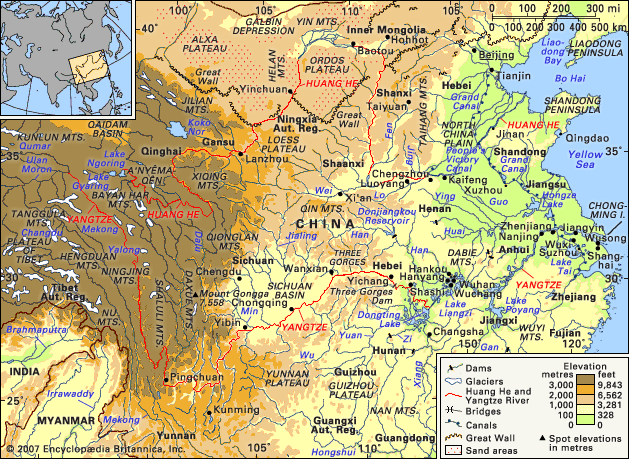
Yangtze River
The Yangtze River serves as the principal navigable waterway of China, functioning as a vital artery for the nation's economy by integrating inland and…
How does the Yangtze River contribute to China’s economy through transportation and trade?
The Yangtze River serves as the principal navigable waterway of China, functioning as a vital artery for the nation’s economy by integrating inland and coastal ports into a massive transportation network.12
Transportation and Trade
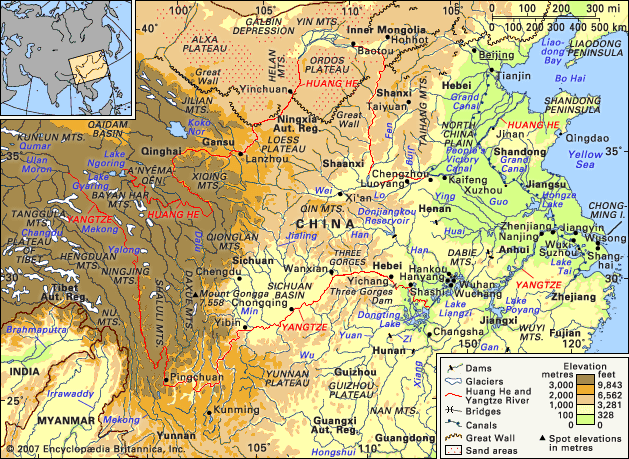
The river facilitates the movement of bulk goods and commodities between production sources and consumption destinations, accounting for approximately one-third of China’s total river freight volume. Key industrial hubs such as Nanjing, Wuhan, and Chongqing serve as central nodes in this network.21
The Three Gorges Dam has significantly enhanced these capabilities by creating a deepwater reservoir that allows oceangoing freighters to travel 2,250 km (1,400 miles) inland to Chongqing. Navigation is supported by sophisticated infrastructure, including five-tier ship locks and a large ship lift, which accommodate vessels of up to 10,000 tons. Furthermore, the Grand Canal connects the Yangtze to other major river systems, enabling the north-south distribution of essential resources like coal and foodstuffs.312
What role does the Yangtze River play in China’s water management and flood control efforts?
The Yangtze River has historically posed a significant flood risk to central and eastern China due to monsoon-driven water level fluctuations and the accumulation of sediment in its riverbed. Managing these risks has been a central focus of Chinese water management for centuries, evolving from early levee construction to modern large-scale engineering projects.67
Flood Control Strategies
- Levees and Barriers: Since the 16th century, extensive systems of levees have been built to protect low-lying plains. Today, there are approximately 1,700 miles (2,740 km) of levees along the main channel. However, these structures can lead to sediment buildup, which raises the riverbed and necessitates further heightening of the banks.68
- The Three Gorges Dam: A primary objective of the Three Gorges Dam is to mitigate downstream flooding. By regulating water flow and holding back excess volume during heavy monsoon rains, the dam has proven effective in minimizing the impact of major flood events, such as those in 2010.67
- Regulating Lakes: Natural lakes, including Dongting Lake and Lake Poyang, historically acted as vital flood-control basins. While some were converted to cropland or cut off by levees, modern management continues to utilize these areas and specialized reservoirs to regulate water levels.687
How has the Yangtze River influenced Chinese history and culture?
The Yangtze River has been a cornerstone of Chinese civilization, serving as a vital economic, political, and cultural force for millennia.
Economic and Political Significance
While much of China’s early political history was centered in the Huang He basin, the Yangtze region was essential to successive dynasties due to its immense agricultural potential. To integrate this “great granary” with northern capital cities, the Grand Canal was constructed, with major portions dating back to the 7th century CE. Over time, the river became a defining political and cultural boundary, demarcating the provinces of South China. In the 19th and early 20th centuries, the river became a focal point for imperialist incursions, with Shanghai emerging as a critical commercial gateway.49
Cultural and Historical Impact
The river’s influence is deeply embedded in Chinese history, including:
- Mythology and Adaptation: Human settlement in the valley has been shaped by the constant threat of floods. Ancient myths and legends frequently recount catastrophic inundations that turned plains into inland seas, reflecting the river’s dual nature as a source of life and destruction.8
- Regional Identity: The river basin supports a rich cultural heritage, including unique local specialties like Yangtze sturgeon and traditional arts, such as the Yiyang opera, which originated in the region.10
- Modernization: Since 1950, the river has been the primary focus of China’s economic modernization efforts, transforming from a historical boundary into a modern industrial artery.4
What is the Yangtze River’s geographical location and length?
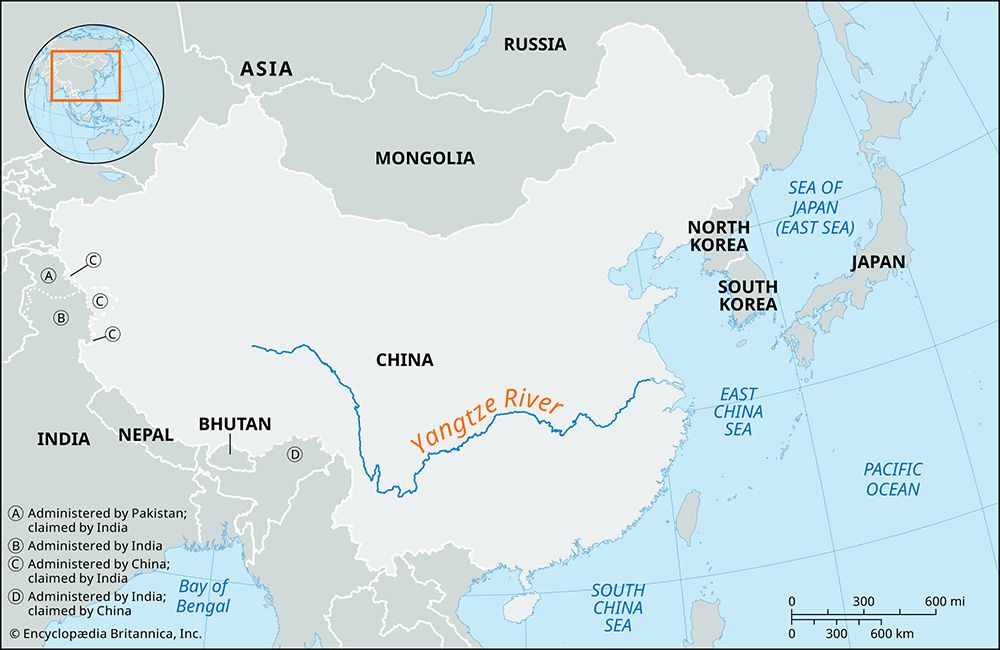
The Yangtze River is the longest river in both China and Asia, and the third-longest in the world, with a total length of 3,915 miles (6,300 km).1112
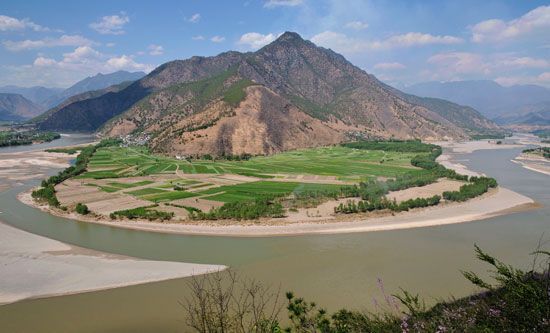
Geographically, the river originates on the Plateau of Tibet and flows eastward to its mouth on the East China Sea. Throughout its course, it traverses or serves as a border between 10 provinces or regions, with more than three-fourths of its path running through mountainous terrain. As it moves toward the east-central plains, the river passes through a complex system of lakes and low-lying areas, including the Yangtze Plain, before reaching its delta. The river’s basin is vast, spanning approximately 2,000 miles (3,200 km) from west to east and over 600 miles (1,000 km) from north to south, draining an area of 698,265 square miles (1,808,500 square km).12913
Sources
- Yangtze River - Navigation of the Yangtze River — Encyclopædia Britannica
- China - Waterways of China — Encyclopædia Britannica
- Three Gorges Dam — Encyclopædia Britannica
- Yangtze River - History of the Yangtze River — Encyclopædia Britannica
- Yangtze River - Economy — Encyclopædia Britannica
- Yangtze River floods — Encyclopædia Britannica
- Yangtze River - The Yangtze delta — Encyclopædia Britannica
- Yangtze River - Hydrology of the Yangtze River — Encyclopædia Britannica
- Yangtze River — Encyclopædia Britannica
- Jiangxi - Cultural life — Encyclopædia Britannica
- Yangtze River: Top Questions — Encyclopædia Britannica
- Yangtze River - The lower course — Encyclopædia Britannica
- Yangtze Plain — Encyclopædia Britannica
Published on · 4 min read