Yellow River
The Yellow River, or Huang He, is widely regarded as the "cradle of Chinese civilization". Its significance is rooted in its role as a central feature of the…
What is the significance of the Yellow River in Chinese history and culture?
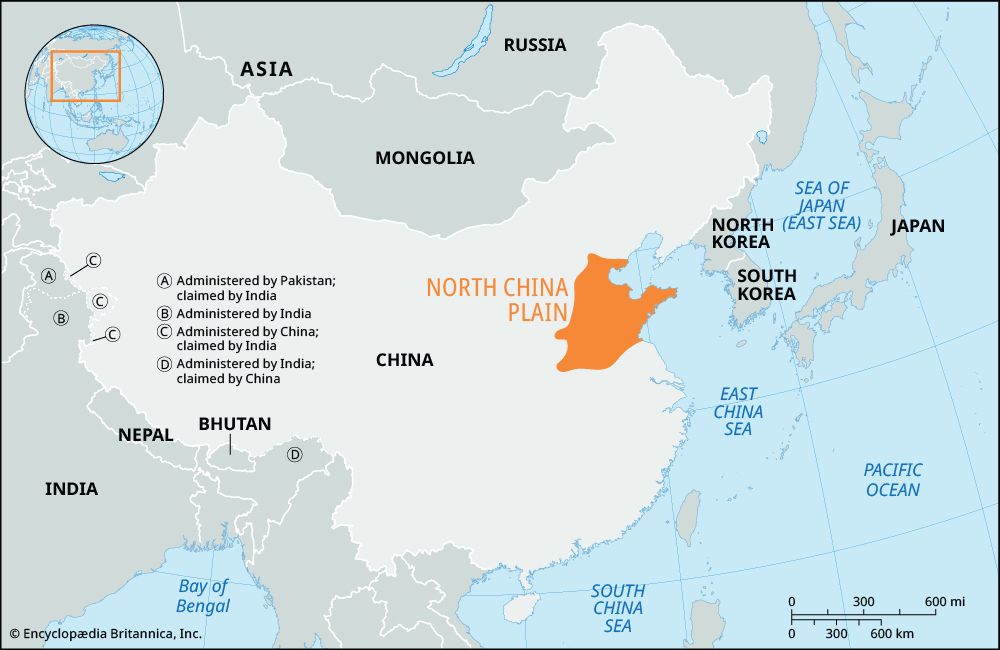
The Yellow River, or Huang He, is widely regarded as the “cradle of Chinese civilization”. Its significance is rooted in its role as a central feature of the North China Plain, where it has supported vast populations and some of China’s oldest cities, such as Xi’an and Luoyang, for millennia.1
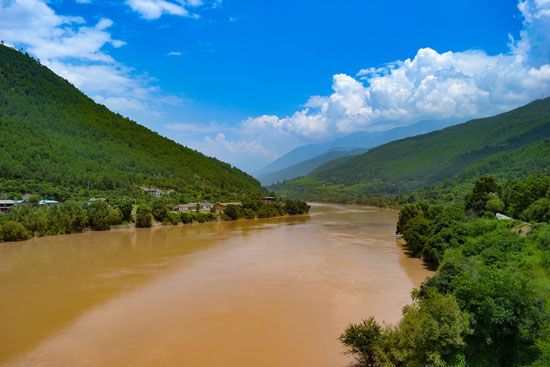
The river’s cultural and historical impact is dual-natured. While it provided the fertile loess soil essential for early agriculture, its tendency to shift course and carry massive amounts of silt has caused frequent, catastrophic flooding. This volatility earned it the titles “China’s Sorrow” and “The Ungovernable”. Throughout history, the struggle to manage the river through dams and levees has been a defining challenge for Chinese governance; hydraulic engineers who successfully mitigated these flood hazards often achieved legendary status.123
Beyond its physical influence, the river is deeply embedded in the Chinese landscape and identity, serving as a constant, living force that has shaped land use, settlement patterns, and the collective memory of the nation.43
How has the course of the Yellow River changed over time?
The course of the Yellow River has shifted radically throughout its history due to its low gradient and high sediment load. As the river flows across the North China Plain, it deposits massive amounts of silt, causing the riverbed to rise above the surrounding land. When the riverbed becomes too elevated, the stream naturally seeks a lower path, leading to dramatic channel shifts.46
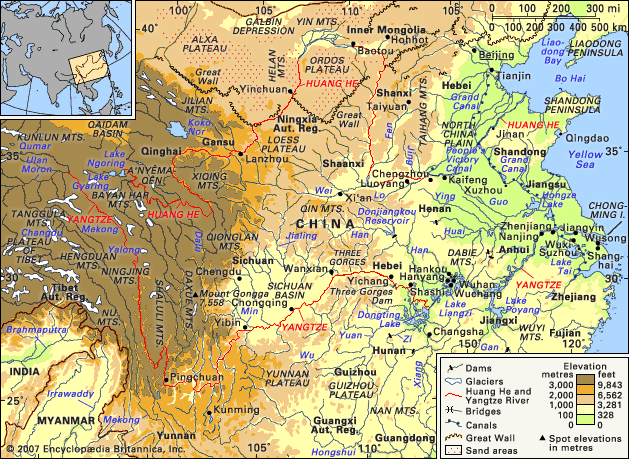
Over the past four millennia, the river’s mouth has migrated across a range of 500 miles (800 km). Key historical shifts include:
- 3rd millennium BCE–602 BCE: Flowed near Tianjin into the Bo Hai.4
- 602 BCE–70 CE: Shifted south of the Shandong Peninsula into the Yellow Sea.4
- 70–1048: Returned to a northern course near its present bed.4
- 1194–1850s: Following major dike breaches, the river occupied various southern paths, including the bed of the Huai River.4
- 1850s–Present: Settled into its current course north of the Shandong Peninsula.4
While humans have built extensive levees to stabilize the channel, these efforts have often backfired; by artificially confining the river, they have caused the bed to rise further, making eventual breaches and shifts more destructive.4
How long is the Yellow River and what major regions does it flow through?
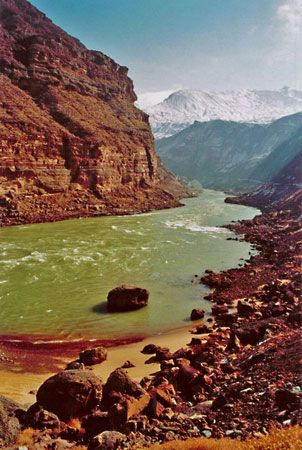
The Yellow River, or Huang He, is the second-longest river in China, with a total length of 3,395 miles (5,464 km). It originates in the Bayan Har Mountains on the Plateau of Tibet at an elevation exceeding 15,000 feet.17
From its source in Qinghai province, the river flows through a diverse array of regions, crossing six other provinces and two autonomous regions before emptying into the Bo Hai. Its path includes:1
- The Middle Course: The river traverses the Loess Plateau, flowing through Ningxia, Inner Mongolia, and forming the border between Shaanxi and Shanxi provinces.8
- The Lower Reaches: Upon exiting the gorges near Zhengzhou in Henan province, the river enters the North China Plain, where it flows toward the sea.18
Throughout this journey, the river passes by several historically significant cities, including Lanzhou, Xi’an, Luoyang, and Jinan.1
What role did the Yellow River play in the development of early Chinese civilization?
The Yellow River is widely regarded as the “cradle of Chinese civilization,” serving as the central axis for the development of early Chinese society for over three millennia. Its fertile loess plains provided the necessary environment for the emergence of early agricultural communities, which laid the foundation for later imperial power.1910
Early Cultural Development
The river valley was the heartland of significant Neolithic cultures, most notably the Yangshao culture (c. 5000–3000 BCE). Centered around the river’s eastern bend, these communities developed advanced pottery techniques and social structures that evolved over centuries. Following them, the Longshan culture (c. 2200–1700 BCE) introduced wheel-made pottery and ritual practices, such as the use of oracle bones, which signaled the transition toward a more complex, stratified society on the threshold of the Bronze Age.11
Political and Strategic Importance
As historical dynasties emerged, the river remained a critical strategic asset. The Zhou dynasty, for instance, constructed an eastern capital along the middle reaches of the Huang He to consolidate control over their territory and support a network of feudal states. The river valley facilitated communication, military mobilization, and the expansion of political influence across northern China.1213
Sources
- Yellow River — Encyclopædia Britannica
- Why is the Huang He river known as China’s Sorrow? — Encyclopædia Britannica
- Origins of agriculture - Land use — Encyclopædia Britannica
- Yellow River - Hydrology of the Yellow River — Encyclopædia Britannica
- Chinese literature - Literary use of myths — Encyclopædia Britannica
- Yellow River - The lower course — Encyclopædia Britannica
- Yellow River - The middle course — Encyclopædia Britannica
- Yellow River: Top Questions — Encyclopædia Britannica
- Chinese pottery - The formative period (to c. 1600 bce ) — Encyclopædia Britannica
- Yellow River - Study and exploration — Encyclopædia Britannica
- Origins of agriculture - The classical-imperial era — Encyclopædia Britannica
- Origins of agriculture - Early agricultural societies — Encyclopædia Britannica
- history of China - Zhou and Shang — Encyclopædia Britannica
- China - Zhou and Shang — Encyclopædia Britannica
Published on · 3 min read