Yuan River
The Yuan River is a vital waterway in southeastern China, flowing through eastern Guizhou and western Hunan provinces before discharging into Dongting Lake…
What is the historical significance of the Yuan River in Chinese culture and commerce?
The Yuan River is a vital waterway in southeastern China, flowing through eastern Guizhou and western Hunan provinces before discharging into Dongting Lake and eventually the Yangtze River.1
Its historical and commercial significance lies primarily in its role as a major transport artery for the mountainous regions of western Hunan and eastern Guizhou. While modern highways exist, the river remains an essential means of moving goods and commodities in these rugged areas. Changde serves as the primary marketing center for the Yuan River basin, highlighting the river’s function as a hub for regional trade. Although the river features rapids that limit the size of vessels in its upper reaches, it has long supported navigation by shallow-draft junks and small steamboats, facilitating connectivity between inland production sources and broader trade networks.12
It is important to note that the Yuan River should not be confused with the Yuan dynasty, which was a historical period of Mongol rule in China.3
How long is the Yuan River, and what are some of the important cities or regions it flows through?
The Yuan River is approximately 635 miles (1,020 km) long. It rises in the Miao Mountains near Duyun in Guizhou province and flows through western Hunan province before discharging into Dongting Lake at Changde and eventually joining the Yangtze River.1
Key locations and regions along its course include:
- Duyun (Guizhou): Near the river’s source in the Miao Mountains.1
- Zhijiang (Hunan): Located along the Wu River, a northern tributary that joins the Yuan.1
- Hongjiang (Hunan): Situated near the Guizhou border, accessible by shallow-draft junks.1
- Taoyuan (Hunan): A point reachable by small steamboats.1
- Changde (Hunan): The primary marketing center for the river basin and the point where the river discharges into Dongting Lake.1
It is important to distinguish this waterway from the Red (Yuan) River, which flows through Yunnan province toward the Gulf of Tonkin.8
How does the Yuan River connect to other major river systems in China?
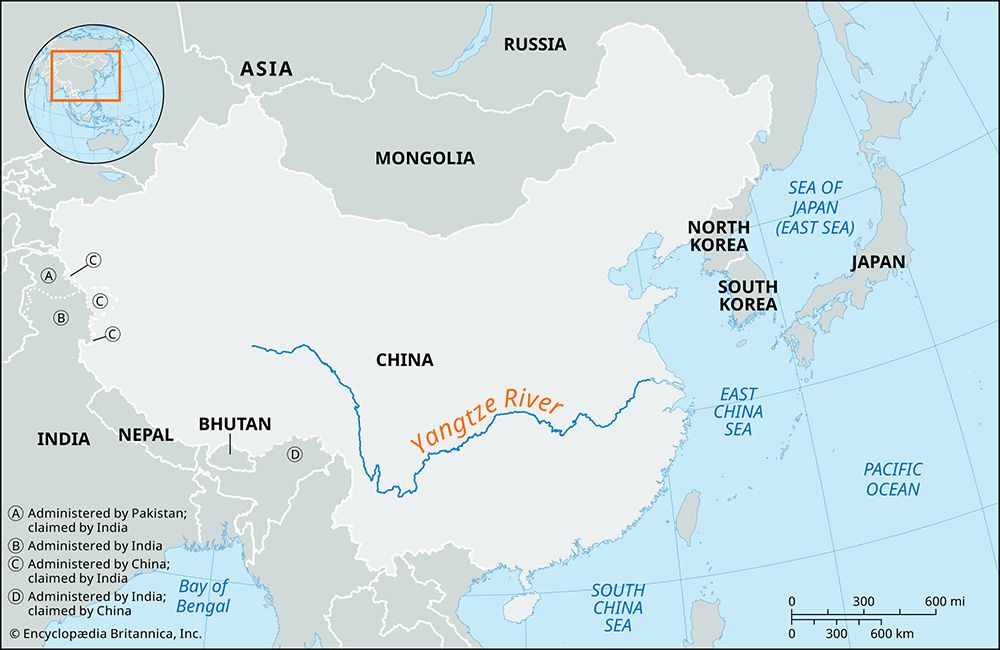
The Yuan River serves as a critical component of the hydrological network in south-central China, primarily by acting as a major tributary to the Yangtze River system.18
Its connection to the broader river network is facilitated through Dongting Lake in northern Hunan province. The Yuan River flows into this lake at Changde, joining other significant regional rivers—including the Xiang River and the Li River—that drain the majority of Hunan province.114
Dongting Lake functions as a vital nexus and a natural retention reservoir for the Yangtze. It is linked to the Yangtze by four channels, allowing the lake to regulate water volume and mitigate flooding by absorbing excess water from the Yangtze during the flood season and discharging it back into the main river system. Consequently, the Yuan River’s waters eventually reach the Yangtze at Yueyang, integrating the drainage of western Hunan and eastern Guizhou into the Yangtze’s massive basin.1481
What role does the Yuan River play in local transportation and trade?
The Yuan River serves as a vital transportation artery for the mountainous regions of western Hunan and eastern Guizhou, where it remains a significant means of moving goods despite the presence of modern highways.1
Transportation and Navigation
The river’s navigability varies by vessel type and location:
- Large vessels: Can travel as far upstream as Changde.1
- Small steamboats: Can reach as far as Taoyuan.1
- Shallow-draft junks: Navigate the upper reaches, including the Wu River as far as Zhijiang and the main river up to Hongjiang near the Guizhou border.1
Trade and Economic Role
Historically, the Yuan River basin has been a center for agricultural trade. Changde developed into the primary market for the region, facilitating the collection and distribution of commodities such as rice, cotton, tung oil, and timber. These goods are typically loaded onto medium-sized ships for transport to major hubs like Yueyang, Changsha, and Wuhan for onward shipment. Timber, in particular, is often rafted across Dongting Lake to reach the Yangtze River system.1617
Sources
- Yuan River — Encyclopædia Britannica
- China - Waterways of China — Encyclopædia Britannica
- Hunan - Settlement patterns — Encyclopædia Britannica
- history of China - Economy — Encyclopædia Britannica
- China - Economy of China — Encyclopædia Britannica
- Yuan dynasty — Encyclopædia Britannica
- Yellow River - Economic development — Encyclopædia Britannica
- Dongting Lake — Encyclopædia Britannica
- Yangtze River - Economy — Encyclopædia Britannica
- Jiangsu - Economy — Encyclopædia Britannica
- Yangtze River: Top Questions — Encyclopædia Britannica
- Yunnan - Relief and drainage — Encyclopædia Britannica
- Yellow River — Encyclopædia Britannica
- Hongshui River — Encyclopædia Britannica
- Yangtze River - The lower course — Encyclopædia Britannica
- Hunan - Transportation — Encyclopædia Britannica
- Changde — Encyclopædia Britannica
- Yangtze River - Navigation of the Yangtze River — Encyclopædia Britannica
Published on · 3 min read