Zugspitze
The Zugspitze is a mountain located on the border between Germany and Austria. Standing at an elevation of 9,718 feet (2,962 meters), it is the highest point…
What is Zugspitze?
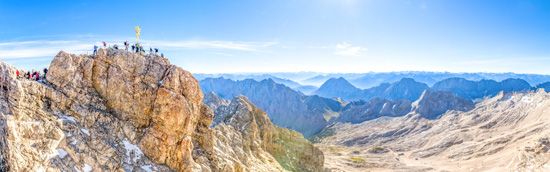
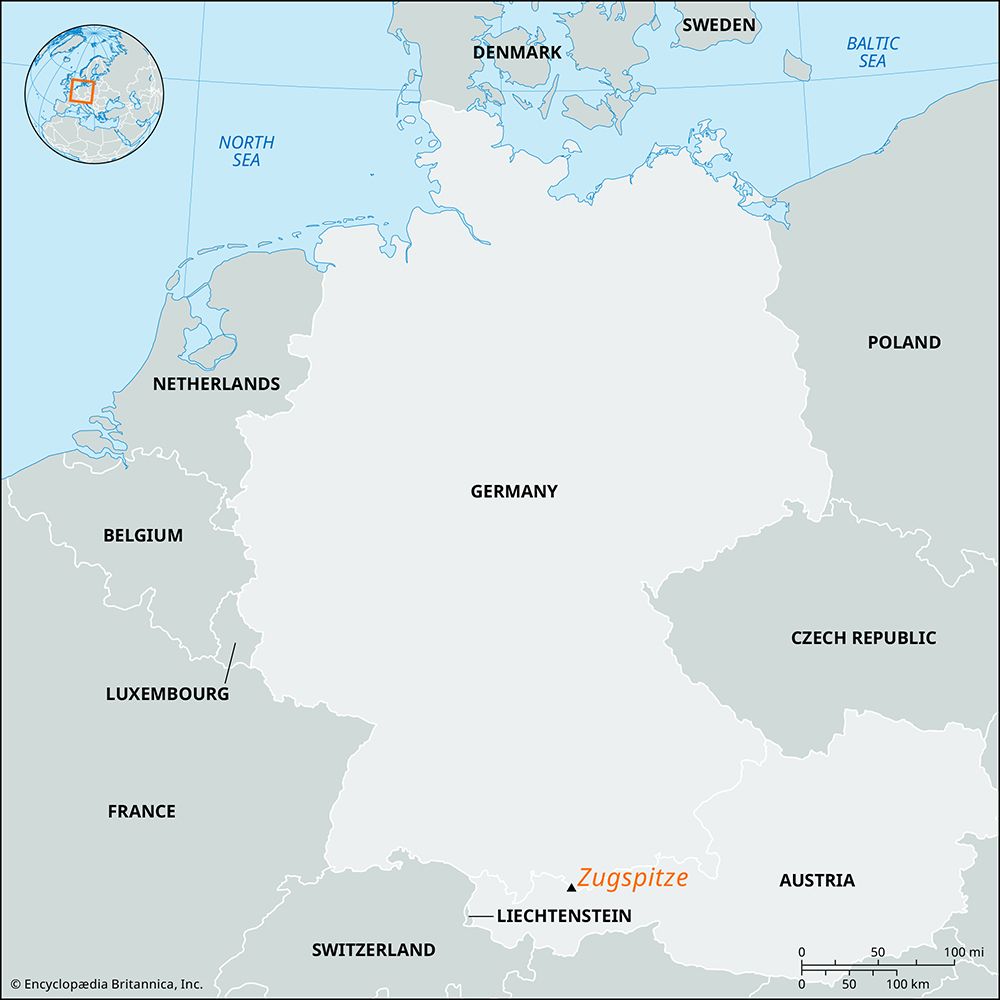
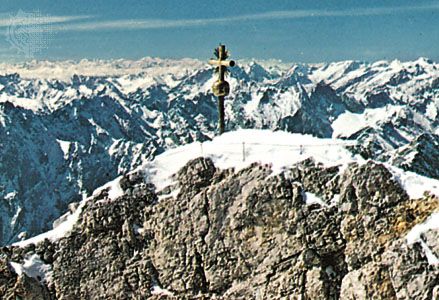
The Zugspitze is a mountain located on the border between Germany and Austria. Standing at an elevation of 9,718 feet (2,962 meters), it is the highest point in Germany and a prominent peak within the Wettersteingebirge range of the Bavarian Alps1.
The mountain is a popular destination for outdoor enthusiasts, offering various winter skiing and summer climbing opportunities. Visitors can reach the peak via an aerial tramway from the village of Eibsee or by a railway originating from the town of Garmisch-Partenkirchen. Additionally, the summit hosts a meteorological observatory, which serves as a key site for scientific observation.1
What are the Bavarian Alps?
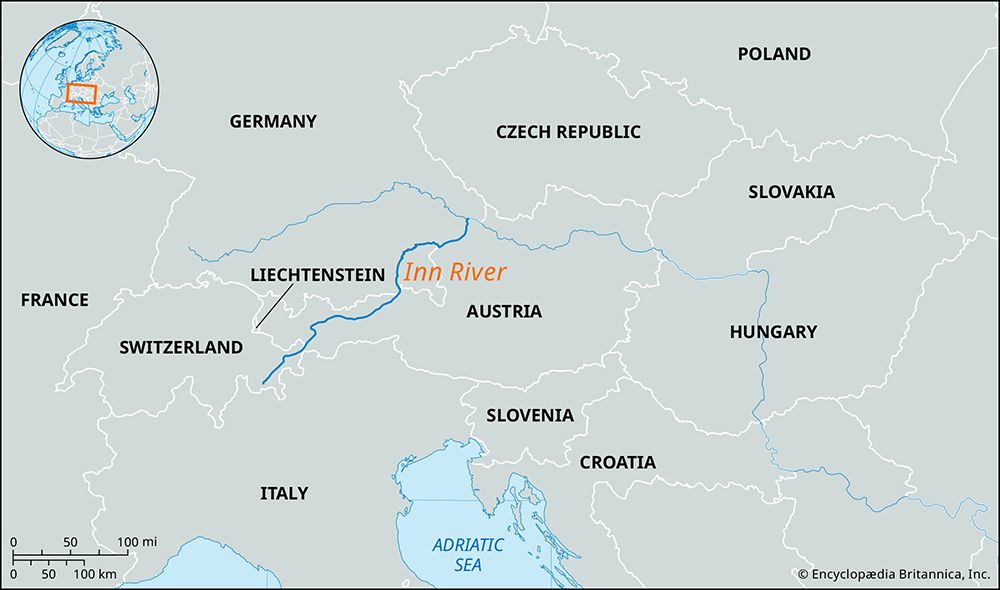
The Bavarian Alps represent the northeastern segment of the Central Alps, stretching approximately 70 miles (110 km) along the border between Germany and Austria. This range extends east-northeastward from the Lechtaler Alps to the Inn River near Kufstein.3
Key features of the region include:
- Geography: The range includes subranges such as the Wetterstein Alps, the Karwendel Range, and the Nord Chain. The Zugspitze, at 9,718 feet (2,962 meters), serves as the highest point in both the range and Germany.34
- Landscape: The southern side of the range is characterized by steep walls overlooking the Inn River valley, while the northern slopes are gentler, supporting cattle grazing.3
- Economy: The region is a major hub for tourism and winter sports. Additionally, the area contains lignite mines and petroleum deposits.35
- Conservation: A large national park exists within the region to protect the original Alpine landscape, flora, and fauna from the pressures of urbanization.3
How do mountain railways and tramways work?
Mountain railways and tramways utilize specialized mechanical systems to navigate steep gradients where standard adhesion—the friction between steel wheels and rails—is insufficient. These systems ensure safety and traction on inclines that would otherwise be impassable for conventional trains.8
Key Mechanisms
- Rack and Pinion (Cog Railway): These systems feature a toothed rail (the rack) laid between the standard tracks. The locomotive is equipped with a cogwheel (pinion) that engages with the rack, providing positive traction to climb or descend steep slopes.89
- Cable Systems: Often used in funiculars, these railways rely on a cable to pull cars up or down a slope. The cars are typically balanced, with one ascending as the other descends, using the weight of the descending car to assist the movement of the ascending one.8
- Central Rails: Some systems employ a center rail that is gripped by horizontal wheels on the locomotive, providing additional friction and stability to prevent the train from slipping on extreme grades.8
What is the role of a meteorological observatory?
A meteorological observatory serves as a critical facility for monitoring the atmosphere to provide the data necessary for weather forecasting. Its primary role is to collect accurate, simultaneous measurements of atmospheric conditions, which act as the foundation for both human insights and complex numerical models.10
These observatories utilize a variety of tools to gather data, including:
- In Situ Measurements: Equipment located directly at the site, such as towers and surface platforms, measures temperature, pressure, wind velocity, and humidity.1011
- Remote Sensing: Instruments like radar and lidars detect atmospheric characteristics from a distance, providing essential information on precipitation, wind structure, and turbulence.11
- Data Integration: By plotting simultaneous observations on a weather map, meteorologists gain a comprehensive, “synoptic” view of prevailing conditions across a broad region.10
Ultimately, the data collected by these observatories are fed into supercomputers to solve mathematical equations, allowing for the objective prediction of how atmospheric conditions will change over time.10
Sources
- Zugspitze — Encyclopædia Britannica
- Zugspitze — Merriam-Webster
- Bavarian Alps — Encyclopædia Britannica
- Alps - Climate of the Alps — Encyclopædia Britannica
- Alps - Tourism — Encyclopædia Britannica
- Alps - Plant and animal life — Encyclopædia Britannica
- Germany - The Alps and the Alpine Foreland — Encyclopædia Britannica
- mountain railroad — Merriam-Webster
- cog railway — Merriam-Webster
- Weather forecasting - Measurements and ideas as the basis for weather prediction — Encyclopædia Britannica
- Atmosphere - Measurement systems — Encyclopædia Britannica
- Weather forecasting - Meteorological measurements from satellites and aircraft — Encyclopædia Britannica
- Astronomical observatory — Encyclopædia Britannica
Published on · 3 min read