Thuringian Forest
The Thuringian Forest is a range of forested hills and mountains located in west-central Germany. Extending southeastward from the vicinity of Eisenach to…
What is Thuringian Forest?
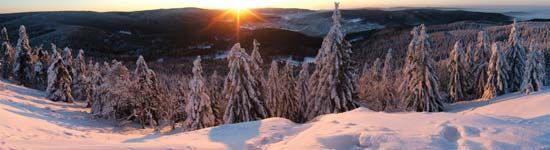
The Thuringian Forest is a range of forested hills and mountains located in west-central Germany. Extending southeastward from the vicinity of Eisenach to the Bavarian frontier, it merges with the Franconian Forest. The range spans a breadth of 6 to 22 miles (10 to 35 km), with its highest point, Beerberg, reaching 3,222 feet (982 m).12
The landscape is characterized by rounded summits, charming valleys, and dense forests primarily composed of pines and firs. The northwest section is notably loftier and more densely wooded, while the southeast is more industrial and populous. Historically, the crest of the range is traversed by the Rennsteig, an ancient path that served as a frontier boundary between Thuringia and Franconia.1
While the area was once a center for iron mining, its modern economy relies on small-scale industries—such as toy making, wood carving, and glass and china manufacturing—and tourism in resorts like Eisenach and Oberhof.1
What is the historical significance of the Rennsteig trail?
The Rennsteig is a historic trail of unknown antiquity that traverses the crest of the Thuringian Forest between the Werra and Saale rivers. Its historical significance is rooted in several key functions:
- Frontier Boundary: The name Rennsteig likely translates to “frontier path,” as it served as the traditional historical boundary separating Thuringia from Franconia.1
- Cultural Divide: The trail functioned as a significant cultural demarcation line between north and south Germany. Historically, the regions on either side of the path exhibited distinct differences in dialects, local customs, place names, and traditional costumes.1
Today, the path remains a notable feature of the region, reflecting the long-standing geographic and social divisions that once shaped the area.
How did the iron-mining industry shape the region’s past?
The iron-mining industry was a foundational element of the Thuringian Forest region’s economy until the 16th century. During this period, the extraction and processing of iron ore served as the primary industrial driver for the area, shaping its early development and settlement patterns.1
The decline of iron mining in the 16th century necessitated a significant economic transition. As the region moved away from large-scale mineral extraction, it pivoted toward the specialized small-scale industries that define its modern character. This shift fostered the growth of traditional crafts such as wood carving, toy making, and the production of glass and china, which remain central to the region’s identity today.1
What are some other notable mountain ranges in Germany?
Germany features a diverse landscape of mountain ranges, ranging from the high peaks of the south to the forested uplands of the central region. Here are some of the most notable ranges:
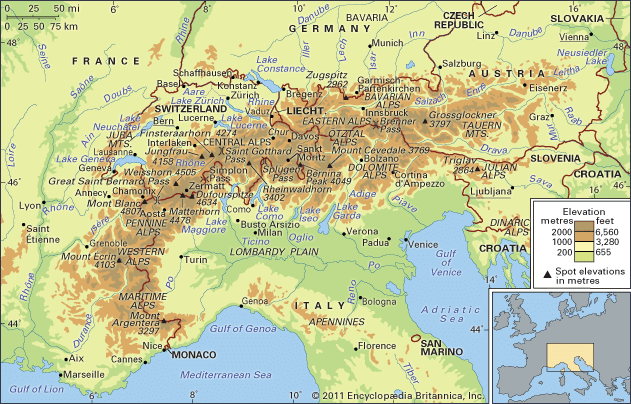
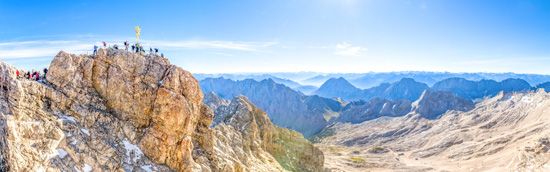
- Alps: Located in the south along the border with Austria, these are Europe’s highest and youngest fold mountains. The Zugspitze, at 9,718 feet (2,962 meters), is the highest point in Germany and is part of the Wettersteingebirge in the Bavarian Alps.415
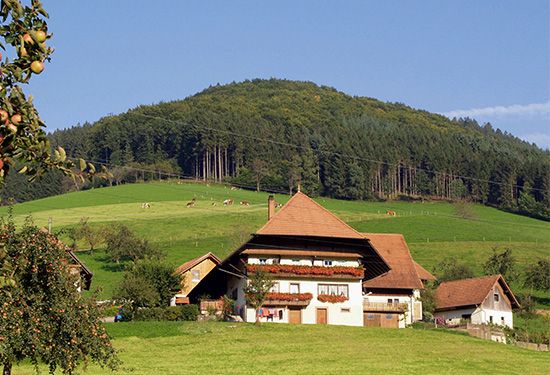
- Black Forest: Situated in southwestern Germany, this granite highland is famous for its dense fir forests. Its highest summit is Mount Feld (Feldberg), reaching 4,898 feet (1,493 meters).67
- Harz: The most northerly mountain range in Germany, the Harz is known for its terraced plateaus and deep valleys. Its highest peak, the Brocken (3,747 feet), is steeped in folklore and literature.8
- Ore Mountains: Extending along the German-Czech border, this range has a long tradition of mineral wealth and mining. Its highest German summit is Fichtel Mountain (3,983 feet).9
- Rhenish Uplands: This complex block of mountains includes areas such as the Hunsrück and Taunus, known for their slate ridges and the spectacular Rhine gorge.10
Sources
- Thuringian Forest — Encyclopædia Britannica
- Thuringia — Encyclopædia Britannica
- Franconian Forest — Encyclopædia Britannica
- Ore Mountains — Encyclopædia Britannica
- Germany - Southern Germany — Encyclopædia Britannica
- Harz — Encyclopædia Britannica
- Black Forest — Merriam-Webster
- Black Forest — Encyclopædia Britannica
- Germany - The barrier arc — Encyclopædia Britannica
- Germany - Climate of Germany — Encyclopædia Britannica
- Germany - Land of Germany — Encyclopædia Britannica
- Zugspitze — Encyclopædia Britannica
- Exploring 7 of Earth’s Great Mountain Ranges - Alps — Encyclopædia Britannica
- Harz — Merriam-Webster
Published on · 3 min read