Zygophyllales
Plants in the order Zygophyllales offer several economic and medicinal applications, primarily within the family Zygophyllaceae.
Are there any medicinal or economic uses for plants in the Zygophyllales order?
Plants in the order Zygophyllales offer several economic and medicinal applications, primarily within the family Zygophyllaceae.
Economic Uses
- Timber: Several species, such as Guaiacum officinale (lignum vitae), Guaiacum sanctum, and Bulnesia arborea, are valued for their exceptionally hard, dense, and durable wood, used for items like ship bushings and mallets.1
- Fragrance: Bulnesia sarmientoi provides guaiac wood oil, which has a roselike scent used in perfumes and soaps.1
- Food: The pickled buds of Zygophyllum fabago serve as a caper substitute, while certain Balanites fruits are edible, and their seeds yield oils for cooking or soap production.1
- Industry: Tannin extracted from the roots of Krameria species is used locally for tanning leather.1
Medicinal Uses
- Diagnostics: The guaiac resin from Guaiacum wood is used in the guaiac test to detect blood in feces.1
- Traditional Medicine: Extracts from Krameria triandra roots are utilized as tooth preservatives in parts of South America.1

How do plants in the Zygophyllales order reproduce?
Plants in the order Zygophyllales reproduce through sexual reproduction, following the typical life cycle of angiosperms. This process involves the alternation of a dominant, photosynthetic sporophyte phase and a reduced gametophyte phase.3
Pollination Strategies
- Insect Pollination: The showy flowers of Zygophyllales are adapted to attract insects, such as bees, wasps, butterflies, and flies, which serve as the primary agents of pollination. These flowers typically possess nectar or oil glands to entice pollinators.2
- Self-Pollination: Some members, such as those in the genus Kallstroemia, exhibit a specialized adaptation for arid environments where pollinators may be scarce. These flowers initially open to encourage cross-pollination by insects; however, if pollination does not occur, the flower closes in the afternoon, causing the stamens to press against the stigma to ensure self-pollination.2
Fertilization and Development
Once pollen is transferred to the stigma, it germinates and grows a pollen tube to deliver sperm to the ovule, where fertilization occurs to form a zygote), where fertilization occurs to form a zygote. Following fertilization, the ovule develops into a seed, and the ovary matures into a fruit, which may take the form of a dehiscent capsule, a schizocarp, or an indehiscent berry.342
What are some common examples of plants from the Zygophyllales order?
The order Zygophyllales includes a diverse range of plants, primarily categorized into the families Zygophyllaceae and Krameriaceae. Below are some common and notable examples:
Zygophyllaceae (Bean Caper Family)
- Larrea tridentata: Commonly known as the creosote bush, this resinous shrub dominates many desert landscapes in southwestern North America.2
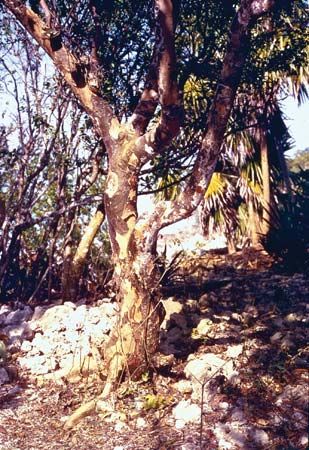
- Guaiacum officinale: Also known as lignum vitae, this tree is prized for its exceptionally hard, dense, and durable wood.210
- Zygophyllum fabago: Known as the bean caper, its pickled buds are frequently used as a substitute for culinary capers.2
- Tribulus terrestris: Often called the puncture vine, this species is considered a weed in many arid regions due to its hard, spiny fruits that can cause injury to animals and damage tires.2
- Balanites: A genus found from tropical Africa to Myanmar; some species produce edible fruits and seeds that yield oils used for cooking or soap production.2
- Bulnesia arborea and Bulnesia sarmientoi: These trees are valued for their timber, with B. sarmientoi also serving as a source for fragrant guaiac wood oil.2
Krameriaceae
- Krameria: This genus consists of hemiparasitic shrubs or herbs found in the New World. Notably, Krameria triandra is used in traditional medicine in Bolivia and Peru as a tooth preservative.2
What are the main characteristics of plants in the Zygophyllales order?
The order Zygophyllales, commonly known as the creosote bush order, consists of two families: Zygophyllaceae and Krameriaceae. These plants are primarily found in tropical or temperate arid and saline regions.2
Key Characteristics
- Habit: Members are typically herbs or shrubs, though some are small trees or, rarely, hemiparasites.2
- Leaves: In the Zygophyllaceae family, leaves are often resinous and arranged in an opposite or spiral pattern.2
- Flowers: The order is characterized by showy flowers that possess nectar or oil glands to attract pollinators like bees, wasps, butterflies, and flies. Typical flowers feature a five-parted perianth, 4 or 10 stamens, and 2–5 fused carpels.2
- Fruits: Depending on the species, fruits may develop as dehiscent capsules, schizocarps, or various types of indehiscent berries.2
- Seeds: The seeds of these plants generally lack endosperm.2
While many species are ecologically significant in desert environments, some are economically valued for their hard timber, such as lignum vitae, or used in traditional medicine.2
Sources
- creosote bush — Merriam-Webster
- Zygophyllales — Encyclopædia Britannica
- Angiosperm - General features — Encyclopædia Britannica
- Angiosperm - Pollination — Encyclopædia Britannica
- Seed - Agents of dispersal — Encyclopædia Britannica
- Seed - Self-dispersal — Encyclopædia Britannica
- sexual reproduction — Encyclopædia Britannica
- Plant reproductive system - Variations in reproductive cycles — Encyclopædia Britannica
- orchid - Bee pollination — Encyclopædia Britannica
- lignum vitae — Encyclopædia Britannica
- Zygophyllaceae — Merriam-Webster
- creosote — Merriam-Webster
- Caryophyllales - Characteristic morphological features — Encyclopædia Britannica
- Palm - Inflorescences — Encyclopædia Britannica
- Zygopetalum — Encyclopædia Britannica
Published on · 4 min read