Albert Nile
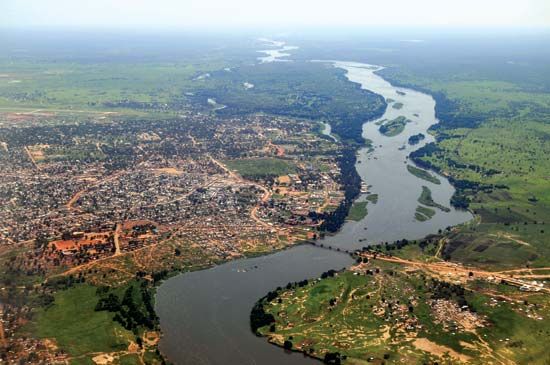
The Albert Nile is the section of the Nile River located in northwestern Uganda. It begins at the northern end of Lake Albert, just north of where the…
What is Albert Nile?
The Albert Nile is the section of the Nile River located in northwestern Uganda. It begins at the northern end of Lake Albert, just north of where the Victoria Nile enters the lake.12
The river flows northward for approximately 130 miles (210 km), passing by the town of Pakwach, until it reaches the border of South Sudan at Nimule. Throughout this course, the river is wider and slower than the Victoria Nile, characterized by swampy fringes, and it remains navigable for steamers. Upon reaching Nimule, the river continues its journey as the Al-Jabal River, also known as the Mountain Nile.12
What is the difference between the Victoria Nile and the Albert Nile?
The Victoria Nile and the Albert Nile are distinct upper sections of the Nile River in Uganda, separated by Lake Albert. Their primary differences include their course, physical characteristics, and navigation:
- Victoria Nile: This section flows for approximately 300 miles (480 km) from Lake Victoria to Lake Albert. Its path is marked by significant changes in elevation, including the Owen Falls dams and a series of rapids that culminate in the Kabalega (Murchison) Falls. It also flows through Lake Kyoga. Navigation is limited to the stretch between Namasagali and Masindi Port.13
- Albert Nile: This section begins at the northern end of Lake Albert, where the waters of the Victoria Nile have already united with the lake. It flows northward for about 130 miles (210 km) to the South Sudanese border. Compared to the Victoria Nile, it is wider, slower, and characterized by swampy fringes. It is navigable for steamers throughout its entire course.43
How does the Al-Sudd region affect the flow of the Nile?
The Al-Sudd region, a vast swampy lowland in central South Sudan, significantly impacts the flow of the White Nile by acting as a massive natural regulator and sink.5
As the Al-Jabal River enters this flat, saucerlike clay plain, it overflows into a complex network of lagoons, side channels, and swamps. The river’s progress is further impeded by dense vegetation, including tall papyrus, aquatic grasses, and water hyacinth, which drastically slow the water’s velocity.5
The most notable effect of this region is the substantial loss of water volume; more than half of the Al-Jabal’s water is lost to evaporation as it traverses the Sudd. This process effectively reduces the total discharge of the river as it continues its journey northward. Historically, efforts such as the Jonglei Canal project were proposed to bypass these swamplands and prevent such significant water loss, though the project remains incomplete due to regional conflict.5
What are the major tributaries that feed into the White Nile?
The White Nile is formed by the confluence of the Bahr al-Jabal (Mountain Nile) and the Sobat River near Malakal, South Sudan6. While the White Nile itself receives no tributaries of importance once it begins its 500-mile journey toward Khartoum, its headstreams and the Bahr al-Jabal are fed by several significant water sources:678
- Bahr al-Jabal Tributaries: As the Bahr al-Jabal flows from the Uganda border to South Sudan, it receives water from various short tributaries on both banks. Additionally, it is joined at Lake No by the Bahr al-Ghazal, which drains a large portion of western South Sudan.86
- Sobat River Tributaries: The Sobat is a major contributor to the White Nile’s volume. It is formed by the confluence of the Baro and Pibor rivers on the Ethiopian border. Other headstreams feeding the Sobat system include the Jokau, Gilo, and Akobo rivers, as well as the Khawr Nyanding and Khawr Ful Lus streams.2
The Kagera River is also recognized as the furthest headstream of the entire Nile system, eventually feeding into Lake Victoria, which serves as the primary source for the Victoria Nile.8
Sources
- Albert Nile — Encyclopædia Britannica
- Nile River - Physiography of Nile River — Encyclopædia Britannica
- Victoria Nile — Encyclopædia Britannica
- Africa - Nile basin — Encyclopædia Britannica
- Al-Sudd — Encyclopædia Britannica
- White Nile River — Encyclopædia Britannica
- Sobat River — Encyclopædia Britannica
- Baḥr al-Jabal — Encyclopædia Britannica
Published on · 3 min read