Amphiuma
An amphiuma is any of three species of North American salamanders belonging to the family Amphiumidae. Because they possess long, slender bodies and very…
What is amphiuma?
An amphiuma is any of three species of North American salamanders belonging to the family Amphiumidae. Because they possess long, slender bodies and very small, inconspicuous legs, they are frequently mistaken for snakes or eels.1
These amphibians are typically found in swamps and drainage ditches. They are known for having strong jaws and sharp teeth, and unlike many other salamanders, they can bite viciously when threatened. Their diet consists primarily of small animals such as crayfish, clams, and snails.1
While there are species with one or three toes, the most widely distributed species is Amphiuma means, which typically grows between 46 and 116 cm (18 to 46 inches) in length and features two toes on each foot. They reproduce via internal fertilization, with females laying clutches of 40 to 350 eggs.1
It is important not to confuse the amphiuma with the amphioxus, which is a small, marine invertebrate belonging to the subphylum Cephalochordata.2
How do amphiumas differ from other types of salamanders?
Amphiumas are distinct from most other salamanders due to their highly specialized physical characteristics and aggressive behavior. While typical salamanders are four-legged, short-bodied vertebrates, amphiumas are characterized by an extremely elongated, eel-like body and diminutive legs with only one to three toes.14
Key differences include:
- Physical Structure: Unlike the generalized form of many salamanders, amphiumas have a very long body and a short tail. Their legs are so inconspicuous that they are frequently mistaken for snakes or eels.41
- Aggression: While most salamanders are not known for biting, amphiumas possess strong jaws and sharp teeth, allowing them to bite viciously when they feel threatened.1
- Respiratory Features: Amphiumas lack external gills as adults, a feature that distinguishes them from permanently aquatic families like the Proteidae (mud puppies and olms) and Sirenidae (sirens), which retain gills throughout their lives. Instead, amphiumas possess a spiracle, or gill slit, that remains open.546
- Dietary Habits: They are strictly predaceous, feeding on small animals such as crayfish, clams, and snails.1
What makes amphiumas unique compared to other amphibians?
Amphiumas are unique among amphibians due to a combination of extreme physical specialization and aggressive behavior that sets them apart from most other salamanders.
Distinctive Physical Characteristics
While typical salamanders are four-legged, short-bodied vertebrates, the amphiuma possesses an extremely elongated, eel-like body with a short tail and diminutive, inconspicuous legs that feature only one to three toes. Their appearance is so specialized that they are frequently mistaken for snakes or eels.15
Behavioral and Biological Differences
- Aggression: Unlike most salamanders, which are generally docile, amphiumas have strong jaws and sharp teeth, allowing them to bite viciously when threatened.1
- Respiratory Adaptations: While many aquatic salamanders retain gills throughout their lives, adult amphiumas lose their external gills but retain an open spiracle, or gill slit.5
- Dietary Habits: They are strictly predaceous, feeding on small animals such as crayfish, clams, and snails.1
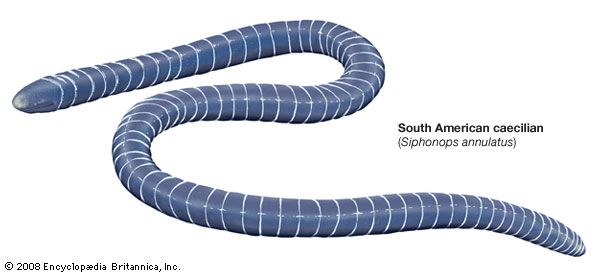
These traits distinguish them from other aquatic groups, such as sirens, which lack hindlimbs entirely, or caecilians, which are limbless and adapted for burrowing.57
Why are amphiumas often mistaken for snakes or eels?
Amphiumas are frequently mistaken for snakes or eels primarily due to their highly specialized body shape. Unlike most salamanders, which typically possess a generalized, four-legged structure, the amphiuma has an extremely elongated, slender body and a short tail.14
This eel-like appearance is further emphasized by their diminutive, inconspicuous legs, which feature only one to three toes. Because these limbs are so small and difficult to notice at a glance, the animal’s overall silhouette closely resembles that of a snake or an eel, leading to common misidentifications by observers.14
Sources
- amphiuma — Encyclopædia Britannica
- Amphiuma — Merriam-Webster
- amphioxus — Encyclopædia Britannica
- Caudata - Annotated classification — Encyclopædia Britannica
- Caudata - Size range and diversity of structure — Encyclopædia Britannica
- Caudata - Life cycle and reproduction — Encyclopædia Britannica
- Respiratory system - The gills — Encyclopædia Britannica
- Respiratory system - Fishes — Encyclopædia Britannica
- Gymnophiona - Annotated classification — Encyclopædia Britannica
- lizard - Locomotion and limb adaptations — Encyclopædia Britannica
Published on · 3 min read