Antilles Current
The Antilles Current is a branch of the Atlantic North Equatorial Current and a key component of the clockwise-setting ocean-current system in the North…
What is Antilles Current?
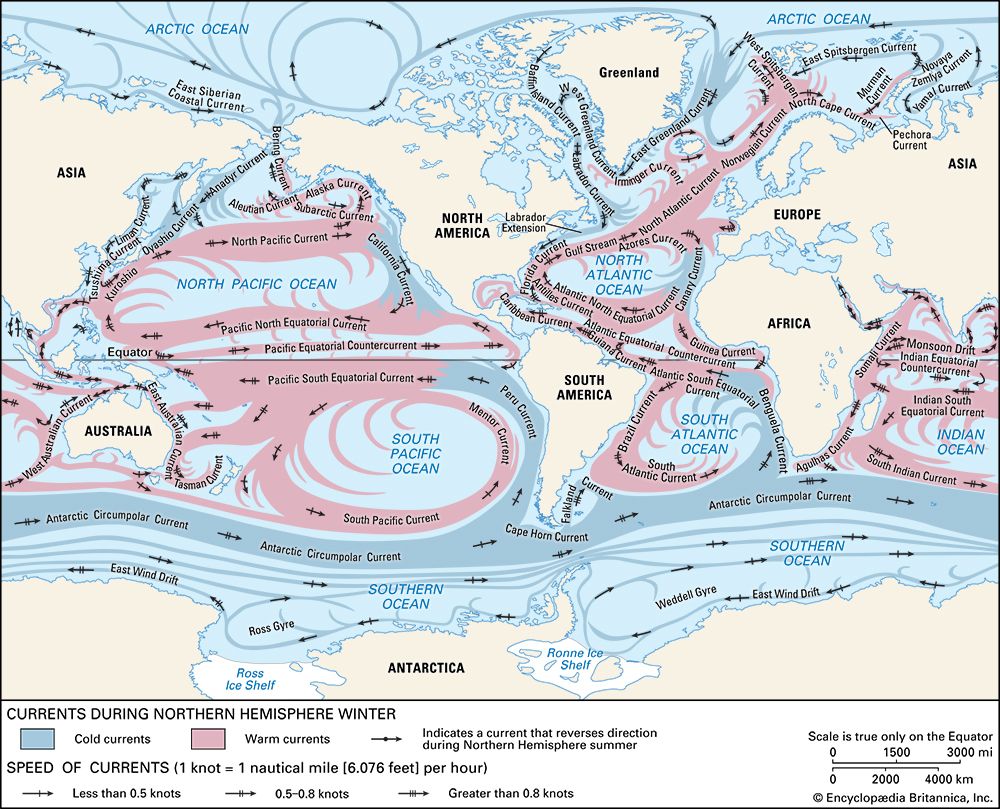
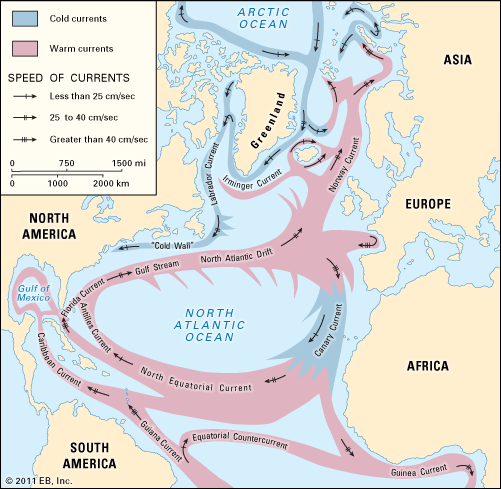
The Antilles Current is a branch of the Atlantic North Equatorial Current and a key component of the clockwise-setting ocean-current system in the North Atlantic Ocean. It flows northwestward along the northern side of the Greater Antilles islands.1
As it moves, the current merges with the Florida Current—which originates in the Gulf of Mexico and exits through the Straits of Florida—to form the initial portion of the Gulf Stream system. By reinforcing the flow of the Florida Current, the Antilles Current plays a vital role in the broader circulation patterns of the North Atlantic, including the gyre that surrounds the Sargasso Sea.12
What is the North Atlantic Gyre?
The North Atlantic Gyre is a large-scale, clockwise-rotating system of ocean currents that dominates the circulation of the North Atlantic Ocean. This subtropical gyre is primarily driven by the overlying atmospheric circulation, specifically the clockwise rotation of the subtropical anticyclone and the influence of the Coriolis force.34
The gyre acts as the central hub for North Atlantic circulation, encompassing several key currents:4
- Gulf Stream System: The western boundary of the gyre, which includes the Florida Current and the Antilles Current.34
- North Equatorial Current: The southern portion of the gyre, which flows westward.34
- North Atlantic Current: The northern extension of the system.24
- Canary Current: The eastern boundary, which flows southwestward along the coast of northwestern Africa.23
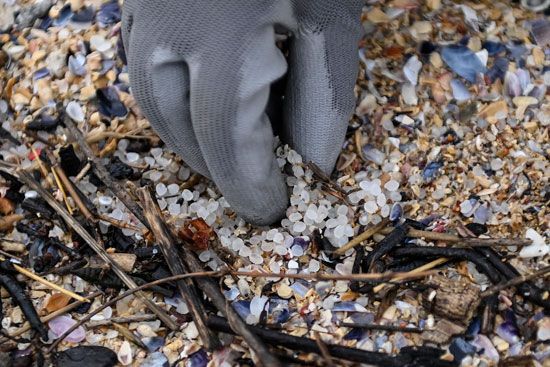
The interior of this gyre contains the Sargasso Sea, a region characterized by relatively still waters. Because of its circular motion, the gyre acts as a trap for floating debris, including plastic waste, which accumulates in the area.3456
How do ocean currents influence global climate?
Ocean currents are fundamental drivers of the Earth’s climate, acting as a global conveyor system that redistributes heat and moisture between the tropics and the poles.89
Heat Redistribution
The most significant climate influence of ocean currents is the transport of thermal energy. Warm surface currents, such as the Gulf Stream, carry heat from the tropics toward higher latitudes. When combined with prevailing winds, these currents moderate the climates of coastal regions, such as northwestern Europe, which would otherwise be significantly cooler and drier. Conversely, cold currents move water from polar regions toward the equator, helping to balance global temperatures.8910
Atmospheric Interaction
The oceans serve as massive heat reservoirs that interact with the atmosphere through evaporation and direct heat transfer. This interaction influences weather patterns, including:9
- Precipitation: Ocean warming accelerates evaporation, leading to increased rainfall and snowfall.11
- Storm Systems: Warm currents provide the energy necessary for the development and intensification of tropical cyclones.119
- Upwelling: Processes like upwelling bring cold, nutrient-rich water to the surface, which stabilizes the lower atmosphere and can create arid conditions along continental coasts.12
Large-Scale Climate Patterns
Complex interactions between the ocean and atmosphere periodically alter global climate, most notably through the El Niño/Southern Oscillation (ENSO). These events, driven by changes in surface temperatures and wind-driven currents, can substantially shift weather patterns across the entire planet.912
What is the Sargasso Sea and why is it unique?
The Sargasso Sea is a unique, elliptical region of the North Atlantic Ocean, situated between 20° N and 35° N and 30° W and 70° W. It is defined not by land boundaries but by the surrounding clockwise-rotating system of ocean currents, including the Gulf Stream to the west.13
The sea is characterized by its relatively still, warm, and saline waters, as well as light winds and low precipitation. It is uniquely famous for being strewn with massive quantities of free-floating brown seaweed of the genus Sargassum. Unlike most seaweeds that attach to rocks, Sargassum in this region is holopelagic, meaning it spends its entire life cycle floating at the surface, kept buoyant by small, berrylike bladders.1314
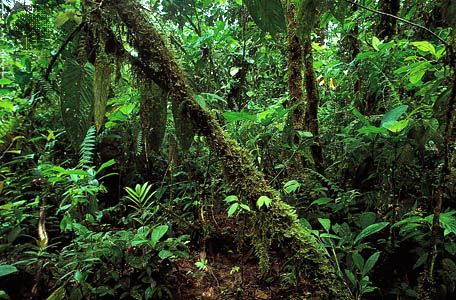
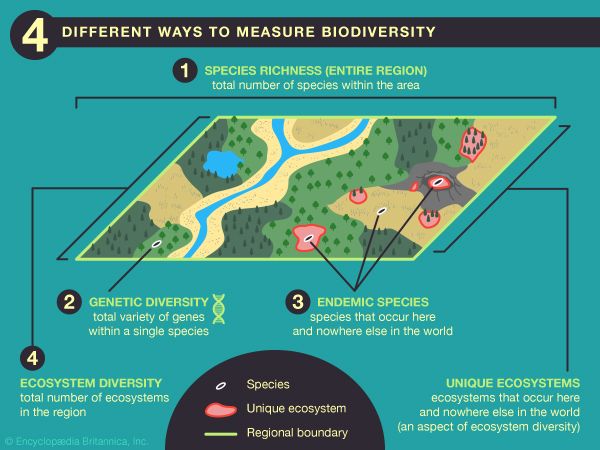
This floating vegetation creates a distinctive ecosystem often compared to a tropical rainforest for the biodiversity it supports, providing essential food, shelter, and breeding grounds for various marine species, including fish, crabs, and juvenile sea turtles. Conversely, the lack of thermal mixing in the region creates a biological desert in the surrounding open water, which is largely devoid of the plankton necessary to support a larger food chain.1413
Sources
- Antilles Current — Encyclopædia Britannica
- Atlantic Ocean - The North Atlantic — Encyclopædia Britannica
- North Atlantic Current — Encyclopædia Britannica
- subpolar gyre — Encyclopædia Britannica
- Climate - The Gulf Stream — Encyclopædia Britannica
- plastic pollution - Plastic pollution in oceans and on land — Encyclopædia Britannica
- Great Pacific Garbage Patch — Encyclopædia Britannica
- How Do Ocean Currents Affect the Biosphere? — Encyclopædia Britannica
- thermohaline circulation — Encyclopædia Britannica
- ocean warming — Encyclopædia Britannica
- Climate - Climate and the oceans — Encyclopædia Britannica
- Atmosphere - Effect of oceans on air movement — Encyclopædia Britannica
- Sargasso Sea — Encyclopædia Britannica
- Sargasso Sea — Merriam-Webster
- Sargassum — Encyclopædia Britannica
Published on · 3 min read