Ocean Warming
Ocean warming refers to the absorption of surplus heat by the world's oceans, a phenomenon directly attributed to global warming. As greenhouse gas emissions…
What is ocean warming?
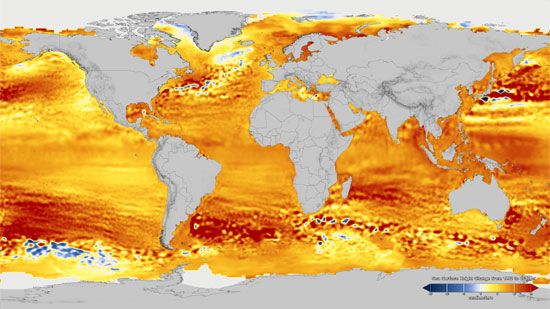
Ocean warming refers to the absorption of surplus heat by the world’s oceans, a phenomenon directly attributed to global warming. As greenhouse gas emissions trap solar energy in the atmosphere, more than 90 percent of this excess heat has been transferred to the oceans since the 1970s.1
This process is measured as a change in ocean heat content (OHC) within the top 2,000 meters of water. The consequences of this warming are significant and wide-ranging:1
- Physical Impacts: Ocean warming contributes to sea level rise through thermal expansion and the melting of glaciers and ice sheets. It also alters ocean currents, intensifies tropical cyclones, and increases the frequency of extreme weather events.1
- Biological Impacts: Warming disrupts marine ecosystems by shifting species distributions, causing coral bleaching, and reducing dissolved oxygen levels, which threatens biodiversity and global food security.1
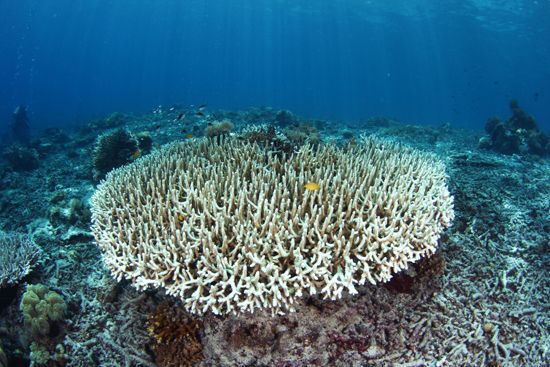
How does coral bleaching affect the overall health of marine ecosystems?
Coral bleaching poses a severe existential threat to marine ecosystems, which are among the most biodiverse environments on Earth, supporting approximately 25 percent of all marine species.34
Because coral colonies serve as the foundational structure for these ecosystems, their decline triggers a cascade of negative effects:
- Loss of Habitat and Food: As corals die, the complex physical structures they provide disappear. This leads to a precipitous drop in populations of reef-dependent fishes and other marine life that rely on the reef for shelter and sustenance.34
- Ecosystem Instability: When critical species are lost, the ecosystem may lose its ability to recover from disturbances. The resulting degradation leaves the area vulnerable to invasive species, such as seaweed, which can fundamentally and permanently alter the reef’s structure.3
- Local Extinctions: Widespread bleaching events can lead to the local extinction of species that cannot adapt to the loss of their primary habitat.3
Ultimately, the breakdown of the symbiotic relationship between corals and their zooxanthellae disrupts the entire community dynamic, threatening the long-term health and survival of the reef system.34
What is the difference between ocean warming and ocean acidification?
Ocean warming and ocean acidification are distinct but related consequences of human-driven greenhouse gas emissions. While both are primarily caused by the accumulation of carbon dioxide (CO₂) in the atmosphere, they involve different physical and chemical processes.81
Ocean Warming
Ocean warming refers to the absorption of surplus heat by the world’s oceans. Since the 1970s, the oceans have acted as a massive heat reservoir, absorbing more than 90 percent of the excess heat trapped in the atmosphere by greenhouse gases. This process increases the ocean’s thermal energy, leading to:1
- Physical changes: Thermal expansion of water and melting of glaciers, which contribute to sea level rise.1
- Weather impacts: Accelerated evaporation, which intensifies tropical cyclones and alters precipitation patterns.1
- Biological stress: Disruption of metabolic rates and the forced migration of species toward cooler waters.1
Ocean Acidification
Ocean acidification is the reduction in the pH of seawater caused by the direct absorption of CO₂. When CO₂ dissolves in the ocean, it reacts to form carbonic acid, which releases hydrogen ions and lowers the water’s pH. This process:8
- Reduces carbonate availability: It lowers the concentration of carbonate ions, making it difficult for calcifiers—such as corals and shellfish—to build and maintain their skeletons and shells.8
- Physiological strain: It can cause acidosis in larger marine animals, impacting their growth and reproduction.8
While ocean warming reduces the ocean’s capacity to store CO₂, the two processes work in tandem to threaten marine biodiversity and the stability of global food chains.81
How do shifting ocean currents impact global weather patterns?
Ocean currents are fundamental to regulating Earth’s climate by transporting heat from the tropics toward the poles and distributing moisture across the globe. Shifting currents alter these heat-exchange processes, leading to significant impacts on regional and global weather patterns.9101112
Mechanisms of Influence
- Heat Distribution: Currents like the Gulf Stream and the Atlantic Meridional Overturning Circulation (AMOC) transport warm surface water to higher latitudes. This moderates the climate of regions such as northwestern Europe, keeping them significantly warmer than other areas at similar latitudes.13912
- Atmospheric Interaction: Ocean currents influence the atmosphere by supplying moisture and heat. Strong thermal gradients at the boundaries of warm and cold currents help position the jet stream, which guides the development and steering of weather systems.11
Consequences of Shifting Currents
When these circulation systems weaken or shift—often due to global warming and freshwater influx from melting glaciers—the consequences can be disruptive:1012
- Temperature Extremes: A slowdown of the AMOC could lead to a dramatic cooling of Europe and increased temperatures in the Southern Hemisphere.12
- Precipitation Changes: Shifts can relocate rain belts, potentially increasing drought frequency in regions like southern Africa and altering the timing of the Indian monsoon.12
- Climate Oscillations: Large-scale patterns like the El Niño-Southern Oscillation demonstrate how anomalies in equatorial Pacific currents can trigger unseasonable weather, such as flooding or drought, thousands of miles away.1415
Sources
- ocean warming — Encyclopædia Britannica
- Climate - Climate and the oceans — Encyclopædia Britannica
- Coral bleaching — Encyclopædia Britannica
- coral reef - Coral bleaching — Encyclopædia Britannica
- coral reef - Other threats — Encyclopædia Britannica
- coral reef - Corals and other reef-building organisms — Encyclopædia Britannica
- Coral Bleaching: A Threat to Our Reefs — Encyclopædia Britannica
- ocean acidification — Encyclopædia Britannica
- Atlantic Meridional Overturning Circulation: Top Questions — Encyclopædia Britannica
- How Do Ocean Currents Affect the Biosphere? — Encyclopædia Britannica
- thermohaline circulation — Encyclopædia Britannica
- Atlantic Meridional Overturning Circulation — Encyclopædia Britannica
- Climate - Circulation, currents, and ocean-atmosphere interaction — Encyclopædia Britannica
- What Is the Difference Between El Niño and La Niña? — Encyclopædia Britannica
- La Niña — Encyclopædia Britannica
Published on · 4 min read