Constellaria
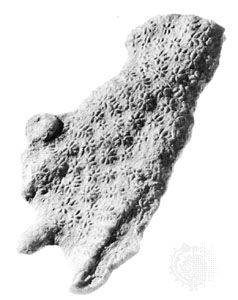
Constellaria is a genus of extinct bryozoans, which are small colonial animals that construct skeletal frameworks made of calcium carbonate.
What is Constellaria?
Constellaria is a genus of extinct bryozoans, which are small colonial animals that construct skeletal frameworks made of calcium carbonate.1
These organisms are particularly characteristic of Ordovician marine rocks, dating back approximately 505 to 438 million years. Physically, Constellaria is recognized by its branching structure, which is typically flattened from front to back and features prominent bumps. They are often discovered within sedimentary rocks or attached to the shells of other animals.1
What are bryozoans?
Bryozoans, also known as moss animals, are a phylum of aquatic invertebrates comprising about 5,000 living species and approximately 15,000 fossil species. They are characterized by their colonial nature, consisting of numerous connected units called zooids, and their use of a ciliated tentacle ring known as a lophophore to capture food particles suspended in the water.3
Key features of bryozoans include:
- Colonial Structure: While individual zooids are typically less than one millimeter long, colonies can grow into various shapes, including crusts, lacy structures, or branching forms, sometimes exceeding 0.5 meters in diameter.345
- Habitat: They are widely distributed in both fresh and salt water, often attaching to surfaces such as stones, shells, seaweed, ship hulls, and water pipes.36
- Classification: They are divided into three classes: the freshwater-dwelling Phylactolaemata, the marine Stenolaemata, and the mostly marine Gymnolaemata.3
- Fossil Record: Because many species possess calcified, calcium carbonate skeletons, they have an extensive fossil record dating back to the Ordovician Period.67
What characterizes the Ordovician period?
The Ordovician Period was the second period of the Paleozoic Era, spanning from 485.4 million to 443.8 million years ago. It was a time of profound transformation in Earth’s climate, plate tectonics, and biological systems.910
Geological and Climatic Conditions
Rapid seafloor spreading led to some of the highest global sea levels in the Phanerozoic Eon, causing extensive flooding of the continents. Atmospheric carbon dioxide levels were significantly higher than today, generally fostering a warm global climate. However, the period concluded with a brief but intense interval of glaciation over the Southern Hemisphere, which contributed to a major mass extinction.1091112
Biological Evolution
The period is defined by the Ordovician radiation, an intense diversification of marine life that saw the emergence of nearly every modern invertebrate phylum and the rise of fish. Common marine life included:109
Additionally, the first plants appeared on land, potentially accompanied by the first terrestrial arthropods.109
How do fossils form in sedimentary rocks?
Fossils are primarily formed when organisms with solid, resistant skeletons—such as bones, teeth, or shells—are buried quickly after death. This rapid burial is essential to prevent decomposition and protect the remains from scavengers.1415
Once buried in sedimentary rock, the remains undergo several potential transformation processes:
- Permineralization: Minerals from groundwater, such as calcium carbonate, seep into the pores of the bone or shell, turning the organic material into stone.1415
- Replacement: The original skeletal material is completely dissolved and replaced by new mineral matter, creating a detailed replica.1415
- Molds and Casts: Acidic solutions may dissolve the original shell, leaving a cavity (a mold) that can later be filled by minerals to create an impression (a cast).1615
- Carbonization: Soft plant matter may be flattened between layers of rock, leaving behind a thin carbon film.15
Because land remains are easily destroyed, the vast majority of fossils are preserved in water environments, where anaerobic conditions often favor the preservation of fine details.15
Sources
- Constellaria — Encyclopædia Britannica
- constellatory — Merriam-Webster
- moss animal — Encyclopædia Britannica
- moss animal - Zooids — Encyclopædia Britannica
- moss animal - Colonies — Encyclopædia Britannica
- moss animal - Distribution and abundance — Encyclopædia Britannica
- moss animal - Marine bryozoans — Encyclopædia Britannica
- moss animal - Evolution and paleontology — Encyclopædia Britannica
- A Journey Through Time Since the Precambrian - Ordovician Period: 485.4 million to 443.4 million years ago — Encyclopædia Britannica
- Ordovician Period - Invertebrates — Encyclopædia Britannica
- Ordovician Period - Mass extinction at the end of the Ordovician — Encyclopædia Britannica
- Ordovician Period — Encyclopædia Britannica
- Ordovician Period - Paleoclimate — Encyclopædia Britannica
- How are fossils formed? — Encyclopædia Britannica
- fossil record — Encyclopædia Britannica
- fossil — Encyclopædia Britannica
Published on · 3 min read