Banyan
The banyan tree (Ficus benghalensis) grows and spreads through a unique process involving adventitious roots, which are roots that emerge from non-root…
How do banyan trees grow and spread their aerial roots?
The banyan tree (Ficus benghalensis) grows and spreads through a unique process involving adventitious roots, which are roots that emerge from non-root tissues like branches.12
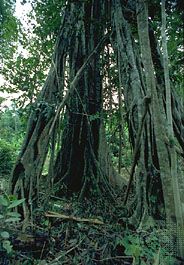
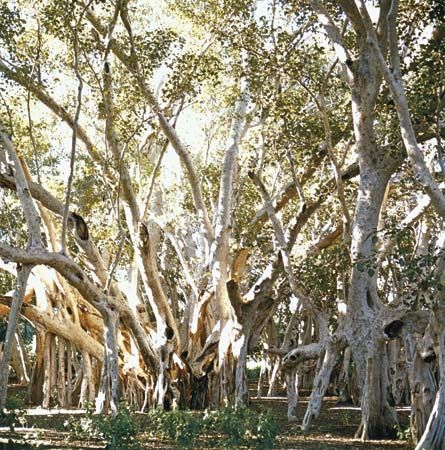
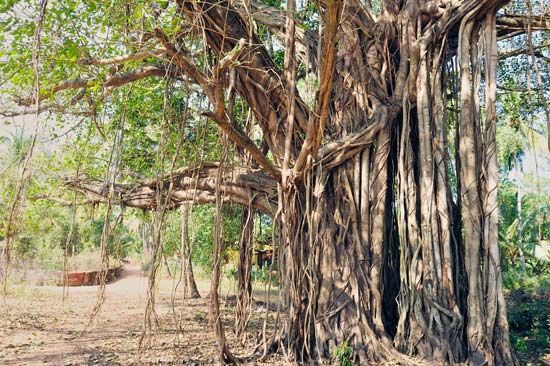
These aerial roots develop from the tree’s horizontal branches and descend toward the ground. Once they reach the soil, they take root and thicken, eventually transforming into sturdy secondary trunks. This process allows the banyan to spread laterally indefinitely, as these new trunks provide additional anchorage and support for the tree’s massive, constantly extending branches. Over time, a single banyan can develop into a dense, thicket-like structure that covers a vast area.34
In some cases, banyans and related species begin life as strangler figs. Seeds are deposited by animals in the crevices of a host tree, where they germinate and send roots down the host’s trunk. Upon reaching the ground, these roots establish themselves and thicken into an interlacing cylinder, often eventually killing the host tree.4
In which regions of the world are banyan trees commonly found?
The banyan tree (Ficus benghalensis) is native to the Indian subcontinent, with its primary range encompassing India and Pakistan.16
Historically, the tree is also associated with regions in Iran, where its name originated from the practice of traders conducting business beneath its expansive canopy. While the species is indigenous to these areas, its unique growth habit—where it can eventually resemble a dense, forest-like thicket—has allowed it to become a prominent feature in the landscapes of its native range.61

What is a banyan tree and what makes it unique among other plants?
The banyan tree (Ficus benghalensis) is a remarkable member of the mulberry family native to the Indian subcontinent. It is distinguished by its unique growth habit, which allows it to spread laterally indefinitely, often assuming the appearance of a dense, forest-like thicket.1
What makes the banyan truly unique among plants is its reliance on aerial roots. These roots develop from the tree’s horizontal branches and descend toward the ground. Upon reaching the soil, they take root and thicken, transforming into sturdy secondary trunks that support the tree’s massive, constantly extending branches.14
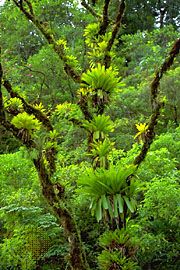
Additionally, many banyans and related species are known as strangler figs. They often begin life as epiphytes after seeds are deposited in the crevices of a host tree by animals. As the fig grows, its roots descend to the ground, eventually forming an interlacing cylinder around the host’s trunk. This process can constrict and ultimately kill the host, leaving behind a “tree” that is actually a gigantic, hollow cylinder of roots.478
What are some of the largest or most famous banyan trees in the world?
Several banyan trees are renowned for their immense size and expansive growth, often appearing as entire forests due to their complex network of aerial roots and secondary trunks.
- Thimmamma Marrimanu: Located in Andhra Pradesh, India, this individual is widely considered to possess the broadest canopy of any tree in the world.1
- The Great Banyan of Calcutta: This notable specimen is famous for its massive spread, covering an area more than 250 meters (about 275 yards) wide.4
While not a banyan, the Ficus genus includes other species with similar growth habits, such as the wonderboom (F. salicifolia) in Africa. A specimen of this tree in Pretoria is also recognized for its impressive size, boasting a spread of 50 meters (55 yards).4
Sources
- banyan — Encyclopædia Britannica
- Adventitious root — Encyclopædia Britannica
- Root — Encyclopædia Britannica
- Tree - Trees of special interest — Encyclopædia Britannica
- Tree - Tree roots — Encyclopædia Britannica
- banyan — Merriam-Webster
- Strangler fig — Encyclopædia Britannica
- Tropical rainforest - General structure of the rainforest — Encyclopædia Britannica
Published on · 3 min read