Bee-eater
A bee-eater is any of approximately 25 species of brightly colored birds belonging to the family Meropidae (order Coraciiformes). These birds are primarily…
What is Bee-eater?
A bee-eater is any of approximately 25 species of brightly colored birds belonging to the family Meropidae (order Coraciiformes). These birds are primarily found in tropical and subtropical regions across Africa, Eurasia, and Australasia.12
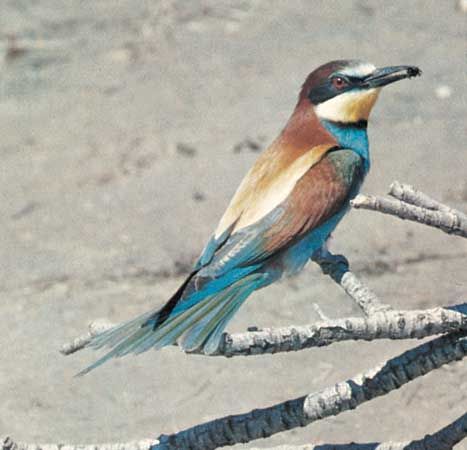
Physically, they range from 15 to 35 cm (6 to 14 inches) in length and possess moderately long, slightly downcurved, and sharply pointed bills. Their plumage is often brilliant, with green frequently predominating, though many species also feature red, yellow, blue, or purple coloration.1
As aerial feeders, bee-eaters spend significant time on the wing, gliding in circles to hunt insects such as bees and wasps, though they also frequently wait for prey from perches. They are known to be gregarious and often nest in colonies, typically digging burrows in banks or walls for their nesting sites2. Both parents generally share in incubation and feeding duties.345
How do bee-eaters safely consume stinging insects like bees and wasps?
Bee-eaters have developed a specialized method for safely consuming stinging insects like bees and wasps. After capturing an insect in flight, the bird returns to a perch and repeatedly beats the prey against a hard surface. This action effectively kills the insect and removes its stinger, allowing the bird to consume it without the risk of being stung.1
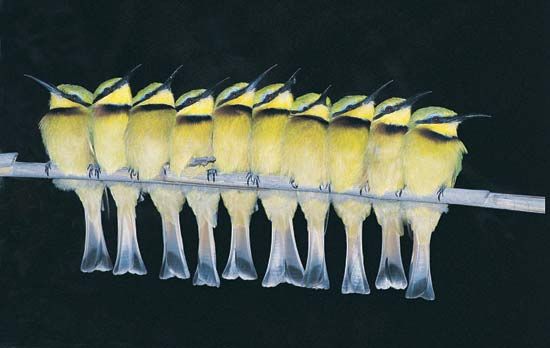
What are some of the most colorful species of bee-eaters found in the wild?
While all bee-eaters are known for their brilliant plumage, several species are particularly noted for their striking and vibrant coloration. Because green is the predominant color across the family Meropidae, the most visually distinct species are those that incorporate bold, contrasting patterns of red, yellow, blue, and purple.1
Some of the most colorful examples include:
- European Bee-eater (Merops apiaster): This species is famous for its multicolored appearance, featuring a rich chestnut-brown crown, a bright yellow throat bordered by a black band, and a vibrant blue-green belly.1
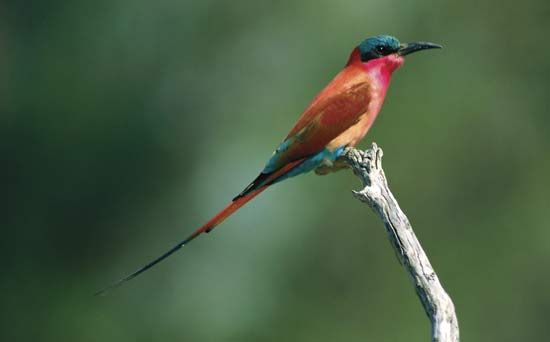
- Carmine Bee-eaters: These birds are renowned for their intense, deep red or carmine plumage, which stands out significantly from the more common green-toned species in the family.1
- Blue-throated and Red-bearded Bee-eaters: These species are often cited for their dramatic facial markings and specialized feather coloration, which highlight the diverse palette found within the order Coraciiformes.1
Many of these birds also feature elongated central tail feathers that add to their elegant and colorful profile in the wild.1
Why do some bee-eater species choose to nest in colonies rather than alone?
Some bee-eater species exhibit colonial nesting behavior, which is a departure from the solitary nesting habits seen in many other members of the order Coraciiformes. While the specific evolutionary drivers for this behavior in bee-eaters are not detailed as a single cause, colonial nesting in birds is generally associated with several adaptive advantages:
- Resource and Site Constraints: In many bird species, colonial nesting is often linked to a shortage of high-quality territories or suitable nesting sites. When appropriate locations—such as the specific cut banks required by some bee-eaters—are limited, individuals may be forced to nest in close proximity to one another.67
- Inclusive Fitness and Cooperation: Similar to other cooperatively breeding birds, colonial living can provide opportunities for individuals to increase their inclusive fitness. By remaining in a group, young birds may act as helpers, assisting in the defense of the nest or the feeding of nestlings, which enhances the survival of related kin.6
- Predation and Environmental Factors: Colonial nesting can be a response to environmental pressures, such as high rates of predation or short breeding seasons. Living in a group may offer collective defense benefits or allow for more efficient use of limited resources in challenging environments.6
Sources
- Bee-eater — Encyclopædia Britannica
- Coraciiform - Life history — Encyclopædia Britannica
- Coraciiform - Locomotion and feeding — Encyclopædia Britannica
- bee-eater — Merriam-Webster
- Coraciiform - Habitat selection and ecological diversity — Encyclopædia Britannica
- Coraciiform - Relationships with other species — Encyclopædia Britannica
- Animal social behavior - Social interactions involving cooperative breeding and eusociality — Encyclopædia Britannica
- Reproductive behaviour - Birds — Encyclopædia Britannica
- Passeriform - Territoriality and courtship — Encyclopædia Britannica
- Reproductive behaviour - Group care — Encyclopædia Britannica
Published on · 3 min read