Tiger
The tiger (Panthera tigris) is the largest member of the cat family, with most classifications recognizing six living subspecies. These subspecies are…
What are the different subspecies of tigers, and how do they differ from each other?
The tiger (Panthera tigris) is the largest member of the cat family, with most classifications recognizing six living subspecies. These subspecies are primarily distinguished by their size, habitat, and physical adaptations.123
Living Subspecies
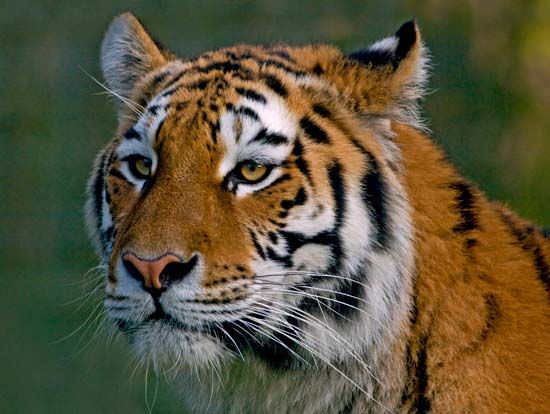
- Siberian (Amur) tiger (P. tigris altaica): The largest subspecies, adapted to cold climates with longer, paler, and softer fur for heat conservation.13
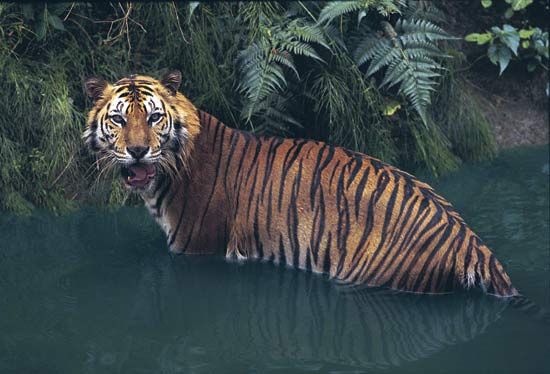
- Bengal tiger (P. tigris tigris): The most numerous subspecies, typically smaller than the Siberian tiger to better navigate hot, humid forests and wetlands.13
- Indo-Chinese tiger (P. tigris corbetti): Features a bright reddish-tan coat with dark vertical stripes.1
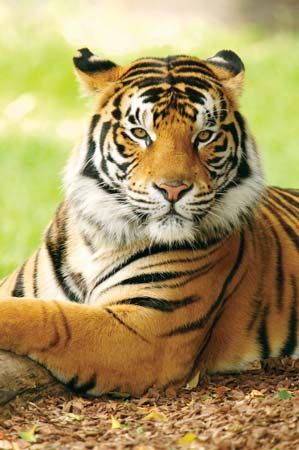
- Sumatran tiger (P. tigris sumatrae): Similar in coloration to the Indo-Chinese tiger.1
- Malayan tiger (P. tigris jacksoni): Recognized as a distinct subspecies in many modern classifications.12
- South China tiger (P. tigris amoyensis): Another recognized subspecies within the current six-type classification.12
Three additional subspecies—the Caspian, Javan, and Bali tigers—have gone extinct within the last century. While these classifications are standard, some researchers suggest alternative groupings or the existence of two distinct species.12
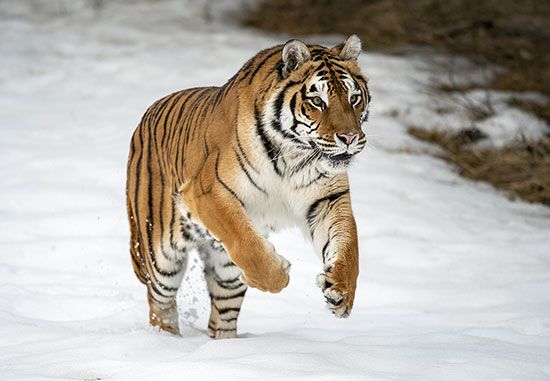
How do tigers hunt, and what are their primary prey species?
Tigers are solitary apex predators that typically hunt by night. Their hunting proficiency is only partially instinctive, as maternal training is essential for cubs to learn how to kill and secure prey effectively. When a tiger makes a kill, it consumes what it can and then makes a deliberate effort to hide the carcass from vultures and other scavengers to ensure it can return for later meals.345
Tigers prefer large prey species, with their diet varying based on their specific habitat. Common prey includes:3
- Deer: Such as sambar, chital, swamp deer, and sika.34
- Wild Pigs: Including wild boars.34
- Other Animals: Tigers occasionally hunt badgers, raccoon dogs, and porcupines—the latter being a notable exception despite the risk of injury from quills.534
While they generally avoid healthy large mammals, they have been known to attack elephants, water buffalo, and even Asiatic black bears. Additionally, they may take cattle from human habitations or scavenge carrion when necessary.34
What role do tigers play in their ecosystems as apex predators?
As apex predators, tigers play a critical role in maintaining the health and balance of their ecosystems. By occupying the top position of the trophic pyramid, they exert top-down control over the biological communities they inhabit.46
Their primary ecological functions include:
- Population Regulation: Tigers control the populations of their prey, such as deer and wild pigs. By limiting these herbivore numbers, they prevent overgrazing, which in turn protects plant life and maintains habitat structure.467
- Predator Management: They regulate the populations of other predators, including leopards, dholes, and clouded leopards. This prevents mesopredator release—a phenomenon where smaller predators increase in number and cause unintended declines in other species.47
- Ecosystem Stability: Through these interactions, tigers trigger trophic cascades, which influence nutrient cycling and overall biodiversity. The presence of such top carnivores is essential for preserving the natural structure and processes of their environments.7
Because tigers are vital for ecosystem integrity, their conservation is crucial for maintaining the services these environments provide, such as clean water and soil quality.7
What adaptations have tigers developed for survival in their various habitats?
Tigers have evolved a remarkable range of adaptations that allow them to thrive in diverse environments, from the freezing Siberian taiga to the sweltering mangrove swamps of the Sundarbans.4
Key physical and behavioral adaptations include:
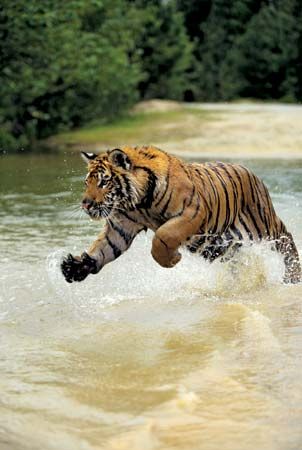
- Thermoregulation: To survive extreme cold, Siberian tigers possess dense, coarse fur and a layer of body fat up to 4 cm thick. Conversely, because they are less heat-tolerant than other large cats, tigers are adept swimmers and frequently bathe to regulate their body temperature in warmer climates.54
- Camouflage: Their iconic striped coats provide disruptive coloration, which helps mask their identity and location by breaking up the outline of their bodies against the background of forests and grasslands.410
- Hunting and Mobility: Tigers are powerful, solitary hunters. While their killing technique is partly instinctive, they rely on maternal training to achieve proficiency. They are also capable of climbing trees when under stress.4
- Territoriality: To manage resources and minimize conflict, tigers establish territories marked through vocalization, scent spraying, and claw markings on trees.4
Sources
- tiger — Encyclopædia Britannica
- Which is bigger: A Siberian tiger or a Bengal tiger? — Encyclopædia Britannica
- tiger: Top Questions — Encyclopædia Britannica
- tiger - Natural history — Encyclopædia Britannica
- Siberian tiger — Encyclopædia Britannica
- apex predator — Encyclopædia Britannica
- Bengal tiger — Encyclopædia Britannica
- tiger - Tigers and humans — Encyclopædia Britannica
- trophic cascade — Encyclopædia Britannica
- concealing coloration — Encyclopædia Britannica
Published on · 4 min read