Bird-of-paradise
Sorry, the Britannica knowledge base does not contain information regarding the historical depiction of birds-of-paradise in art and literature. The…
How have birds-of-paradise been depicted in art and literature throughout history?
Sorry, the Britannica knowledge base does not contain information regarding the historical depiction of birds-of-paradise in art and literature. The available records focus on their biological classification, physical characteristics, and geographical distribution.1
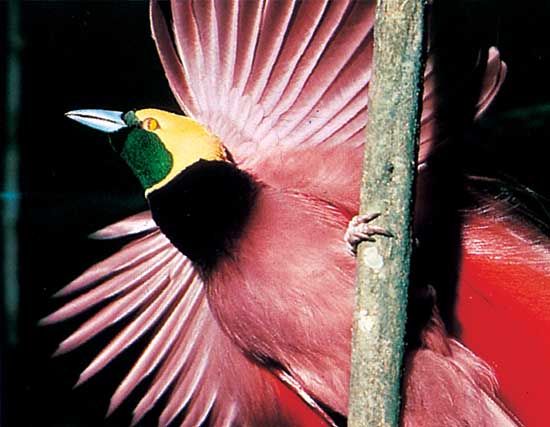
How do male birds-of-paradise use their colorful plumage and elaborate displays in courtship rituals?
Male birds-of-paradise (Paradisaea) utilize their striking, colorful plumage and elaborate, communal dances as part of a specialized courtship strategy known as lek behavior. In these systems, males gather on common courtship grounds to perform “incredibly bizarre” displays intended to attract females.45
These displays are a primary example of sexual selection, specifically a process termed epigamic selection. Because these birds often exhibit extreme sexual dimorphism—where males are brightly colored and adorned with conspicuous, cumbersome plumes while females remain relatively dull—the males’ appearance serves as a signal of their relative fitness.56
By performing these intricate rituals, a male communicates his genetic quality to potential mates. Females exert selective pressure by choosing the most “fit” males, favoring those whose displays and coloration suggest they are healthy and capable of maximizing gene survival. However, this process is balanced by natural selection; if these ornaments become too elaborate, the male’s increased visibility may make him more vulnerable to predation before he can successfully reproduce.65
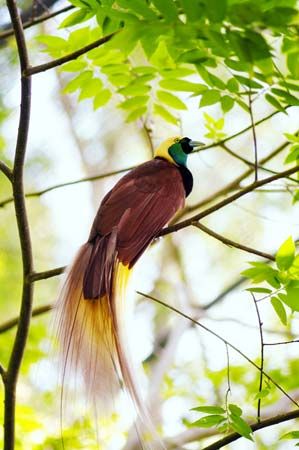
What are some of the most unique or rare species of birds-of-paradise?
The family Paradisaeidae includes approximately 45 species, many of which are renowned for their extraordinary plumage and specialized courtship displays. Among the most notable and unique species are:
- King of Saxony’s bird-of-paradise (Pteridophora alberti): This species is distinguished by a shoulder cape and a pair of exceptionally long head-streamers. These streamers are composed of about 40 squarish, enameled-looking lobes.
- Wilson’s bird-of-paradise (Diphyllodes respublica): Known for its unique appearance, this bird features a bare crown patterned with a distinctive “cross of Christ” design, along with two wirelike tail feathers that curve outward.
- 12-wired bird-of-paradise (Seleucidis melanoleuca): A short-tailed bird characterized by flank plumes that have evolved into forward-curving, wirelike structures.
- Superb bird-of-paradise (Lophorina superba): This species utilizes a spreading breast shield and a broad cape that can be transformed into a fan around its head during display.
- Long-tailed birds-of-paradise (Astrapia): These five species are notable for their extreme tail length; males possess long, graduated tails of broad feathers, resulting in a total body length that can reach 80 to 115 cm.
What are the distinguishing physical characteristics of birds-of-paradise?
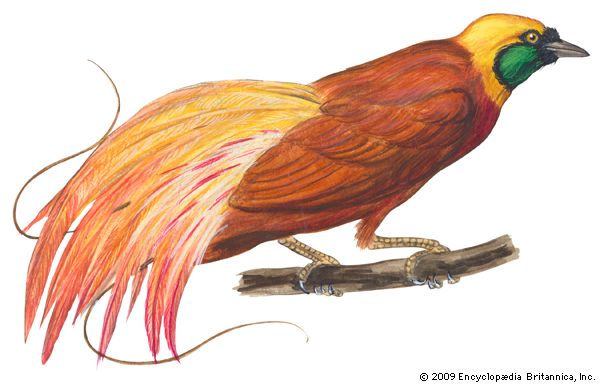
Birds-of-paradise (family Paradisaeidae) are small to medium-sized forest birds known for their extraordinary physical diversity, particularly among males. Their distinguishing characteristics include:2
- Extreme Sexual Dimorphism: Males often possess bizarre, highly specialized plumage, while females are typically plain and dull in appearance.25
- Elaborate Ornamentation: Males are frequently adorned with striking features such as elongated central tail feathers (often shaped like wires or twisted ribbons), filmy flank plumes that can be brought forward to hide the wings, and specialized head-streamers or crests.2
- Structural Diversity: Species exhibit a wide range of unique physical traits, including:
- Flag-tipped wires: Found in species like the six-plumed birds-of-paradise (Parotia) and the king bird-of-paradise.2
- Capes and Shields: Some species, such as the King of Saxony’s bird-of-paradise, feature shoulder capes, while others like the superb bird-of-paradise possess spreading breast shields.2
- Iridescent Plumage: Many males exhibit shining, iridescent feathers, particularly in the long-tailed Astrapia species.2
- Size Variation: While generally small to medium-sized, total body length varies significantly across the family, ranging from as small as 13 cm in the king bird-of-paradise to up to 115 cm in the long-tailed Astrapia species.2
Sources
- bird of paradise — Merriam-Webster
- Bird-of-paradise — Encyclopædia Britannica
- paradise bird — Merriam-Webster
- Reproductive behaviour - Birds — Encyclopædia Britannica
- sexual selection — Encyclopædia Britannica
- Pelecaniform - Courtship behaviour — Encyclopædia Britannica
- Reproductive behaviour - Displays — Encyclopædia Britannica
- Psittaciform - Evolution — Encyclopædia Britannica
- Reproductive behaviour - Courtship — Encyclopædia Britannica
Published on · 3 min read