Helmet-shrike
A helmet-shrike is any of nine species of African songbirds belonging to the family Prionopidae. These birds are typically about 20 cm (8 inches) long and…
What is Helmet-shrike?
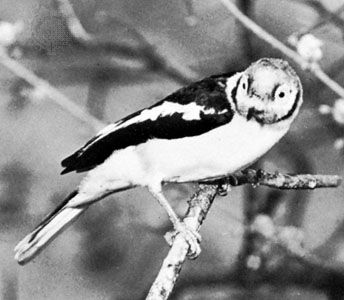
A helmet-shrike is any of nine species of African songbirds belonging to the family Prionopidae. These birds are typically about 20 cm (8 inches) long and are distinguished by a forward-directed crest on their foreheads. Their plumage is generally a combination of gray, white, and black, sometimes accented with buff or rufous tones, and they possess a slender, hooked bill.1
Unlike typical shrikes (family Laniidae), helmet-shrikes are highly social; they travel in groups of a dozen or more, moving through forest vegetation while chattering and snapping their bills to glean insects. They also exhibit cooperative breeding behaviors, where an entire flock may assist in attending to a single nest. While some authorities group them with the Laniidae family, they are often classified in their own distinct family.12
How does social breeding benefit the helmet-shrike flock?
Social breeding in the helmet-shrike involves a cooperative strategy where all adult members of a flock participate in attending to a single nest. While the specific evolutionary advantages for this species are not detailed in the provided search results, cooperative breeding generally allows groups to pool resources, share the labor of chick-rearing, and provide collective protection for offspring.1
It is important to note that the colonial breeding described for pelecaniform birds is distinct from the social, cooperative breeding of helmet-shrikes. Colonial breeding in birds like boobies or cormorants is often driven by the scarcity of safe nesting sites, forcing individuals to crowd into protected areas, whereas helmet-shrikes exhibit a social structure where the flock actively assists in the care of a shared nest.13
What are the main differences between helmet-shrikes and typical shrikes?
While some authorities classify them together, helmet-shrikes (family Prionopidae) and typical shrikes (family Laniidae) exhibit significant differences in social behavior and hunting habits.
Feature
Helmet-shrikes
Typical Shrikes (Laniinae)
Social Structure
Highly social; travel in groups of a dozen or more.
Solitary birds.
Breeding
Cooperative; the entire flock often attends a single nest.
Generally solitary nesters.
Hunting/Feeding
Glean insects while moving through vegetation in groups.
Predatory; kill lizards, mice, and small birds.
Behavioral Traits
Characterized by chattering, bill-snapping, and fluttering.
Known for impaling prey on thorns (hence the name “butcherbird”).
Physical Features
Possess a forward-directed crest on the forehead.
Often feature a distinctive black mask.
While typical shrikes are known for their solitary, predatory nature and harsh calls, helmet-shrikes are defined by their communal lifestyle and cooperative care of offspring.14
What other types of birds belong to the order Passeriformes?
The order Passeriformes is the largest and most diverse group of birds, comprising approximately 5,700 species. Taxonomists generally divide these “true perching birds” into two primary suborders: the suboscines (Tyranni) and the oscines (Passeri), or songbirds.5
The diversity within this order is vast, encompassing numerous families with distinct characteristics:
- Oscines (Songbirds): This group includes familiar birds such as crows, thrushes, finches, and tanagers. It also features the Icteridae family, which includes blackbirds, grackles, orioles, meadowlarks, cowbirds, and bobolinks. Other members include birds of paradise, flycatchers, warblers, and kinglets.67
- Suboscines: This group includes birds such as antbirds, broadbills, asities, sharpbills, and plantcutters.6
Because of their rapid evolutionary radiation, the classification of these birds continues to be refined through DNA analysis, which has recently clarified relationships among groups like the gnateaters and various warbler families.6
Sources
- Helmet-shrike — Encyclopædia Britannica
- helmet shrike — Merriam-Webster
- Pelecaniform - Reproduction — Encyclopædia Britannica
- Shrike — Encyclopædia Britannica
- Passeriform — Encyclopædia Britannica
- Icteridae — Encyclopædia Britannica
- Passeriform - Critical appraisal — Encyclopædia Britannica
Published on · 2 min read