Psittaciform
Psittaciform birds, commonly known as parrots, are primarily inhabitants of the world's tropical and southern temperate regions. Their global distribution…
How are psittaciform birds distributed geographically around the world?
Psittaciform birds, commonly known as parrots, are primarily inhabitants of the world’s tropical and southern temperate regions. Their global distribution includes:1
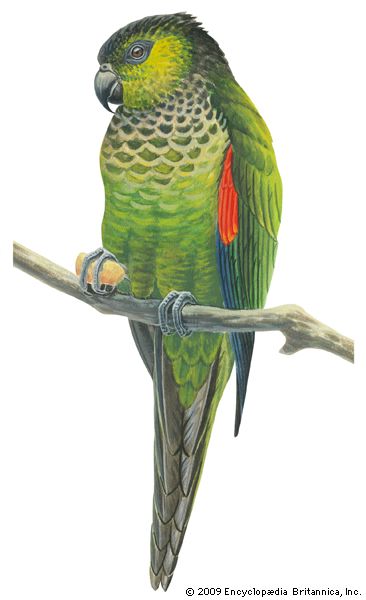
- The Americas: They are found throughout South America—reaching as far south as Tierra del Fuego—and the West Indies. While they once had a broader range in North America, including the now-extinct Carolina parakeet, they are currently limited to rare sightings in the extreme southwestern United States.12
- Australasia: This region exhibits the greatest structural diversity of parrots. Cockatoo species are restricted to Australia and New Guinea, while other parrots range into Tasmania and New Zealand.21
- Asia and Africa: In Asia, they occur across India, extending north to the Himalayas and southern China. They are absent from Europe and parts of extreme southern Africa.1
Although they are most diverse in the Australo-Papuan region, the greatest number of species is found in the New World tropics.2
How do psittaciform birds’ beaks differ from those of other bird orders?
The most distinctive feature of psittaciform birds is their strongly hooked, powerful bill. While it superficially resembles the beaks of hawks and owls, the parrot’s upper and lower mandibles typically exhibit a more uniform and stronger curve.3
Key differences and specialized features include:
- Enhanced Kinesis: While most birds possess a kinetic (movable) upper jaw, this trait is exceptionally well-developed in parrots. Their upper jaw is connected to the skull by a hinge and can move independently, allowing for greater manipulation of objects, cracking of hard nuts, and use of the bill as a “third foot” while climbing.3
- Mechanical Assistance: The undersurface of the upper bill often features transverse or oblique filelike corrugations. These ridges, working in tandem with a highly manipulative, fleshy tongue, help the bird secure seeds while the chisel-shaped edge of the lower bill peels away the outer cover.3
- Structural Design: The anterior edge of the lower jaw is often broad and truncate, providing a sturdy surface for processing food.3
These adaptations distinguish the parrot’s bill as a highly versatile tool for feeding and locomotion compared to the more specialized, singular functions of other bird bills.34
Which bird species are classified as psittaciforms?
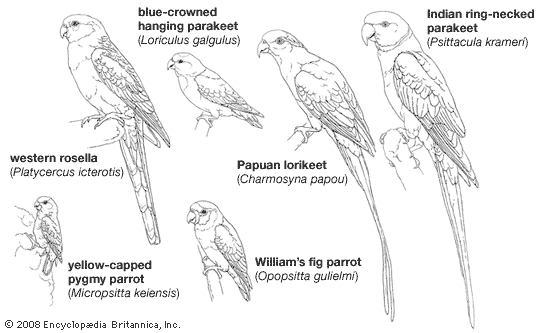
The order Psittaciformes comprises more than 360 species of birds, commonly referred to as parrots, which are classified into two distinct families.78
Family Psittacidae
This family is the larger of the two, containing 333 species. It includes a wide variety of birds such as:71
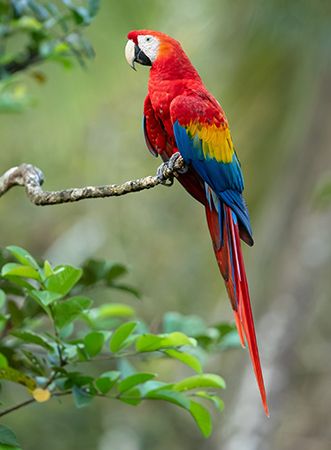
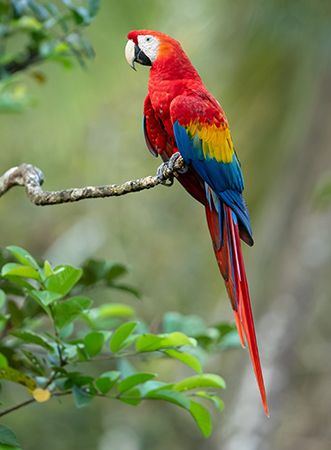
- “True” Parrots: Including macaws, Amazon parrots, conures, lovebirds, and African gray parrots.78
- Parakeets: Such as the monk parakeet and the extinct Carolina parakeet.78
- Lories and Lorikeets: Members of the subfamily Loriinae, known for their brush-tipped tongues.78
- New Zealand Species: Including the kea, the kaka, and the kakapo.78
Family Cacatuidae
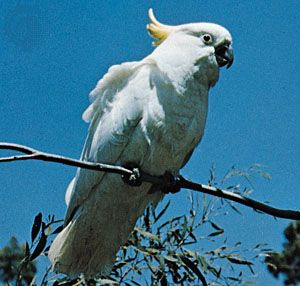
This family consists of 21 species of cockatoos, which are found primarily in Australia, New Guinea, and nearby islands. This group includes the cockatiel. Cockatoos are distinguished from other parrots by specific anatomical traits, such as the presence of a gallbladder and the structure of their skulls.718
What are the defining characteristics of psittaciform birds?
Psittaciform birds, commonly known as parrots, are defined by several distinct morphological and anatomical characteristics:
- Bill Structure: They possess a powerful, strongly hooked bill. The upper mandible is highly kinetic, allowing it to move independently via a hinge connected to the skull, which facilitates climbing and the manipulation of food. The undersurface of the upper bill often features filelike ridges that work with a fleshy, highly manipulative tongue to process seeds.85
- Zygodactyl Feet: Unlike most birds, which have an anisodactyl arrangement (three toes forward, one back), parrots are zygodactyl. They have two toes directed forward and two directed backward, supported by a short, stout tarsometatarsus, enabling them to grasp objects and climb with exceptional dexterity.3
- General Morphology: These birds are typically chunky with short necks and wings. They are often brightly colored, highly vocal, and gregarious.8
- Anatomical Features: All parrots possess a cere, a patch of soft skin surrounding the nostrils.5
While these traits generally apply to the order, the family Cacatuidae (cockatoos) differs from the family Psittacidae by possessing a gallbladder and having distinct skull and arterial structures.8
Sources
- Psittaciform — Encyclopædia Britannica
- Psittaciform - Evolution — Encyclopædia Britannica
- Psittaciform - Bill and skull — Encyclopædia Britannica
- Beak — Encyclopædia Britannica
- Psittaciform - Feet — Encyclopædia Britannica
- jaw — Encyclopædia Britannica
- parrot — Encyclopædia Britannica
- Psittaciform - Annotated classification — Encyclopædia Britannica
- Psittaciformes — Merriam-Webster
- Zygodactylae — Merriam-Webster
Published on · 3 min read